Monday, May 21, 2007

millennium ramble

And then I saw a city made without walls coming down from heaven. Its roads were obsidian and its sidewalks were a special polymer that gave when you walked but retained shape and durability. And the Traffic lights of the city were all in sync and none stayed on too long or too short. And pedestrians filled the sidewalks and there was plentiful street parking. And drivers drove cars made of high strength metal and with care to each other and to pedestrians and cyclists. And the streets were filled with cyclists and rickshaws and carts of myriad shapes and divers sizes. And there were parks where people strolled safely and played and walked pets. And the air was clear as crystal and as pleasant to breathe as spring breeze. And there was no night there, the streets being lit with a bio-luminescent form of plant life. And people were reading books and speaking with each other as if the other were important simply for being a human being. And there was no church or temple or mosque or reading room or kingdom hall anywhere in the city. And the people were happy. There were unhappy people, to be sure. The people who were outside the city were unhappy: these were people who insisted that culture and happiness could not exist without the absolutes provided by religion; that without a singular moral authority issuing from irrevocable heights and mediated through a tradition and by the authorized spokespeople of that tradition, where people ordered their lives around ritual and taboo, accepting draconian punishment for abstract transgressions of divine law, that chaos and lawlessness would reign, an epoch of anarchy and misery would ensue, death, plague and poverty would be the lot of humanity. But it didn't turn out that way at all: though the people outside the city insisted that it would - although the people in the city were quite happy and had persisted in their happiness for many years. Happiness however was not restricted to the playing out of absolutes - no matter how old or absolute; nor was happiness found in correctly crafting syllogisms that demonstrated God's existence or humanity's depravity or whatever the syllogism crafter wanted to prove: appeals to authority and appeals to logic simply increased the frustration of those leveling the appeals: the people in the city remained immune to ideology. They knew that humanity trumped ideology, no matter what the intentions of that ideology: that for instance, going to war for "liberation of a people" was trumped by seeing the people targeted for war as individuals: they new that it's not terrorists or infidels that are killed but mothers and fathers and children, friends, lovers, people who have dreams and take joy in simple things like any one else. Therefore they did not kill nor desire the death of anyone.
Whenever an ideology was promulgated that promised "better living through chemistry" or "nation building" or "social engineering" the people in the city were not taken in: they recognized rhetorical attempts at dehumanizing others as inhumane. The apocalypse is this: that we, like those in the city, recognize when great evils come dressed in the veneer of good - that this good is often stated in terms of an ideology that demonizes another group of people (immigrants, homeless, hippies, commies, et al) for the power and greed of a few. This is why Jesus teaches us to pray for enemies and give to people who cannot repay, that we see them as people like ourselves and not as annoyances or obstacles (an objectified other); he tells us to do this because that is how God, his father and ours, is. When Jesus says, "be perfect as your father in heaven is perfect", he is not enjoining us to be moral goody-goodies but to participate in God's project of creation, a project that heals and restores creation, especially the image of God - and we all (capitalists, terrorists, poor, homeless, foreign, crazy and sane) are that image.

Friday, May 18, 2007

From our honeymoon


We stopped at a pub in Hampstead after clamboring about the Heath and had some of the local ale. Jami, elegant in the first frame, watches me as she drinks her pint; I, perhaps a bit winded from walking around the Heath's slick muddy fields and grass, am a bit blurry at first, but after my first sip, I've become solid and in focus again. It's a wonderful beer that restores vertical hold to the world. Yet here I am, now, all concrete and defined, and I've continued to be concrete and defined since. Was this some magic potion that I imbibed that day? Sure. Here's what I think happened. When we visited Keat's house earlier in the day, I noticed in the hutch that one of the glasses was missing. I think that the glass I'm holding right now is that glass. Am I implying that this glass, if it were that glass, has some kind of magical property? Maybe. Let's look at the facts. ******************************************************************* If that doesn't satisfy a critical inquiry I don't know what will.

At the hour I heard hearing

And then I saw a linoleum floor, made up of red and blue squares set obliquely to the wall. The floor was nearly but not exactly square and bounded by molding and wainscoting. Opposite the front door was a window and to the left of the window, on the wall perpendicular to the window wall, was another door. Crown molding went around the top of the wall, and the ceiling was smooth. In the middle of the ceiling were two exposed light-bulbs. One bulb was out. The walls were painted a faint yellow and the ceiling was white. The window was an old casement window with four square panes on the top and bottom half. This window was slightly open and a glass of water was on the sill to the left side, near the door on the wall perpendicular to the window wall. The front door was open, which was how I knew what the room looked like. I was walking down a hallway about two and a half people wide. I had just walked up to this floor from the floor below and taken about ten steps down the hall, to the right, as I left the stair landing. I was in a hurry down the hall and would have missed the room if I hadn't caught it from the corner of my eye as I was lifting my glance from my watch. It was 3 pm. I thought, "it's not often that the time is exactly on the hour like this." I was late. This building had been abandoned for a few months and was going to be demolished. In its place was going to be a newer building with cleaner offices and bigger; with larger windows and more floors; with central heat and air; with that neutral smooth carpeting that infiltrates institutional buildings now, and over head fluorescent lights. This space that I'm in right now will no longer exist in this way. This space will be part office and part hall and the floor will likely be where my knees are now. This building itself replaced an earlier building from a time in the last century. That building did not have more than one floor and was really more a cabin - a dog trot cabin with an open breezeway. This would be unknown except for an earlier photo. That building had burned down. When they excavate this site workmen will find a layer of ash. As I exited this building I looked behind me. I was walking down a path through an arboretum but I turned before entering and had the chance to see the room with the glass of water on the window sill. It was still there and I could see it well.

res ipsa loquitur


The building at the top of the page, which is the building in the foreground of the bottom picture, is the building where the first classes met for what is now Columbia Theological Seminary. It is in Lexington, GA. Last Spring John Richardson and I drove from Decatur to check it out. There are some photos of this building in earlier days. One photo, on display in Campbell Hall at the Seminary, shows this building with a porch and wisteria. The porch was where the concrete steps with pipe hand-rail are now. The porch stretched across the front of the structure. The inside of this building has no original flooring. The current flooring is some kind of artificial board and plywood. I entered one room and my feet began sinking into the floor. The material was sodden and reacted to my weight as rubber might. I didn't stay on it long enough to see how far it could be stretched. The building has a top story but this story is inaccessible: the ladder/steps leading up to the top are in the room with the questionable flooring. This building is now being used as a Sunday School room/clubhouse of some sort. There is a kitchen. A massive stone fireplace remains in the middle of the structure and might be original to the building. As near as I can tell this building is beyond restoration - at least on the interior. It has suffered years of neglect and materials have been scavenged for other houses from it. I think that this is what happened to the porch.
John and I marveled at the building. We were glad to be able to walk inside and look around. At first we couldn't believe that this was the structure we were looking for. Even though there was a large sign on one side of the building, we had difficulty getting around how little it resembled the photo from earlier in the century. But as we walked around the neighborhood we had to conclude that this sad structure was indeed Columbia's first home.
Right next to it is a marvelous Presbyterian church. It has pointed windows and promised quite a wonderful old interior. We weren't able to get inside of this building, but a friend of mine, Cheryl Gosa, preached there as a student and told me that it is indeed old and quaint inside. Outside in the graveyard are the graves of early Georgia governors. Lexington was a busy place 170 years ago. Not so much now.

Thursday, May 17, 2007

A Rooster, symbol of protestantism

And then I saw a metal rooster against a gray sky on a cold day. It was stylized, with pointy wings and a raised back head, and it was fabricated from metal. I was with my classmates on a trip to Hungary, and we were now in a church yard for a theological institute in Slovakia waiting to go inside the Institute's library for a discussion on the Church and church life after the removal of Soviet troops. The Rooster is the standard symbol of the protestant church in Europe. Perhaps because of its association with Peter's moment of recognition when he hears the cock crow: "I'm a betrayer," he suddenly realizes. The Reformation was an aha moment like that: "we've been going the wrong way, but that can be corrected." In a nutshell, that's what the protesting was about - the values of the Church had been betrayed: the Church had sold out to the state, to being like the Empire that persecuted it. Of course the Church that protested proceeded to be like the state and exonerate the protestant state's oppressions, land grabs, wars. When I think about it, the Church's distressing abandonment of its principles (having all things in common, bearing each other's burden, loving neighbor and enemy, being a voice for justice, visiting prisoners and advocating for them, etc - all that stuff in the gospels that make us uncomfortable and just has to be spiritually interpreted because they're so impractical) for the security and approval of whatever state or culture comes along is scandalous. Whenever the Church has had the opportunity in history, whenever the big state has said, "hey cutie: How'd you like to hang out, help me do some things," the Church has said Sure and left all it stands for behind. What would it be like for the Church to respond to the overtures of the state, "No. No I don't think so. I'm perfectly happy where I am, hanging out with the people I'm hanging out with. I don't like your resort to violence, your dependence on fear and threats. I'm not going to lose myself in you." What would it be like for Christians all over the land to realize that the flag, any country's flag, but for us, the US flag, erases the Cross. Put a flag and a cross in front of the sanctuary - these are two different symbols, with contradictory meanings: the (so called) triumph of good intentions by violence vs the triumph of love over death by non-violence. The marriage of Church and State is like the most "in denial" of all abusive marriages: every day the state comes home, drunk, demanding to know where its dinner is and why the living room is a mess and why the children are the way they are and threatens, emotionally if not with physical force, to mess her up. And does the Church leave this relationship? One day - we can all pray.

Remember your baptism?

This painting has been re-stretched, and now the fold in the upper left corner is fixed. I painted this painting in 1993 before I left Athens, GA for Middle-of-Nowhere, NM. As may be imagined this painting calls forth passionate opinions: some of which surprise me.This painting like the Lucretia is a painting that I've had a difficult time finding a home for.

Perhaps I'm over reacting about Lucretia


Here's a photo of my friend Davis Hankins. He's setting the world of Old Testament studies ablaze with an extensive critique of text using Marx, Zizek, Lacan, Spivak and a host of others, including his own razor sharp mind. I was going through some photos and came across this: It's fragmentary yet incisive, containing an explanation of the person but leaving much to the imagination. I think that Davis owes me a beer, but he'd probably also like his Spivak volume back from me.

Wednesday, May 16, 2007

Lucretia


Who knows if this painting will ever find a home. It is the story of Lucretia, raped Roman wife of a general, who over throws the Etruscans, in vengeance of his wife's rape and suicide, and then establishes the Roman republic. I liked the paintings by Rembrandt (in Minneapolis and the National Gallery in DC) and wanted to produce my own version of the event, but how I hate having to explain the story behind this painting. She's in pain. OK.
This could be the painting with the most emotional impact I've ever done, and it's pretty much homeless. Too painful to hang in someone's home or in the library. There are some fine passages around the mouth and hands - as pretty much for the entire painting.
If there's anything discouraging at times about being an artist it is the suspicion that all my best work can be had for a small sum - and my very best work is unwanted.
But who doesn't feel that way - it's part of the creative enterprise. The world is filled with creative people - or people creating something. I remember once, in New Mexico, at a bed and breakfast, being corralled into a conversation with someone who was very excited about what he had learned to do. He elaborated his technique to me, how intricate and involved. How it satisfied some inner ache of his soul - and how he thought it could be profitable. When he finally showed me what he was doing I was speechless: he was doing those howling coyote in silhouette pieces - works indistinguishable from what I had seen in tourist kitsch stores all over New Mexico. He had simply copied the design and done them in some material that was used for spackeling stucco or pool installation. yet he was very proud of what he was doing; I could tell he had a real enthusiasm for the process, and yet I felt a despair plunging inside me like a weight dropped into a maelstrom from a great height. I realized that we were going after two totally different things.
One dilemma of creating things is that you're just a single bit in a very large pool of creators. All you can do is try to make what you do as singular and full of quality as possible, displaying a dexterity of imagination and a depth of feeling, and a willingness to try something unknown, to work with courage. For the most part the world of creators is dense and the thought that your tiny boat might negotiate its way among the tankers and freighters, the shoals and ice bergs, to some successful rendezvous is overwhelming. Might it happen? Sure. Should you be upset if it doesn't? no. To me that is a difficult no. I feel that with the Lucretia I painted a large yes that has received a large no.

I interrupt my apocalyptic ramblings


I have to interrupt this rambling of mine to put up a picture of the most beautiful woman on the planet. I took this photo last summer when we were walking along the Art Loeb trail above the parkway. We were with Tom and Suzanne and their daughters Jane Margret and Elizabeth. We're still having fun and she's still the one.

And I saw a plain

And I saw a plain filled with idiots. They were driving large cars and living in houses with more room than they needed and filling their time with appointments. And they loved Jesus and hated gays, blacks, feminists, liberals, the French, Palestinians, Arabs, "terra-ists", ecologists, and really an exhaustive list of anyone that wasn't like them, and they didn't like themselves all that much either. But they were adamant: they loved Jesus. And they were adamant that the worst thing in the world would be some teenage girl in Chicago or rural North Dakota getting an abortion. This was far worse than their not having health care, or a job, or an education for their children. And they rejoiced that the CEO of a company that lost a billion dollars earned a 100 million dollar bonus, because the real enemy was not this hero of capitalism but the "illegal immigrants" who were taking away the jobs of "working Americans." And they loved Jesus as more people were locked away in prison, as more of their rights were taken away, as more poor and homeless people were banished from the city. They loved Jesus because they constantly said, "we love you Jesus." They loved Jesus because he was going to take them away up into the clouds before destroying the gays, blacks, feminists, liberals, the French, Palestinians, Arabs, "terra-ists', ecologists, and all who were not like themselves.
And an Angel came to me and spoke and asked, "Daughter of Man what do you see?" And I said, "I hate to say this but I see a plain full of idiots. I mean they say they love Jesus but it's almost like they've never actually read the gospels. Doesn't Jesus excoriate the wealthy and embrace the prisoner, the poor, the outcast, women, those who society has turned its back on? It seems that this Jesus is just a projection of their own fantasies of escape and denial." And the Angel said, "Sure. Watch this though." And as I looked at the idiots on the plain there was a great trumpet blast, and then from every corner the idiots began to levitate up into the sky. They left behind houses, cars, clothing, pets, soccer balls, iPods, and paraphernalia of all kinds. They levitated towards the clouds singing "yes Jesus love me" and angels were descending to meet them with golden crowns. Then just as they reached about 20000 feet they started dropping like flies. One after another just started hitting the ground like sacks of cement. For an hour, another hour and a half hour and another, the idiots quickly de-levitated back to the ground with resounding thuds. And the thudding of their thuds thundered thunderously back across the plain. And I said, "That was unexpected. Why'd they all come falling back to earth?" And the angel answered me and said, "let's ask this scientist whose articles are published in peer reviewed journals and who doesn't accept money from corporations or conservative think tanks." "Are they the only ones who can speak truth, "I asked incredulously? And the angel responded, "so you'd think."
Then the angel called out to the scientist, a bespeckled woman carrying a clipboard and wearing a smock (and the whiteness of the smock was brighter than the sun, whiter than any fuller can clean them), "hey you, what is the reason for the declension of the idiots?" And the scientist looked up at us and responded saying in response, "it appears they passed out from lack of oxygen and pretty much died when they fell back down to earth." And her voice echoed like a whisper, like the breath of the Spirit, and hovered over the face of the plain.

And then I beheld


And then I beheld a beast speaking to a vast multitude. It had two heads and 5 horns, a trumpet and a trombone. He spoke with accordion several things, but its meaning was sax and violins. He played an old organ, pumping his language with augmented intervals of bombast; he played his organ, grinding monkeys writing Shakespeare and holding court. And the multitude cried for more. Lie to us they begged. Tell us what we want to hear. Tell us we are an innocent nation. Tell us we are God's chosen. Tell us our cause is just. And the multitude painted their faces with stars and smiley faces, and each wrote an accusation on the back of their neighbor: Kick me. And they sang to the beast, "we get a kick out of you." And the beast told them to take all their jewels and all their wealth, all their love and all their dreams, and fling them down a hole. And the hole is called Patriotism. And the beast lead the people in worshiping the hole.
Holy Hole, Moley Mole
Save us from our fears
Save us and provide for us
Harbor for hopes
Hopes for a past so good and clean
Hopes for a past where a man is a role to live
Hopes for a past where a woman is a blank slate
Hopes for a past where we're all in suits, and we all know our place
Hopes for a past where children remain children
Where none grows up and death is a kindly uncle
Holy Hole our Wholely Whole
Our holey soul
Our Soley hole

It was morning in America and I saw a city on a hill. Around this city they built a wall and around that wall they'd built another wall. And I asked the angel (who previously the reader'd no idea existed) and I asked asking, "Angel what is the meaning of the two walls?" and the angel answered me answering and saying, "The inner wall is against all mirrors that they may not be invaded by seeing themselves as they actually are, and the second wall is against the future, that all remain as it was in a past that never existed." And I said to the angel, "That doesn't seem very apocalyptic, in that it's a bit transparent don't you think? And a bit tenditious too. Where's the fire and cataclysm? The vapor and smoke? Where's the horsemen of death, pestilence, famine, and that other thing - war? Isn't there supposed to be a lamb in all of this?" And the angel looked at me, and a great silence fell upon the earth for a time, time and a half a time and half a half a time and again a time; and the angel said, "you people are never satisfied."

Tuesday, May 15, 2007

Write this

Write this to the Church in Sardis, said a voice. "Do you really need a gym? Does it seem a bit excessive. I know that the other churches have big education centers and gyms of their own, and you're thinking, 'wouldn't we get a bunch of youth to stay in our church if we had a gym?' But let me tell you - that's unlikely to happen. Have you thought about just inviting people in from the neighborhood? Does it seem odd to you that the congregation on Sunday morning drives in from out of town? What's up with that? About the gym again, really when you're raising money for these things don't quote verses about tithing to build the temple - I guess that's what really tees me off. See this is what is most irksome: the very content of the gospel is what you evade with an almost evangelical ardor; building great big hardwood caverns and putting yourself in debt for 20 years - that's what you've got a hard on for. Get a clue. So says the one who walks among the lamp stands and kicks around the playground. "

And Then I saw

And then I saw two people walking along a beach: a man and a woman. They were wearing shorts and over-sized t-shirts. On one t-shirt was an image of a heavenly banquet and on the other t-shirt was an image of a great beast. As they walked along the beach the man was trying to explain the balk rule and was doing so badly that he was confusing himself. Around them children played in the surf: frisbees, surf boards, beach balls, kites all bounded from one body to another, filling the air. Dogs romped up and down the wet sand, large ones with lots of hair, while smaller dogs were on leashes yipping at the surf tickling their paws. Under large beach umbrellas sat men and women reading books and drinking beer. Some were sleeping, emulating the color of lobsters - perhaps for a pageant later that evening. Radios blared, but all sound was engulfed by the sound of the waves crashing and the wind blowing.
I went back toward the beach house. I showered off my sand caked feet and my sunscreen irritated eyes. How hot my head was. I went inside the house. It was dark and cool and I became aware that the TV was on. On the couch was a half-finished New York Times crossword from Sunday. I could not remember what Wilde might have said in the Literary Review. I thought that I would just grab a Corona with some lemon and then head back out to the beach. I remembered that I hadn't come to the beach to stay inside all day. As I looked back out toward the ocean I saw a fishing boat, a charter, and I remembered a picture of my grandfather, standing with a catch of Snapper, eyes glistening with life, on Daytona Beach in 1956. Fish would be good. I pushed the lemon into the Corona and took my first swig. Happy I walked back across the wooden walkway and onto the hot sand. Over head flew a large white kite with an image I couldn't make out.

Monday, May 14, 2007

A further vision

I opened my eyes and I could not see. I opened my eyes and I saw for the first time.

chapter the second


And then from the trees of the forest arose a cascade of voices, each bringing issue against the frozen lake and against the city imprisoned in it. And the air was choked with the sound of the birds and insects. And their song echoed across the lake.
Holy Holy Holy Lord and maker
giver of life and parent of us all,
She who is the Father of light,
The Son and offspring maiden,
Who dwells in unapproachable splendor,
Who walks along the solar arc and measures the galaxy's span,
Heal us
Heal us
Seal us in your faithfulness
Seal us in your Holy Spirit.

And when they finished the sound of their song was like the diminution of thunder. When I turned around to see the trees and to see the birds, all was quiet and still. And a voice said to me, "look out onto the lake, over the ice. Tell me what you see." I turned from the forest back toward the lake and I looked. I spoke and said, "I see a leopard sitting on a throne and smoke ascends from its lips. It presses a goblet of pearl to its lips and in its ear are jewels, gold, jasper, and sapphire. " And the voice said, "this is the fear of life and the lust for death. She holds all the world captive. People sacrifice what they love in return for the promise of safety." And I looked closer and saw ravens devouring her. Before I could speak, the ground shook and the earth melted. I reached to break my fall and I fell, faint.

Apocalypso chapter eins

I was in the middle of nowhere on the Lord's day, because of the testimony and because of the witness. The sky above me contained a single cloud and the land around me was all waist high grass bisected by an empty draw. All around me was silence but for the sound of distant thunder. And I thought I would lie down and sleep. And a voice spoke to me saying, "mortal, can you see beyond the sky?" and I answered that I did not know. Startled I looked around and could see no one speaking to me, but the wind picked up across the grass and formed a path, and the voice said, "walk here." And I walked. As I was walking I became aware that the grass contained many living creatures: insects, lizards, birds, rabbits, snakes and suddenly, as I reached the empty draw, there was a deer. The deer had two massive antlers with fifteen points each. It's coat was gold and silver. It's eyes were emeralds and its hoofs were teakwood. It smelled of incense. I stood in awe of it. It looked at me and spoke with a human voice, "Son of man, pay attention to what you are seeing here for it is a vision of what must certainly happen." And as soon as the magnificent deer spoke, the grass separated and water gushed down the draw and it would have swept me away but I was snatched up into the air and brought to the shore of a lake. The lake was solid ice but all around it was a verdant forest alive with sounds and fecund with growth. When I put my foot on the ice I saw that frozen within its sheet was a city of men and women, each was frozen in the business of buying and selling. And as I looked at them my heart was heavy with sorrow.

How beautiful you are

Almost a year ago, the morning I was graduating from Columbia, I took this photo of Jami, and I'm almost certain she didn't like it, what with the chin being cut off and the slight distortion of the camera angle; but for me, every time I see her smile and hear her voice, my heart is strangely warmed.

Sunday, May 13, 2007

The primrose path

What would a new apocalypse look like? Apocalyptic was a common genre in ancient times. We read Revelation today and think, "how weird and unusual." Back then a reader might have thought, "not this shit again." What do you need for an apocalyptic? you need beasts: dragons, chimeras, goats, bulls, sphinxes; you need visions: women clothed with the sun, women running through the desert, etc; you need fire and smoke; you need angels and trumpets and bowls and scrolls. Repeat the phrase, "then I saw ..." Remember this: a vote or two going the other way and our bibles end with the Shepherd of Hermas: a wonderful apocalypse that begins with an episode of voyeurism: "I saw her bathing in the river."

eschatologically banqueting


When we read the apocalypse, I believe it is a mistake to read it as a history of the future. I think that for its time, such a reading would be unlikely: these people believed in the immediate return of Jesus - as well as fearing the recurrence of Nero. What the Apocalyptist writes about is about the Christian Church's current situation. The Church is already confronted by the beast and the beast is already judged. The beast is the empire, or any world or local system, that the individual finds herself in. From systems theory we know that the individual is in thrall to systems - that the only way to beat a system is to leave that system, and the only way to change a system is to be a more differentiated self. You can't change a system by directly confronting it or generating force. The weapon of the system is itself force and violence - that you are under a threat. Jesus changes the system, or offers a way to change the system, by being faithful to himself - and more over, faithful to God's intention for him and for all humanity: that we pray for enemies, comfort the mourning - in short, eschewing the methods of the beast. Whatever the beast is, we are called to not be that way. The most the beast can do is crucify us.

Musings on Narrative

Is is possible for me to write a narrative account of a person's search that comprises a lengthy arc of development, with believable characters, human, flawed, yet sustaining interest, with a supple attention to language? The model for such a thing for me has always been Walker Percy's The Movie Goer. In many ways because I feel I am Binx Boling, movie goer, reader of Kierkegaard, scion of decayed southern yeomanry, facing my own limit experiences: or having faced such things as death, unemployment, disappointment, despair and having grown up in the American South with its own built-in limit experience - loss of The Wah(r) - having faced such things and having emerged out the other side, a sane, calm individual who is learning to take things in stride and not see being cut off in traffic as a throwing down of the gauntlet, an impingement on my honor. But such a narrative I might craft would have to take a different tack all together. No damn southern cliches, or else explode them altogether.

Saturday, May 12, 2007

Last Spring at Six Flags


Last Spring at Six Flags, Jami won a large Tweety Bird for her niece, Hattie. We kept it at our house for a few months, until we drove up to Nashville. While Tweety was in our house, Louise made friends with it.
I originally went to this file of pictures for a roller coaster picture. I didn't take any. I was hoping to use the caption "roller coaster of love" a song from the 70s. Jami was singing it the other day. When she was a young girl, she apparently memorized the lyrics to the top 40 playlist. It amazes me.
I have a bad memory for lyrics. I listen more for melody, probably resulting from my years as a trumpet player. I remember thinking, in certain pieces of music, "I wish these people would quit singing so we could play some real music." In some music it's just nearly impossible to tell what the lyrics are. Certainly when I'm listening to Puccinni's La Boheme I'm not brought to tears by the lyrics, which are in Italian, but by the rise and progression of certain arias.
The very first time I heard it, I thought Elton John was singing, "she's got electric boobs." I can hear why people think Hendrix is singing, "skews me while I kiss this guy." In many ways it's a more interesting visual picture than his potential "touching the sky." And I, and Jami, who actually knows most lyrics, think that Nicks is singing "like a one winged dove": a more visually interesting picture than the actual lyrics.
When I hear the lyric "one winged dove," I am reminded of an etching by Paul Klee, done early in his career, of a one winged hero. I think of this etching often. Sometimes, when I've indicated an arm on a figure, I toy with adding a wing. I will sometimes leave a figure with one eye. I do this I suppose because I have only one good eye. I am like the cyclops. I am sympathetic to the plight of Polyphemus in the Odyssey: eye-gouged blinded hurling boulders toward the sea and the fading taunts of Wiley Odysseus, crying to his concerned neighbors that his grave wound was inflicted by no-man. The Polyphemus episode is probably the historical genesis of the joke we see on the Simpson's where Moe, the bartender, is holding the phone and calling out, "Is there an Amanda here? I need Amanda Holden-Kiss." You may need to say that name fast: Amanda Holden-kiss.
And that reminds me of one of Jami's favorite jokes. Termite goes into a bar and asks, "is the bar tender here." That beautiful woman holding the Tweety bird with her niece, Hattie, comes up with jokes like this. She might have you believe that she leaves the field of bad puns as a place solely for me to romp in, that she is untainted by frivolous word-play of the groaning variety - but she more than willingly joins me there. She comes up with very bad puns and she laughs about it while maintaining an air of mock-dignity.
I love her.

Thursday, May 10, 2007

Last Judgment

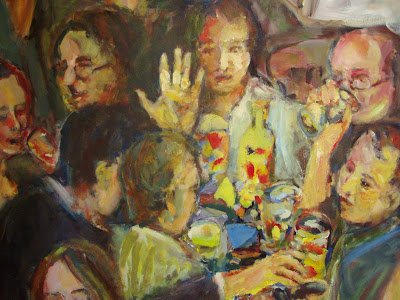
In the waning days of this web company I worked for I set up a five foot square canvas in my office. I had a ninth floor office with a floor to ceiling picture window and a view of South Peachtree Creek. On this canvas I painted a memory of the previous spring's trip to Manhattan. This is no particular moment in Greenwich Village but a feeling of what it was like - for me. As I worked on this and as it developed, people would ask me what it was, and I said, "it's a last judgment." Indeed here's a guy checking his watch. But look, people are doing what they're doing - no fiery molten cascades of molten fiery agonized frenzy. Just people spending time being themselves: singing, biking, loving; out with their cats and dogs. No screaming melodramatic lining up for a great white throne. Imagine. Healing and peace - not damnation and fury.

Tuesday, May 08, 2007

kitten pals

Louise, our cat pictured here, has a difficult relationship with what I call her "kitten sisters in Christ." Deep inside I know she wants to embrace them; to cherish them; to encourage them with acts of charity and altruism. She can't help it if tuna shorts out the altruism circuits of her brain. She can't help it if she's conditioned to protect her territory at all costs. When you see her here, a pink bow appended to her neck, what you are looking at is more than a small domestic cat capable of multiferous vocalizations. What you see here is a cry for help.

Monday, May 07, 2007

Honeymoon shot

It's all warm and spring time now - actually it's a bit cool today for it to be early May. Here's a phot from back in January during our honeymoon in London. Jami is standing on the porch of the National Gallery, Trafalger Square, with Nelson's Column in the background. She's the loveliest part of a lovely picture.

Saturday, May 05, 2007

Last August we went to a ball game

Here Jami and I are, probably at the Cubs game, enjoying a day at the ball park. I look like a cyclops. Jami is just beautiful. I think the Braves might have won this game - but I can't remember.

Our IKEA artifact


The pictures say it all.

Friday, May 04, 2007

Sermon discussion


Last Sunday my friend, Joe, was installed as an associate pastor. We met the Friday before at Twain's to discuss this and to drink beer and to read over sermons and drink beer. This is Joe's technique. Notice the economy of motion. From the moment the glass is lifted from the table there is no doubt: beer is being consumed.
You may point out to me that the beer glass becomes a water glass, as if that were some kind of inconsistency, as if my montage lacked continuity. Well it's like in the gospels where Herakles cleans out the Augean stables with a butter knife and other places where Theseus rescues the Minotaur from the wicked witch after a long sleep in a Procrustean bed - which in ancient times was the most comfortable of all beds and now - not so much.

Yin and Yang kittens

Thelma, on top, and Louise, on bottom, have a lot to teach us about relaxation. Notice the open book on the chair's arm. Neither kitten has any curiosity about its contents (yes, it's probably Barth - I'm taking some time with Barth lately, but this doesn't mean that I don't relish all life has to offer). They are as relaxed as possible. I ask, "how is it possible to be so relaxed?"

Thursday, May 03, 2007

Jami with mit

When we went to the ball game, Jami came prepared to snare a foul smash behind the visitor's dugout. Only a couple of balls were hit near us. Sure the Braves lost. Redman pitched miserably and those who followed him weren't much better. But the seats were great. I could practically reach out and yank Miguel Cabrara's hat over his face - not that I would do such a thing. In the stands, to our right, some fan threw a ball out on the field during one of Willis's pitches. It was not taken as an act of subversion or games-man-ship and he was escorted out.
As I said, Dontrelle Willis pitched and he was masterful. I tried again and again to capture that leg kick of his with my camera, but the downside of digital cameras is that the shutter is so delayed.
Again, the woman in this post with the ball glove: I love her.

My Easter sermon

Isaiah 65:17-25 17 "For behold, I create new heavens and a new earth, and the former things shall not be remembered or come into mind. 18 But be glad and rejoice forever in that which I create; for behold, I create Jerusalem to be a joy, and her people to be a gladness. 19 I will rejoice in Jerusalem and be glad in my people; no more shall be heard in it the sound of weeping and the cry of distress. 20 No more shall there be in it an infant who lives but a few days, or an old man who does not fill out his days, for the young man shall die a hundred years old, and the sinner a hundred years old shall be accursed. 21 They shall build houses and inhabit them; they shall plant vineyards and eat their fruit. 22 They shall not build and another inhabit; they shall not plant and another eat; for like the days of a tree shall the days of my people be, and my chosen shall long enjoy the work of their hands. 23 They shall not labor in vain or bear children for calamity, for they shall be the offspring of the blessed of the LORD, and their descendants with them. 24 Before they call I will answer; while they are yet speaking I will hear. 25 The wolf and the lamb shall graze together; the lion shall eat straw like the ox, and dust shall be the serpent's food. They shall not hurt or destroy in all my holy mountain," says the LORD.


Luke 24:1-12 But on the first day of the week, at early dawn, they went to the tomb, taking the spices they had prepared. 2 And they found the stone rolled away from the tomb, 3 but when they went in they did not find the body of the Lord Jesus. 4 While they were perplexed about this, behold, two men stood by them in dazzling apparel. 5 And as they were frightened and bowed their faces to the ground, the men said to them, "Why do you seek the living among the dead? 6 He is not here, but has risen. Remember how he told you, while he was still in Galilee, 7 that the Son of Man must be delivered into the hands of sinful men and be crucified and on the third day rise." 8 And they remembered his words, 9 and returning from the tomb they told all these things to the eleven and to all the rest. 10 Now it was Mary Magdalene and Joanna and Mary the mother of James and the other women with them who told these things to the apostles, 11 but these words seemed to them an idle tale, and they did not believe them. 12 But Peter rose and ran to the tomb; stooping and looking in, he saw the linen cloths by themselves; and he went home marveling at what had happened.


“These words seemed an idle tale.” That is what the disciples thought. And our old testament passage, with its new heavens and new earth, rampant vegetarianism in the animal kingdom, seems fantastic as well. How do we get from an idle tale to this new creation? How do we get from an idle tale to Christ resurrected from the dead – never to die again? To many living in the world today the thought that there is more to life than what we have now seems an idle tale. Isaiah word that they shall neither hurt nor destroy on my holy mountain runs counter to current notions of how to secure nations. Isaiah paints a world where people live in their own houses without fear of being homeless; where people work without fear of being jobless. God does this – we are not told how.

In our passage from Luke's gospel we are not told how Jesus has risen from the dead, but we are shown something. We are shown that something about the world is changing. The women at the tomb see a vision of angles and are told not to seek the living among the dead. Well to them it was only reasonable to seek Jesus there, among the tombs. He was after all dead. They are told though to consider that this dead man now lives. This is a new world indeed. And Jesus is not just any dead man who now lives: he is the embodiment of Isaiah's new heaven and new earth. He is the embodiment of a promise that had been killed. When the women visit the tomb that morning they have in their minds ,”this is where the new heaven and new earth we'd hoped for is buried. We thought for a moment that it was ready to be fulfilled on earth, but now it is gone. Now things are as they have always been and they will never change.” Then something unpredictable happens: the tomb is empty.

The empty tomb is unpredictable. It is a sign that the assumptions we make about God and the world and other human beings are conditioned by predictability. It is a sign that God is not predictable. To the people of Israel that Isaiah writes to, a people in exile, it is incredible that they will ever inhabit Zion once again, much less that they will dwell in non-violent security, safeguarded by God. This text to them told a story that seemed unpredictable, an idle tale. Even so, the resurrection of Jesus is even more unpredictable. But to us today, having heard this story so often over the years, have we lost an appreciation for this unpredictability? Has the resurrection taken on an appearance of predictability for us. Study of the old testament shows us a God who is unpredictable. God is passionate, angry and loving, changing his mind, describing himself as a father and a mother, a warrior and a shepherd. This God, who Jesus calls Father, avoids being pinned down. He is always loving and faithful. But. He will not be predictable.

But if today God seems predictable to us, and therefore amenable to the way of the world, supporting whatever the national agenda is, whatever the apocalyptic expectation is, and the God of the old testament is different, and the God of Jesus is different; then we have to wonder how we arrived at the point. Because at this point, if we are worshiping a God who is agreeable to whatever the world wants to do, endorsing consumerism, building a large military state, then we are not worshiping the God who said ,”you shall have no other gods before me.”How have we strayed so far from a God who is unpredictable, not quiet, not willing to sit in the back of the room while we adults do the important work? Such a God is surely safe and comfortable, but such a god is surely a hollow idol, a projection of our own desires. How do we get back to the God who loves us and is faithful, but in unpredictable ways? This God of Jesus who will not be quiet and go along with how things are. This God of Isaiah who wants to remake all of creation into a vegetarian, anarcho-collectivist theme park? Talk about unpredictable.

The way to find God is through the resurrection. In some churches today they repeat the phrase that the resurrection is the renewal of creation. This should fill us with wonder, not just at the natural coming of spring, but wonder at the power of God, loving and unpredictable, at work in this world and in our hearts and lives. This is the wonder of Easter.

The wonder of Easter is that Jesus rose from the dead.” Think about that, “from the dead”: what does that mean? We know the full story now, but that first Easter, the disciples knew only that Jesus was dead. Really dead.

I thought: how quickly we skip from the cross to the resurrection. In our imaginations do we leave time for Jesus to be really dead? What does it mean for the Son of God to be really dead? Is God faking it? Is Jesus only pretending to be a corpse and then when the stone is rolled over the tomb's door, he springs up and amuses himself with whatever you'd amuse yourself with in a cold,dark tomb? He would bide his time, and then, on the third day, as the stone was rolled away, walking out of the tomb with a yawn and he would say, “hey, look at me. I'm risen from the dead.”Or did his cold body lay there and his spirit go off on a holiday, visiting his Father in heaven, catching up on what happened while he was away? Or did his spirit prowl the caverns of hell, bursting open locks to infernal dungeons, liberating souls pressed beyond hope in a death that seemed unending?

Such thoughts spring from an ancient heresy called docetism.: the belief that Jesus only appeared to suffer, only appeared to be dead. Like all heresies it is a weed that never is eradicated from the garden. It springs from the desire to protect God from things that seem undignified, as if God were a child that needed protection from bad things. Such a God is the god of the Greek philosophers, an unmoved mover. They imagined a god who never feels or desires – such human responses were the result of the corruption of matter. To the Greeks matter is evil and must be overcome. One way to overcome matter is to practice being unaffected, to face death and loss showing as little concern as possible – and also to treat success and triumph the same way. In this way, matter is overcome and the person begins to resemble God, an unmoved mover.

Such a god is not the God we meet in the Old Testament. In the Old Testament God creates matter and revels in it. God is passionate. God loves and regrets, is angry and weeps. God's relationship with Israel and Israel's relationship with God is like one of those relationships where a couple is throwing plates at each other one minute and planning a second honeymoon the next. If you think I'm exaggerating, read Ezekiel 16 for God's side and Psalm 88 for Israel's. These texts are extreme in their bitterness, but they show how deeply held the passion each has for the other is. As Judaism and later Christianity encountered the Greek world, the tendency was to say, “our God is like your God.:” to soften the hard edges of Israel's God. And so well meaning theologians have created ways in which the language of scripture, where God regrets, hates and loves, is read metaphorically, necessitated by our limited human understanding. God only seems to regret, love and hate. The Greeks are superior to the Hebrews and so this unmoved mover, that's got to be right. It sounds so right. So respectable. And best of all predictable. As omnipotent, omniscient, immutable and eternal as such a God is, such an unmoved mover is predictable – and if some thing's predictable, then it can be manipulated. And if human beings can manipulate god, then we can control God – pretty clever.

But the Old Testament God, Yahweh, Abraham-Isaac-and Jacob's God, the Father Jesus prays to in the garden, is unpredictable. While an unmoved mover might pretend to like matter and might pretend to die, this God of Israel actually loves matter and actually would pull a stunt like dying. The unmoved mover blinks but God doesn't. God drives straight for the edge of the cliff and slams down on the gas. And so, when the women go to the tomb on Easter morning, followed by Peter and John, Jesus is, for all they know, really dead. Their teacher , their brother, their friend has died. How deep must their grief have been when they arrived at the tomb that morning? How exhausted by sorrow they must have been over the past two days. Jesus had gone to the cross and there had been no last minute reprieve, no legions of angles, no angelic host wiping out the Roman army and restoring the Davidic blessings and monarchy to Israel. Jesus kept driving straight for the cliff and the results had been predictable.

Or not. Not predictable: the resurrection is unpredictable. It seems an idle tale. Jesus is risen from the dead; he is risen indeed. And just as he was really dead, he now really lives. He was dead, like we're really afraid of dying. What will it be like for each of us when our hearts stop and our brains turn to dust: the sound goes off, the screen goes blank? Jesus knows. As scripture says, “he tasted death for all humanity.” And Jesus lives in the way we're really afraid of living. Jesus lived with unpredictability. He did not seek comfort. He did not seek a home. He talked about God clothing flowers and feeding birds, and acted as if that was as much concern as he needed to devote to such things. He claimed it was more important to pray for enemies and help difficult people. That fear about what people might do or think and worry about tomorrow: these were a waste of time. He claimed that the way to handle the Roman occupation was to ask if they needed any more help. He forgave sinners their sins left and right too: all kinds of sinners, all kinds of “not our kind of people” - he went and told them that they were OK with God and OK with him. And then he warned the authorities, the very people you want on your side, that they probably were not OK with God or with him – at least just as they were. When you think about it, it's obvious that he's pedal-to-the-metal towards the canyon rim – and he's having just a normal conversation: “some weather we're having. Have you considered the lilies of the field? What if we offered to carry a burden an extra mile, no charge, for these Roman soldiers – that'd freak them out wouldn't it?”

And it's obvious that he's courting death. You don't live a life that displays the powers as weak and ineffectual without making them mad. Jesus is setting a bad example and they must stop him. Jesus is giving people the idea that they don't have to be imprisoned in the system; they can just step out. They don't have to live in fear; they don't have to crave security; they don't have to get a little more; they don't have to get ahead. . If people ceased to voluntarily put themselves under control of the powers, then the powers, the systems, would starve. So the leaders: pharisees, saducees, and civil authorities push back, hoping that Jesus will resort to their weapons. If Jesus will just adopt the tactics of violence, the tactic of giving a little to get a little – well the systems of the world understand that. The systems – the banks, the armies, the bureaucracies – hope Jesus will meet them on their terms, because then he'd be just one problem among others instead of The problem.

So Jesus has to be treated as an enemy of religion and an enemy of the state. He has to be crucified and certainly he'll blink there. Certainly facing crucifixion he'll succumb to fear and fall under the sway of the powers and world systems. Of course they'd kill him anyway, but how delicious his ruin would be. Except that Jesus doesn't blink.

But at least he's dead and things can go back to where they've always, predictably, been. Except something unpredictable happens. That Jesus is risen from the dead means that victory belongs to us and not to the systems, the powers, the “way the world works.” That Jesus lives means that all that talk about not fearing, not being anxious, not craving security but being generous, loving, and non-violent is bed-rock truth, while the world's promise of better living through greed, fear, and violence is a house built on sand. It's an impressive house made with $100 screw-drivers and the best things money can buy. Every day great carloads of people and materials are pumped into it. This house almost seems to block out the sky, but it is built on sand and one day it will tumble down into the desert. A rusting hulk, an oddity to travelers. How do I know this? Because Jesus is risen from the dead.

Jesus is risen from the dead and Jesus is the same after the resurrection as before the resurrection. And this Jesus will come again. Jesus's life is the defeat of the powers and systems -those things that say, “come to us for food, come to us for security, come to us for what you need. Play by our rules and we'll feed you; fight our wars and we'll secure you; repeat our slogans and we'll put a roof over your head.” But all these promises the world makes are hollow. For all the fear, for all the willingness to spend on the next big thing, for all the sacrifice of our lives and for all we promise to do for scraps of bread – the promises of security, prosperity, predictability have no real capital backing them up.

Jesus is risen from the dead, and he comes again in judgment. But not judgment as popular imagination might have it: shoveling sinners by the thousands into a lake of fire. Jesus judges the powers and systems that have captured the people of the world and that scar God's good creation. Jesus has judged and he will conquer the false promise of the world's systems and powers. Jesus does not conquer by violence. Good reformed theology, and theology as ancient as the early Church, says that Jesus conquers not because he is mighty, but because he is worthy. This is what Revelation says, “the lamb is worthy.”

The last hope of this world's systems and powers is that we may be mislead about who Jesus is and what his rising from the dead might mean. The world hopes that we'll think God was just pretending. But we do not think this is an idle tale do we?
A Sermon from way back in Lent

Genesis 15:1-21 After these things the word of the LORD came to Abram in a vision, "Do not be afraid, Abram, I am your shield; your reward shall be very great." 2 But Abram said, "O Lord GOD, what will you give me, for I continue childless, and the heir of my house is Eliezer of Damascus?" 3 And Abram said, "You have given me no offspring, and so a slave born in my house is to be my heir." 4 But the word of the LORD came to him, "This man shall not be your heir; no one but your very own issue shall be your heir." 5 He brought him outside and said, "Look toward heaven and count the stars, if you are able to count them." Then he said to him, "So shall your descendants be." 6 And he believed the LORD; and the LORD reckoned it to him as righteousness. 7 Then he said to him, "I am the LORD who brought you from Ur of the Chaldeans, to give you this land to possess." 8 But he said, "O Lord GOD, how am I to know that I shall possess it?" 9 He said to him, "Bring me a heifer three years old, a female goat three years old, a ram three years old, a turtledove, and a young pigeon." 10 He brought him all these and cut them in two, laying each half over against the other; but he did not cut the birds in two. 11 And when birds of prey came down on the carcasses, Abram drove them away. 12 As the sun was going down, a deep sleep fell upon Abram, and a deep and terrifying darkness descended upon him. 13 Then the LORD said to Abram, "Know this for certain, that your offspring shall be aliens in a land that is not theirs, and shall be slaves there, and they shall be oppressed for four hundred years; 14 but I will bring judgment on the nation that they serve, and afterward they shall come out with great possessions. 15 As for yourself, you shall go to your ancestors in peace; you shall be buried in a good old age. 16 And they shall come back here in the fourth generation; for the iniquity of the Amorites is not yet complete." 17 When the sun had gone down and it was dark, a smoking fire pot and a flaming torch passed between these pieces. 18 On that day the LORD made a covenant with Abram, saying, "To your descendants I give this land, from the river of Egypt to the great river, the river Euphrates, 19 the land of the Kenites, the Kenizzites, the Kadmonites, 20 the Hittites, the Perizzites, the Rephaim, 21 the Amorites, the Canaanites, the Girgashites and the Jebusites.


I find this passage endlessly compelling. I almost couldn't begin composing a sermon. Every time I wrote a thought down, I read a bit more, and then I thought a bit more: I wrote and erased. I began and began again. You may think that this passage is straightforward: a man in the desert has a vision from God; God tells him that he'll have a son and possess a land. His, Abraham's, descendants will become a great nation – in fact, many nations. Some of his descendants will even be in a land “not their own” and be enslaved. But then they will be rescued and come into this land to possess it. And what a land: stretching from the river of Egypt to the Euphrates.

Much has been written and rewritten about this text. In Romans and Galatians, Paul uses verse 6, “the Lord reckoned it to him as righteousness,” as a means to describe how believers are brought into covenant relation with God. James quotes this verse when he writes that faith without works is dead. So this verse tells us that faith is more than mere assent or the mastering of a systematic theology.

Walter Brueggemann has written a wonderful book called The Land. I found it in a stack of books in my studio while I was preparing this sermon. Or I should say that it found me. Anyway, I've sat in his class in seminary and heard him talk about land, among other things, but it was while reading his book that this text in Genesis became refocused for me. I say refocused because the connection to Paul's argument in Romans and Galatians is more in the forefront of my protestant mind. Indeed it's hard to hear this passage without hearing it through the filter of 500 years of reformation history with 2000 years of church history. From Paul to Augustine to Luther to Calvin to Barth – and more in between and coming after we're conditioned to almost not hear this text. Justified by faith, not by works, and smacked down in the middle of the covenant – God's ray of sunshine beams down on us amidst a world of rain. Or so seems the popular expression of what this means: condensed for rapid consumption, reduced to bumper-sticker sized thought for today's consumer.

So I came back to this text over and over, each time trying to erase more of the overlaid interpretations of history to arrive at the moment itself. What moment? The moment where Abraham, having left home and taken his family out into the wilderness, wandering to a land that God would show him, has a vision from God. When he has this vision he is already old and he asks God what will God give him since he has no son. You can tell it's been on his mind: this sonlessness thing. And God says what are you worried about? Here look at the stars and try counting them, that's the number of your descendants.

Right here Abraham believes God. Abraham is utterly taken in by God's promise. In the face of all the questions that Abraham could ask: where have you been all this time? How likely is this? Do you know how long I've already waited? Abraham believes. He believes as one who knows from experience the character of God.

Could Abraham have had this vision and promise years earlier. Say when he and Sarai were still young? Before they'd lost so much time? Before the birth of Eliezer of Damascus in his house? Before so much experience of the world's difficulties? But all this time Abraham has experienced the world, he's also experienced God: God's steadfastness, God's loving-kindness, God's unpredictable presence. He never knows what God will do, but he knows that God will do something, say something, encounter him with something that will knock him out of complacency, change his direction, and bring him to a new way of seeing the world. God doesn't do any of this all at once, and so it's only here, over 90 years old and with Sarai old and barren as well that God brings up the notion of a son and inheriting the land.

Abraham's faith doesn't cause God to reckon him righteous; Abraham's faith is a sign that his thinking, his heart, is right in line with God. How could Abraham have known that he had faith until this moment when God tells him this incredible tale: you'll have a son and your descendants will inherit this land. Such faith is not a work because it is not the result of conjuring up an emotional state – it just is; it's existence is as effortless as the existence of love in the presence of the one you love. Faith results from being intimate with God. Such intimacy has had this effect on Abraham over the course of his life, that now in his 90th year when God tells him something unbelievable (that the laws of nature you've witnessed over a lifetime don't apply), Abraham is in such a state that he believes him. And so- Abraham has righteousness.

This word righteousness as we encounter it in the rest of the Old Testament, especially the prophets, has an ethical quality. Righteous people care for the poor and the land, they seek justice for the alien and the widow, they deal honestly and don't lie. Indeed these are the very things that God cares about. Abraham has been with God long enough that he knows what God cares about. Abraham believes God's justice is directly connected to the promise of a son and to this promise of land.

The land is important to understanding God’s character in this passage. The land promised to Abraham is currently filled with iniquity. Injustice fills the land. The righteous God does not directly give an unrighteous present. Instead Abraham's descendants will go to a land “not theirs” where they'll be enslaved until the day when this land of promise is ready for righteousness. So there are two lands: this promised land and this land of enslavement. Notice how righteousness and iniquity are differentiated: Iniquity loses the land; righteousness possesses the land. In the history of the covenant: iniquity loses the land. Amos, Isaiah, and Jeremiah all state this theme. God's righteousness is found in pursuing justice for the margins of society, for the weak, for the dispossessed. God seems upset when Israel gets lost in pleasure while widows are kicked out of their homes, while poor people are trapped further in debt. God doesn't blame the victim, he blames the person with the biggest pile of cash – that is, if the epistle of James is to be believed. And so Israel goes into exile when they no longer resemble Abraham but instead resemble the Amorite. This is exactly what happens: Israel possesses a land in righteousness; Israel is told do righteousness, and then Israel is distracted. Israel is distracted by pleasure, sure, but also by business, by war, by the need to get ahead, by the need to expand. In all its working hard and playing hard there was bound to be some collateral damage. But if they would not listen to their society's cry for justice, God did. And Israel found itself in exile. Back where they started, but this time on the river Euphrates. It's interesting isn't it, how in our text, the two rivers mentioned as the boundaries of God's promised land are the two rivers along which Israel suffered separation from God. They hadn't suspected anything was wrong, but now they know.

In both exiles, they are not so separated that God isn't with them, that God doesn't hear them, that God doesn't passionately yearn for them (read Hosea and Ezekiel). Indeed Israel enters the land not once but twice. The second time under Nehemiah and Ezra they're going to get it right. Well up to a point. What is the New Testament about but a new entering the land and a new exile. What does Jesus talk about but how God's cause is with the weak of society: those who have no defense in law courts or with banks; those who are easily trapped by market forces. Jesus doesn't talk about getting tough on crime or family values; Jesus doesn't talk about celebrities or how to invest for retirement. And this is most distressing for me: Jesus doesn't talk about the new baseball season or some new movie opening. When Jesus is presented with his day's version of the 6 o'clock news (the tower of Siloam fell and people were crushed; Herod's been up to no good again) his response is that “if you don't repent you'll likewise perish.” Jesus is focused on God's righteousness like a laser beam.

God's righteousness is not an abstract quality. Jesus constantly points out that it's a matter of how people treat each other. Are enemies being prayed for? Are neighbors being loved? Are the hungry being fed and the homeless housed? How about widows and orphans and prisoners? Is the resort to violence being denounced? Are people treating their possessions like a hot potato? Jesus knows God like Abraham knew God.

And so Paul tells us that it's this kind of knowing faith, this faith of Jesus that places us in the covenant. It's this faith that makes its power felt in acts of love that shows we've had an encounter with God's righteousness. We read in Paul that we've been taken from a land of enslavement and exile to a land of promise. Jesus desires to gather us together as chicks under his wings in a land where righteousness abounds.

Just as God never forgets Israel, he never forgets us. God's love and steadfast care are always with us. Jesus invocation to come is not a one-time offer, but an encouragement for every day. Come to God's land of abundance where there's enough for everybody. Come to God's land where there is justice for all, no matter how weak or obscure. Come to God's land where fear of scarcity is abolished by a generosity that never ends.

This is my thought for Lent: how can I fully show my gratitude to God in God's land of plenty, and how can I live less in the land of scarcity and exile.


Peonies from heaven

We have a large purple flower in our front yard. It bloomed over night. Jami is very excited by its presence among us, gracing the strip of lawn next to the mail box and between the sidewalk and the street. My knowledge of horticulture is limited. I love looking at nature, but I don't think about the names. So whenever I am able to place a name with a plant I have an inner satisfaction: now if ever in the future I am presented with a strange blossom, I can perform the "peony/not peony" test. I can say, "this is a peony" or failing that, "whatever this flower is, it is not a peony." Unless perhaps it might be a mutant peony.

Wednesday, May 02, 2007

A Ridiculous Painting

This is the ridiculous painting I made reference to some days ago. It's a wonderfully painted painting: lots of free brushwork, each square inch meticulously attended to, and it's chock full of symbolism. Is it patriotic? Is it an allegory of spring? Is is about prayer and abundance? Note the speckled snake along the bottom of the painting (an allusion to Sherlock Holmes' story of the speckled band?) and behind her head, in one of the blue fields, a crescent moon and between the moon and her head, a green star. It's a lovely painting.

Braves vs Marlins in early April


If it's April it must be time for me to beat my head against a wall - baseball season has begun: that wonderful season of fascination where I project my childhood dreams of athletic prowess onto fallible individuals, who actually possess such prowess, only to be frustrated by their failure to hold a lead or to hit a small horsehide ball pitched very fast. I'm learning to not care - as Eliot wrote: "teach us to care and not to care." Still this is a happy night for me. I'm at a Braves game in early April with my lovely wife, Jami. She loves baseball. She can love baseball without all the baggage that I grew up with. I see Mark Redman giving up five runs to start off the game - she sees a poor man who is in search of his dignity.
Here we are at the game: Jami radiates happiness in the moment - a beer, a New York dog, sitting in the stands with me as I shout at the Marlin's third baseman. What fun we're having and you can see it in her face. Meanwhile, by the sixth inning, with the Braves safely out of the game, I'm thankful that I had the foresight to bring Barth's Church Dogmatics IV,iii,2 along with me.