Showing posts with label barth. Show all posts

Thursday, August 16, 2007

Reading Barth at the Beach

Jami, my beloved beautiful wife, loves it that I bring a theological library to the beach and that I sit in the sun, wearing my old panama hat, pouring over Barth's Church Dogmatics 4.3.2. I can't think of anything better to do. Barth continues to be the most engaging theological mind available to us. Note that my nubby pasty knees are beginning to look reddish.
Today, during the examination committee, Martha asked me, other than Barth, which theologian I would take with me - I suppose in some kind of bomb shelter situation or else some kind of exile where I couldn't take much. She wouldn't let me take Barth. I said, "you'd let other people take him." And she insisted. So I responded Eberhard Jungel. Jungel has said, "God's way of being himself is by being God for us." And "God's entry into history in the incarnation and the cross, his historicality and his impassibility, is his own chosen goal." This is related to Barth's statement that God's freedom is expressed in God's limiting and directing his activity - that is: it is the Greeks who speak of God as limitless, but limitlessness is a unique prison, where God becomes predictable to philosophers as an abstraction but not much help to particular human beings in particular circumstances. Jungel extends Barth and brings up some interesting discussions: particularly in writing about parables as descriptions of the kingdom. His magnum opus is God the Mystery of the World.
When I was talking to my cousin Cheryl after all this, and I told her Martha asked me this question, I mentioned how my response had thrown her. Jungel is not a typical response. I had thought about James Cone. But speaking with Cheryl it occurred to me that I should have responded '"Charlotte von Kirschbaum." That would be the smart aleck response. Von Kirschbaum was Barth's secretary. They wrote the dogmatics almost in tandem - and she's given little credit. CvK is buried with Barth and his wife, Nellie - it was a strange relationship. A book could be written about strange relationships of Christian writers: CS Lewis, Charles Williams, Tillich. To outsiders these relationships appear strange, but to those inside they probably seemed OK. Karl and Charlotte were undoubtedly productive. I could have said Von Kirschbaum and still carried my volumes of the Church Dogmatics with me - at least up to 4.1 or so when she came down with Alzheimers.

Monday, May 28, 2007

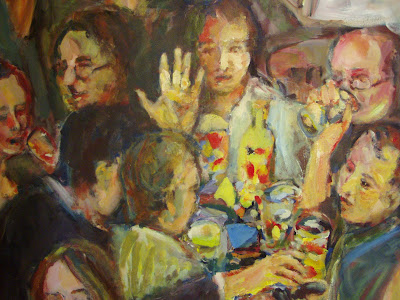
My Shirlie Guthrie painting


This painting is currently on display at the CTS bookstore and it is at such an angle that I didn't get a good picture. The top picture captures more the richness of the color and the bottom picture captures the sense of the composition. Guthrie was the latest in a line of theological personas to in habit Columbia. He studied under Barth and marks the passing of the old, conservative guard typified by Green and before him Thornwall and Girardeau, to a more modernist tack on theology. I was fortunate to have him in a couple of classes which he taught even though he was then an emeritus and needn't bother with new students. I had already been reading Barth when I came to Columbia, but in speaking with Shirlie, Barth's more important issues became imprinted on my mind. To me I have to remember that human beings trump ideology and that Jesus' concern was and continues to be with humanity and not the procrustean patterns of thought and answers that are continually brought up as universal solutions. And also, that in attending to the living word, Jesus, we realize our vocations and rediscover our vocations in our limits. Well that's certainly badly stated. Let me just say that theology has the possibility and recognizes the necessity for change. Before Barth (and Tillich, who I haven't studied very much at all) theology modeled itself on the definition of God in the Westminster catechism: infinite, eternal, immutable in all aspects of its being. And Reform theology was the apex of this perfection - especially Reform theology as voiced by Calvin through the scholastics like Turrentine and into the last century by Bavinck: the reiteration of God's eternal decree as trumping all human effort (and even any effort of God that might be contrary to God's eternal decree - some strains of calvinism actually worship the "eternal decree" and not the eternal decreer [but don't tell them that; it'll only upset them]). That's how I felt about the Reform theology I began with, Berkohf's: that it was an ultimate system that was very proud of its ultimacy. But that's the danger of any kind of scholastacism: that the system answers its questions (questions which are chosen to provide the opportunity for the very answers given) with finality and aplomb - all enemies being shown to be heretics, misguided, enemies of the faith, callow, calumnous, apostate, victims of illogic. Such a system can be wrapped around the soul for comfort - as long as there is no pain, or grief, or difficulty, or existential lack. The illusion of such a system is that one only needs Jesus for his salvific effects. Is it any wonder that this conservative Dutch reformed theology sanctions the worst evils of capitalism, and particularly the worst evils of racism, apartheid? But that is the beauty of worshiping the "eternal decree" and not the decreer: the power to steal and enslave and call it good comes from above - therefore my greed which issues in power and enslavement of you is God's perfect will. Barth repudiates all this. He points out the docetism inherent in such conservative theology and he goes back to scripture. He holds to the person of Jesus as the embodiment of scripture and exemplar of love in faithfulness, while claiming that we can not go beyond Jesus, that Jesus is more than a means of salvation, or that salvation is something separable from life in Christ, and therefore, costly discipleship. More importantly Barth says that we must be wary of imprisoning God in categories of omnipotence. That God's freedom is a freedom to limit and direct God's own activity, and that while the decree maybe eternal, it is at once working in real changeableness. That when the Old Testament speaks of God changing God's mind, that this metaphor is indicative of God's act qua act and not some play-act put on for human limitations. What Guthrie Got from this is the sense of theology has changeable: that the truth we have is a penultimate truth (which is a thought more prevalent in Brueggemann perhaps), and therefore theology is always discovering some new avenue for understanding God: feminism, liberation, process - these are all conversation partners in theology as a learning experience.
So my painting, with its deep green background and sky blue foreground, is the setting for a Lucien Freud take on the portrait: where threads of orange and blue and green weave together and knot into a likeness. It is a good enough likeness.

Wednesday, May 02, 2007

Braves vs Marlins in early April


If it's April it must be time for me to beat my head against a wall - baseball season has begun: that wonderful season of fascination where I project my childhood dreams of athletic prowess onto fallible individuals, who actually possess such prowess, only to be frustrated by their failure to hold a lead or to hit a small horsehide ball pitched very fast. I'm learning to not care - as Eliot wrote: "teach us to care and not to care." Still this is a happy night for me. I'm at a Braves game in early April with my lovely wife, Jami. She loves baseball. She can love baseball without all the baggage that I grew up with. I see Mark Redman giving up five runs to start off the game - she sees a poor man who is in search of his dignity.
Here we are at the game: Jami radiates happiness in the moment - a beer, a New York dog, sitting in the stands with me as I shout at the Marlin's third baseman. What fun we're having and you can see it in her face. Meanwhile, by the sixth inning, with the Braves safely out of the game, I'm thankful that I had the foresight to bring Barth's Church Dogmatics IV,iii,2 along with me.