Saturday, June 16, 2007

Happy Birthday Jami, Beautiful Wife


I was born on the Fourth of July, a very historical date for the US, but not so much for the rest of the world. Celebrations of the Fourth are low key in Italy, for instance, and delayed till the 14th in France. Jami was however born on an even bigger holiday, Bloomsday, the day of the month of June where all the action occurs in Joyce's Ulysses. This is a great literary holiday. People all over the world are hoisting a Guinness, ghosting a highness, and goosing a hostess. Wikipedia has a grand entry on Bloomsday. Suffice it that Joyce picked this day for the action in his book because its the day of his first date he had with his wife, Nora Barnacle. So Three Quarks for Muster Mark, as Joyce says in Finnegan's Wake, as well as The Proteiform graph itself is a polyhedron of Scripture.
And I sat [sic] about reading the Wake this morning to be sure of my quotes above, and I came upon this gem: amid all the punning and portmentauing, Joyce writes, "What has gone? How it ends?/Begin to forget it. It will remember itself from every sides, with all gestures, in each our word. Today's truth, tomorrow's trend./Forget, remember!" Something so elegiac startles after 615 pages of Burlesque. Undoubtedly a clue to the circularity of the narrative: the last sentence "a way a lone a last a loved a long the" leads right back to "Riverrun, past Eve and Adam's" and we find ourselves, with Sir Tristram, "passencore rearrived from North Amorica." This is related to what Eliot will later write in the last Quartet "to make an end is to make a beginning./ The end is where we start from." Every day an end and a beginning. The past pokes through in every new moment and tempts us with possibilities, while the future threatens us with its predeterminations and inescapable mystery. And when we arrive, in each new day, we are as we started, and know ourselves for the first time. And then we forget. Remember? St. James describes the casual hearer as one who "looking n a mirror walks away and forgets what manner of person they are." [my paraphrase] That's what Stephen Daedalus's and Leopold Bloom's and Molly Bloom's journeys are in Ulysses: odysseys, two along the streets and one in the heart, weaving and looming, discovering where to end a beginning, begin an ending. In them Joyce is trying to walk away from the mirror and remember who he is.
Marriage is an odyssey. Two people rediscover themselves and each other every day. It is a journey without timetable. Yet time and language are in the warp and woof. Delight and joy and laughter are the sound that cloaks our presence with each other. Tears, anxieties: like storms they thunder and light striking, but they spend their energies and what remains of them is a clear blue sky.
I cannot say how grateful I am for Jami. I love her bunches.

Thursday, June 14, 2007

last sunday's sermon

This is last Sunday's sermon. I read the text from Kings about Elijah and the widow, from Luke about Jesus and the widow of Nain, Galatians about Paul's conversion, and preached from Psalm 146. Psalm 146 is a great Psalm and it contains the existential kernel of Kierkegaard's and Niebhur's dictum that absolute worship belongs to absolute things: that you don't give absolute worship to temporary things - this is where sin begins: in the anxiety such a miscalculation provokes. At least that's my understanding of Niebhur. Cheryl told me that this message would just go flying over everyone's head.
So I wrote, focusing on this verse in Ps 146: that prince's can't help us deal with the fundamental human condition of death, in that they themselves are subject to that condition. But when we listen to the psalm, we discover how God leads us into understanding and action in that condition. That we're authentic when we follow God into the places where loss occurs, and less authentic the more we evade those places. God dwells where the pain is in our human lives.
The italicized passage is a passage that Jami felt was unnecessary, but then she said maybe it was.

Psalm 146:1 Praise the LORD! Praise the LORD, O my soul! 2 I will praise the LORD as long as I live; I will sing praises to my God all my life long. 3 Do not put your trust in princes, in mortals, in whom there is no help. 4 When their breath departs, they return to the earth; on that very day their plans perish. 5 Happy are those whose help is the God of Jacob, whose hope is in the LORD their God, 6 who made heaven and earth, the sea, and all that is in them; who keeps faith forever; 7 who executes justice for the oppressed; who gives food to the hungry. The LORD sets the prisoners free; 8 the LORD opens the eyes of the blind. The LORD lifts up those who are bowed down; the LORD loves the righteous. 9 The LORD watches over the strangers; he upholds the orphan and the widow, but the way of the wicked he brings to ruin. 10 The LORD will reign forever, your God, O Zion, for all generations. Praise the LORD!


How do we live in this world? What is it to be really who we are? The writers of the Westminster Confession answered this in the first question: What is the chief goal of humanity. And the answer is: God has created us to Glorify God and enjoy God forever. This is perhaps the most quoted phrase in the English Reformed tradition – of which our presbyterian church is a part. Wherever I've been, among conservatives and liberals, I know that most people will be familiar with this response. In another , may be less familiar, Reformed creed, we're told that our only hope in life and death is that we belong body and soul to our Lord Jesus Christ. These are important things to keep in mind as we approach ever day. Am I glorifying God and enjoying God. What does that enjoying God mean? I think that today's psalm, as well as the other passages in the lectionary help us answer these questions.

Early in the psalm, the singer tells us what not to do. The psalmist commands us not to put our trust in princes, in mortals, in whom is no help. Well I hadn't been putting any trust in princes – after all they're mostly in Europe. .But the key word in this sentence is “mortals”. And this is an apt translation because no matter how well off, or how privileged in life a human being is, that person is subject to death. The psalmist begins with an exhortation to Praise the Lord and then gets right down to the problem of life. The problem of life is that we can die so easily: that no life is a sure thing, that we're haunted by separation and loss and change. This is the problem of how we live in this world, the problem the confessions and creeds also address: How do we live in a world dominated by death?

But why does the psalmist focus on princes to answer this question? . Princes have money and privilege. They are not encumbered by long work hours and they command respect. They seem to be the most free of all the human community. Today the psalmist might say don't trust in the powerful, the celebrity in the news, the great leader. If you see them or happen to be in their presence, have only this thought – this person is going to die just like me. Don't think: how can this person help me? Don't think: this is a perfect networking opportunity Don't think: I'm so honored. Instead remember: this person is going to die. This person lives under the possibility that that they will become ill, that they will lose a family member, that they will lose the ability to control their bodies or control their minds. Death is not just the cessation of life, it is the loss of lots of little things and big things that all add up to zero. They could lose the power of being a prince – and that would be nothing. If you lose money – you can get that back, or at least some of it back. But your life? But a friend? A parent? When dementia took my grandmother's mind, every visit to her was witnessing a new death – something new was forgotten every day. Sometimes I would be surprised at something she would remember, but then, days later, that too would be forgotten. Death is inescapable; but it is evadable – at least for a time. We can insulate ourselves. We distract ourselves with entertainments, politics, arguments, hatreds, chemicals, thrills. We go into debt to avoid thinking about it. People look for a hero to save them from death. People join mass movements because a leader seems invincible. But the psalmist says it isn't so. Don't put your hopes in princes, politicians, heroes, celebrities, or anyone who is only a mortal.

Instead, the psalmist says put your hope, your trust, in God. The God of Jacob, of Israel, who created heaven and earth, the sea and all that is in them. God cares for the poor, feeds the hungry, lifts up the bent over, frees the prisoner, and delivers from oppression. God creates justice in the world. God's faithfulness never ends. The plottings of the wicked, God bends back on them. God does not fear death. God has died in the person of God's son, Jesus, and death could not hold him down. Jesus conquered death. If there is any hero, it is Jesus. If there is any prince we should look to, it is Jesus. And what kind of prince and what kind of hero is he? Like the description of God here in the psalm, Jesus feeds the hungry, he frees the prisoner, he gives life to the dead. Hence the Reformed confession that “our only comfort in life and death is that we belong body and soul to – not to ourselves but to our faithful savior, Jesus Christ. Indeed that we're redeemed from the power of Death by his blood and sacrificial work, his conquering of Death and the world systems that manipulate the fear of death. And that because of this all that we owe God is gratitude.

And this is the Christian struggle:to live in a world dominated by death, and then, like Jesus, to go right to those places that remind us how fragile our life is. We don't have to act heroically or attach ourselves to some human movement or powerful leader. We belong to Jesus and not ourselves. And our gratitude towards Jesus is not some minor obligation. Our gratitude towards Jesus is the substance of the Christian life. How do we live this out? Look at the psalm. We see there that God is active among people who can't help themselves. God is active in the very places that death attacks us. God is active in breaking up the plans of the wicked. God is involved with helping those who are shoved up against loss. We live out our gratitude when we go where God goes. And God goes to some difficult places. God is with the bent over, the burdened. God is with people who are losing. And this scares us. How can we be with God in these places? These are places we don't want to be because they remind us how fragile our life is.

Look at the story of Elijah: he is called out to be with a widow during a drought, to see that she has food and sustenance. He is called to bring life back to her son. Elijah walks into the place of death, not without some reluctance, to be sure. He cries out to God ,”why are you bringing this calamity even upon her?” and he says “even her”- implying that he's not feeling so well himself. But he isn't trusting in princes. He isn't trusting in some human agency. He's trusting in God, and so he is able to meet people in their grief. He is able to be with her an let her have her grief. Elijah doesn't tell her to cheer up or get over it. He is able to be with people in their reduced circumstances. It isn't easy but he knows God is with him, because he knows that God is especially present in these kinds of difficult situations.

Jesus is the living Word. This is not just an empty title. In this story of the widow of Nain, we see that a living word is how he is: that what he says and how he acts are identical. He does not say one thing and do another. In this story he walks out to the widow who's lost her son. His heart is drawn to her. And he doesn't consider whether she is worthy. As with the Elijah story there is nothing about this widow to commend her. God didn't chose her based on what she did or because she was powerful. Jesus comes out to this widow and restores her son to life. Jesus is where the pain is. Where the discomfort is. To the place where life is most fragile. Whatever else this widow might be, to Jesus she is a carrier of the image of God and that is enough.

And Paul, what a story his is. He was once filled with hate for Jesus and for Christians. His hate drove him to damage people's lives. Even though he was well versed in the scriptures and could read how God was invested with helping people, with saving and not destroying, Paul knew this psalm quite well. But Paul still aligned himself with the powerful and set out to destroy. And in destroying he destroyed himself. And then Jesus confronted him and saved him from hating. Paul was a new man. He gave up hating and joined with those who loved. He went to the widows, the orphans, and those who were bent over. He became a healer of souls and preached Jesus, not just with his words but with his life. When imprisoned in Phillippi he freed not only the prisoners, but the jailer as well.

The jailer himself is imprisoned in what the jail symbolizes. Just as Paul was imprisoned in his hatred. Just as the psalmist cautions against trusting in mortal solutions as an escape from death. The psalmist recognized that what imprisons us all is death. And just as the jailer seems free compared to the prisoners but is really imprisoned; and just as Paul seemed free from death by bringing death upon early Christians, but was really bringing death upon ;himself. So the psalmist warns us that mortal solutions to the problem of death simply imprison us in death and loss behind bars of fear.

And so our life is lived with God. It may seem daunting to us. We're not Elijah or Paul. At times Jesus seems far off. But the Holy Spirit helps us do what we can to participate with God . Over time we get better as our experience opens our hearts. We enter every day into God's story, a story that tells of conquering death and loss. We leave behind a mortal story, a story about evading death and loss, about pretending that I'm different or special, this group will save me, this strong leader will keep me from harm. We don't have to be in denial that we will die and that we are fragile. We don't have to be phony, pretending that we're not hurting inside, pretending that we're not afraid. Why does God dwell in such painful places? God dwells in the truth, and the truth of our situation is that we are encumbered by death and are powerless to save ourselves. Our gratitude stems from this: where we encounter defeat, Jesus brings victory; where we stumble in blindness, Jesus lights our lives with his love. This is the perfect love that casts out all fear. And so we can look at death and not despair. Our Lord Jesus has conquered death. He is the prince of peace in whom we can trust. And he saves us because having died he lives and dies no more. Because of him we need not fear painful things. In our pain we re not alone. In death we are not alone. Ever how long the grief, how deep the sadness, he is there. Praise the Lord. Praise God who reigns from generation to generation. Praise God's name, always.
Sunday, June 10, 2007

robed up and with my cousin at her ordination


In the top photo I'm posed in all my ministerly glory: robe, stole, and Book of Common Worship with some notes. The bottom photo shows the commission of my cousin, Cheryl's, ordination. I'm behind her. Cheryl is soon to be the as(sis)(cociate)tant Dean of Students. It was a bouyant moment. That was last Sunday week. This last Sunday I preached at her pulpit while she was at the Wise family reunion. This has become our running joke: each year she goes to the Wise reunion and I, a Wise, substitute for her.
Fellowship Presbyterian is located along a country road - the original roadbed still curves through the churchyard and is now the driveway. The old white frame church burned down in the 1950s and now the church building is a brick A-frame with large picture windows. It's a fine example of 60s style.
Behind the church is an extensive graveyard behind a stone wall. In the near corner is a Wise family plot. Imagine my surprise. Alas after the 1890s no Wises died here. Where did they go? Presbyterian Wises are rare in these woods. I figure that when the early Wises left Virginia they were Anglican. But somewhere they descended into frontier Baptists. By the 1900, in my group of Wises, they were the worst "landmark" Baptists (a group of Baptists that believed that education was a tool of the Devil - and therefore clergy needed to be as ignorant or more ignorant than their congregation. Look them up in Ahlstrom's Religious History of the American People). It cheers me up that at least some of my relatives had the sense to be Presbyterian.
Presbyterians are not immune to ridicule though. Walker Percy has a good morsel about them in the Movie Goer. His protagonist, Binx Boling, relates that 5 of his 6 aunts are of the highest Brahmin sensibilities - the 6th is still a Presbyterian.
It's true, to a Presbyterian from Massachusetts, a Presbyterian from Georgia looks just like a Baptist. Our regional penchant for revivalism and agrarianism and general anti-intellectualism is the great leveler. All the differences we perceive about each other fellow southerners are miniscule when viewed from any objective perch. And to us, they're all alike as well. Objectivity only going so far.

portrait of an endowment

Last week I was eating at Los Bravos with my friend Bob, and during our conversation I had a vision. I knew what needed to be painted now more than anything else, more than yet another nude biblical character or some mythological being ordering a pizza. I looked at Bob while he was speculating about whether Thomas Aquinas would have been a guitarist or a drummer, and I said, "I know what I can paint. This is something so necessary." I explained that we had lots of portraits in the library and in the refectory of luminaries and eminences, theological and spiritual promotories. But we lacked a representation of the thing that lies more at the heart of the seminary than any of these people: more central than the old guy with his crutch or the guy playing the fiddle. There are guys (and one or two women) sitting and standing, wearing robes and suits, but there is no image of our endowment. It is the invisible eminence. The endowment lives among us, unheralded, yet we are often enjoined to think of it. What might the endowment feel if we do this or that. The endowment is almost like a child: it needs to be protected. Yet the endowment has a mind of its own: it's up this year after being down a few years.
What does the endowment look like? Dismiss the obvious entendre out of hand. That's too obvious and obvious doesn't have much aesthetic value. Perhaps a Coke bottle in the rain: is the coke bottle half empty or half full? Again too obvious.
I will have to abstract something. I will have to dig within myself and express the essence of the endowment. How does the endowment feel? We never talk about that. Does the endowment walk the campus at night and ponder the stars? Is it a creature of the day or the night? Has the endowment suffered a lost love? Does it send its mother a Mother's day card?
Perhaps we need a "children's letters to the endowment" program. "Dear endowment, I am a young boy in middle school. Everyday my mom packs peanut butter sandwiches in my lunch. When I grow up I hope to be an astronaut or a rodeo clown. I'm failing math, so I don't know about the rodeo clown. Did you eat peanut butter sandwiches when you were a kid?"
Endowments love heartfelt letters like that. Only children can write that way.
But what does the endowment look like? We know that it's a large endowment and capable of doing anything. It can save and protect us. Is the endowment Super Man or UeberMensch?
I'm struggling with this in my studio.

Friday, June 08, 2007

Ancient Grafitti

In this image, at the top center, is a diagram of a cat. Jami draws this cat and she's got it down: two peaks, dots for eyes and nose, and long whiskers. Lately I think she's making the nose bigger, and here she's indicated more of a mouth, creating a broad smile, a Cheshire cat smile. When I think of the Cheshire cat, I remember the story in Alice, and the original illustrations (and how wonderful illustrations were in that era), and how they conveyed the wonder of such a cat that becomes invisible except for its smile. In Chesterton's Man Who was Thursday the mysterious man in the room takes on a kind of reverse Cheshire Cat aspect, in that he disappears by becoming very large, expanding beyond the comprehension of the title character, Thursday.
To the left of the Cat is the word "paint" - off image this word finishes the phrase "enjoy paint." I need to remind myself that the aesthetic for me is to enjoy the paint, the act of making is different from the act of looking. In a product oriented culture, the presentation of process is hard to present - since the nature of process is not presentable: a diagram may be drawn or notes taken or a film made, but the process, its interior hinges remains elusive in its essence. Still for me, it's the process, not the product, that satisfies me most. The process is like alchemy. It is possible that viewing could be alchemic (alchemy as Jung understood, a visualization of an interior narrative of becoming, the invention of symbols to move to an unknown but compelling goal); in fact anything could be alchemic - in that it provides space for contemplation.
Under the cat is a diagram of the chi-rho page from the Book of Kells. At first glance this image looks like a giant "p" but it is an "x" or chi with the upper left leg very small and the lower left leg very long and curved, with the two right legs stretched horizontally and curved inward on the inside while being pulled outward on the exterior. It's a fun thing to draw. In the original book of Kells, a cat spies on a mouse and a beaver captures a fish inside the curlicues and ornamentation on the page.
Lower left is a cat, something I've painted over one of Jami's earlier cat icons. This image contrasts the iconic and the mimetic. The iconic is the representation of a symbolic space and the mimetic is a declaration of similitude, that the symbol is the real. Iconoclasts confuse the symbolic with the real, but people who use icons for worship don't make that mistake: they remember that symbols are symbols. The rise of the mimetic begs the question of this confusion.
Somehow I think all this might connect with Lacan's imaginary, symbolic and real - as well as with the mirror stage. But I have to ponder it some more. Plus, I have to discover not just the theoretical reality of this, but the actual reality of it. Which so far has taken 25 years. May be more.

Thursday, June 07, 2007

Beaiutiful woman with kitten

On Saturday a chain of circumstances saw us with a kitten: a small bundle of spunk. At first he was lethargic and in need of medical attention, but now he's getting better. He runs very vast, scampering on tiny legs. And he mews a high piercing mew, like some bird of prey - a very tiny condor. He's named Mousey Tongue (pronounced Mao Tze Dung). Our other four cats, Thelma, Louise, Catelina and Cleo, are the gang of four - they stand at the screen door to the screened porch and take turns hissing: it's their motherly instincts - or else territorialism. Jami loves little creatures and she cares for this little fellow. She was gone for a couple of days this week and I took care of the kitten, but I'm not very motherly. This kitten will make some lucky person a wonderful feline companion one day soon. I know it in my bones.
Jami is very lovely. And never so lovely as when I get a double word score and 50 points for "horsier" : the quality of being more horsey.

Tuesday, June 05, 2007

skaters

I should have posted more today. I thought about Kierkegaard and Jung and Paint and Trains. I photographed these skaters in Budapest in January of 2005. It was our last day in Hungary and we had left the national museum of art and trekked across Hero's Square to this little restaurant where we could get some beer and soup. I looked down at these skaters and thought about a picture my dad had taken when he was in the service in 1956 of skaters in Germany, somewhere, of skaters, in black and white. My dad, and the whole NATO force was ready to go to the aid of the Hungarians in 1956, but didn't. So 49 years later I told my dad I was taking that trip to Budapest he almost took when he was in Europe.

Monday, June 04, 2007

Aviary for a new millennium #6


Some lucky, perceptive teenage boy bought this for $75 - a happy kid, a smart kid. Probably not the envy of his class: there were certainly more gimmicky birdhouses that were bid on: easy to open concepts with all the depth of a penny newspaper history of the United States, but my birdhouse was the only one created in the spirit of Pete Voulkos, the abstract-expressionist potter who lived in Montana. This is a birdhouse that voices the anger of a new generation. This birdhouse is a protest. A protest against conventionality, a protest against birdhouses made more for humans than the birds, a protest against the very bird-housey-ness of bird-housey-issitude acceptable among the sorts of people who clamor for birdhouses in a bird-housey kind of way with just that attitude that cuts against all bird-housey reason. A more contemporary approach would have me put it all in a wood chipper, and all the nails in a grinder, and put the results in a clear sandwich bag: Birdhouse Cole Slaw.
This birdhouse was made with thin plastic - from the wrappings of the fan blade of the fan I purchased to keep my studio ventilated - stretched and folded and ripped apart on the wooden body of the bird house and then tacked with tacks and nailed with nails and toothpicked. And I added some duct-tape. Upon all this I painted layer over layer of paint, shiny acrylic, and touched it all off with a ghostly figure on the back panel. I was going to be more representational in my approach, but as I worked on it I thought, "why would I want to do that?" And so I applied color recklessly along with stretching and folding the plastic in order to distort the shape of the structure.
In the end I wanted a birdhouse that didn't seem like a birdhouse: nor anything else, nothing else even other than its own structure, that existed in itself as itself. I was attempting a birdhouse that was itself itself and not reliant on the label, the convention that occurs to the viewer, the viewer who through training responds out of habit rather than through analysis, with the deduction, "this is a birdhouse." In this sense, that the birdhouse harbored its own unique identification, relying not on the conventions of symbol association and indexing, but existing with an indeterminate scale and size, it was a minimalist statement. In the sense that it contains a surfeit of materials over-elaborated into a convoluted design it is baroque. So my birdhouse is a baroque-minimalist statement of anti-birdhousiness indexed to birdhouse qua birdhousing. What you have is a birdhouse that vacates the notion of birdhouse while engaged in the code of birdhouse an sich. See how these things nest, nestle and nest again?
But when I look at the pictures above I'm afraid that my birdhouse still adheres too close to conventions: three holes, peaked roofs, a box with a perch. I was hoping to make it look more like a tree or a cloud. A birdhousing should be a fuselage, an enhancement to flight, rather than an evasion of flight.

I've just told a very bad pun


Jami is trying to ignore what was a very bad pun, but as you can see her smile is about to erupt in breathless guffaws. Here we are at the auction for the Solarium last evening and my birdhouse is coming up for auction [photo forthcoming]. I can't remember what I said, but instead I'll use an old stand by: we have birds in our chimney, Chimney Swallows, and they're the most amazing birds. They're very tiny and sometimes they fly into the house and Jami gently apprehends them and releases them back into nature. She'll say, " a chimney swallow just got in." and I'll crow, "How a bird that small can swallow a whole chimney I'll never know." It's Gold! and the best part it never gets old. Each telling is just as fresh as the first time.
The woman holding back gales of laughter in the photos above is the most beautiful woman around.

Saturday, June 02, 2007

Last Wednesday or Tuesday we ate at Six Ft Under


Last week sometime someday Jami and I ate at Six Feet Under, a fish place on Memorial across from Oakland cemetery. Famous and rich Atlantans are buried here and many of them erected monuments, statues, mausoleums, markers, obelisks, and tablets to memorialize themselves and ensure that they would be near the heart of the city after they died. And here they are, right across the brick wall; and here we are, on a deck looking down on them. I'm drawing on matchbooks (the restaurant has wonderful blank matchbooks that you can personalize) and reading Kierkegaard and here Jami is making wisecracks and being incredible. From this deck you can see the capital dome. Sitting here with Jami I feel like Odysseus on the isle with Circe just before he goes to consult the dead about a way home and what chances the Braves might have this year. Of course with Jami I'm already home, so no libations for the dead from me. Tireaseas, though dead his mind intact, will have to wait another day to do his blood guzzling snake dance for some other poor wayfarer.
Tonight Jami beat me by 35 points in Scrabble. It might have been more but I came up with some good scores and closed the gap. If "vultra" or "vap" were words I'd be the one sitting atop the scrabble mountain, crowing and basking in the knowledge of my own personal wordsmithy excellence. To me though it takes more creative skill to invent words than to simply slavishly follow whatever merriam-webster might have included in some so-called unabridged accumulation of paleologisms. You won't find neologisms in websters; nor will you find portmanteau words or foreign expressions - surely the english language is more flexible enough to contain room for vap and vultura, and spearsy. Why isn't spearsy a word. Don't you think explorers might have found themselves in a cannibal situation where they might have said, "it's awfully spearsy here don't you think old fellow?"
I love her.

A painting's evolution


The bottom picture is how the painting looked at my show in March. I was bothered by the head/body disconnect of the mother figure; Jami was bothered that the child looked like some kind of alien. So one day I changed it and the result was the picture above the bottom: a nice enough solution, but to Jami the child looked like Danny DeVito. Maybe not here, but in some earlier incarnation. The child didn't seem childlike enough. So I painted the next painting, the one second from the top, and we're all happy. It's my Max Beckman solution. The child even looks like a child. I say it's my Max Beckman solution because the lines are so heavy around the forms and it's as much drawn as painted. Still it now has an energy and vitality it lacked at the show.
Now I have a virgin on the high-seas with child: she's smoking and he's piping. It's a religious painting for a new era: an era of peace and harmony; an era of truth telling and putting an end to realpolitik; an era of non-violence and defeat of the beast - the beast of systems, agenda, and ideologies that enslave God's good creation. The Virgin of the High Seas with Camel and Child and Flute on Boat is the emblem for a new order, a new modus vivendi for the Church. The Stella Maris, which is the name for the Virgin as well as the name for Aphrodite, brings erotic love back into the church and states a way for eros and agape to live together. I don't think Lewis in his Four Loves intended agape, eros, phillia and that other thing (which stands for the simple affections) to be read as antithetical to each other - but that's the way they're often read: and Nygren didn't help with his Eros and Agape. The early Church makes the mistake of splitting eros off from agape: it's what gives us the cult of virginity and celibacy - like people who weren't married or married people who acted like they weren't married were holier. Everyone knew that they weren't that holy. Oh sure, it's easy to be holy sitting on a pillar not swatting any flies that land on you and eating only the most rancid of meat and chasing that with the most flat of beers: "look at me lord, see how much I love you and am sorry for my sins - why I'm barely existing." For centuries the Church lived under the triumph of the neo-Platonic Knuckleheads. There's just no other word for them. St Anthony - knucklehead; St. Mary Egptiana - Knucklehead. St. Jerome - Knuckleheadissimus. The Church developed the "treasury of merits" for all their super-erogatory works, for all us poor idiots who got married and went to work and could never be holy enough for Jesus to spend much time with us: no matter how spiritual we were or how much we read and delved into the mysteries of the faith; the Church believed that Jesus didn't like us as much as the emaciated, celibate, body hating saints. Agape trumped Eros: neo-Platonism trumped the gospel. But now I think we're reevaluating it. Here's to the virgin on the high seas with her camel and her baby playing his flute. She's Mary and Aphrodite all at once: sex and goodness rolled up in one easy to swallow goddess pill. You can now be married and working and be, of all things, just as holy, if not more, than some starving guy sitting on a large phallic symbol in the Egyptian desert - it's not that they were so good at being holy anyway, but so almost very good at repressing and calling their repressions a solution.

From the Heath

When Jami and I honeymooned in London this January, one of our favorite days was spent in Hampstead. Hampstead is where Keats' home is (just across the street from the Heath), and it is a wonderful Victorian suburb. I felt like I was in Chesterton's Man Who Was Thursday and that any moment we might be confronted by a gang of anarchist/policemen. The mud of the Heath is incredible, all gooey and black and off amazing depth and slickness. I don't recall encountering mud like that here in the States. The hillsides of the Heath are really vertical marshes. So we learned to stay on the beaten path. But when we reached the height of the Heath, there was a break in the trees, and we could see the lights of London. In the photo you might be able to make out Jami as she has hazarded to walk down the hill some ways, to get a better look. I wonder if one of those lights might be the Millennium wheel. We had thought of riding it, but being in a pod of clear glass as it slowly revolved up to and down from a great height was a not pleasant thought. Instead we sent to the British Film Institute theatre nearby on the south bank. There we saw two Bogart films Sahara (a war film about grace under pressure in the desert) and the Big Sleep (where Bogart and Bacall smoke up the screen). The Big Sleep needs to be seen on the big screen - I'd never seen it, except for an excerpt on TV. A large screen makes all the difference. Size is particular to any work's aesthetic. When I taught art history each image was reproduced in the same size, in the book and on the screen. When I went to a Picasso show here in Atlanta I encountered his early painting of a boy and his horse - it was enormous. I walked through the rest of the exhibition in a stupor. I could not get out of my head the effect of seeing a work that I was very familiar with in its actual size: I felt that I had never seen the work before.

Friday, June 01, 2007

From the Farm

This old tree was photographed last summer as we walked around Jami's family's old farm. I photographed it because it seemed particularly interesting: its lopped off branches and viney growth suggested to me the quality of endurance. This tree has lasted through the loss of many things, but it continues. Shortly after I took this photograph the land across from my childhood home was sold and is now home to a Kroger and several other stores. This large pasture land that was always there is now buried under concrete and asphalt; its gentle curves and undulations are now graded for better drainage and ease of use. Long ago the house I spent the first 12 years of my life was turned into the office for a used car lot; the woods that I played in was plowed under for a shell station; and the road that once carried 2 cars every 10 minutes now carries 50 cars a minute, more perhaps at rush hour. My great grand father's farm is now buried under a subdivision and day care center. A McDonald's and a Wal-Mart are just across the street. When I grew up I was surrounded by farmland, now only strange remnants still exist - houses that haven't gotten the word that they're no longer needed, old homes and farmland that are now weed choked and sprouting signs for hardware stores and other stores - "coming soon." How relentless is change. I told Joe today, as we sat at Twain's and drank some beer, that death comes for all of us, but we live as if in denial. Some people amass large piles of money, resources of wealth, and others struggle to survive: regardless, some and others will find the same end, and that will be the reward of their virtue and the reward for their inattention. All of us stand under this harsh reality, and in our limited time we must ask a question: Am I living, am I conscious of being me in this place with these people? Or am I failing to see, to taste, to feel each atom of existence in each moment of time in that I'm so wrapped up in my worries, my need to get ahead? I think that that's what Kierkegaard was driving at in his Postscript: that systems, ideologies, agendas give us the illusion of control over the limitations of life and the ultimate limitation of death, but that we lose sight of who we are. For Kierkegaard it was an incredible thing that someone might know "humanity as a universal in all its essentials and historical proclivities" and yet fail to be a living individual. When I worked for a web development company I commuted 3 hours each day, I worked in an office with a window but I was hunched over my desk editing - over time I became aware that I wasn't living. I felt my soul being devoured each day.
So I walked with Jami through these fields one last time as they were and I saw this old tree. I remember the feel of the heat and the give of the ground under my feet. I remember the muffled sound of traffic on the Pike. And I hear cicadas. Where is this moment now? Is it with my 12 year old feet as they follow my grandfather across the crusted furrows to see how the corn is coming up? Is it picking blueberries in our old cow pasture and hearing the yellow jackets buzz about us? Is it with the look of my family, dad's face, the preacher's face, nanny's face, as I walked in the door on the day my mother died?

Thelma on the red chair


Thelma is our cat who lets us know that every pain existent in the universe is felt: she is a compact estheometer, calculating each micron, each nanon, each googlian of despair, suffering, sorrow in this wide world. She takes all this and filters it though her soul and it exits her mouth as a tiny mew, a meow so small, that even when she's underfoot, I've been fooled into thinking that I've heard the sounds of a dying civilization from billions of light years away, just before it disappears into the event horizon of a black hole. But it turns out to just be this little kitten standing beside her empty dinner bowl.
In other news I finished a bird house to raise money for the Solarium. It was a conventional three hole birdhouse with a large central section. I'd stretched plastic over it, hammered nails, tacks and tooth picks into it, and covered it with duct tape. Then I'd painted it shiny colors and painted a mysterious figure in the back. And then I forgot to take a photograph of it before I delivered it. I suppose that I will have to take a photo at the auction this Sunday. I definitely want to post its image here as it's very wacky.

a detail from a large painting

Here's the central area of a painting that I began in 2002. It's hung in other people's homes, been rolled up in a closet, and finally finished - as far as I was concerned, last Summer. Sometimes the process of painting can be lengthy. Often what gets in the way is some preconceived idea of what I want to happen. At some point I have to understand when that that I want is not what the painting will do, and then try to understand what can be done. In this case, as in most cases, the solution was more satisfying than what I was trying to do. I suppose that often I am trying to something very conventional, and for a while I'm able to be conventional, but then a point arrives where conventionality doesn't work. That's what imagination is for: to give us the resources to overcome the limitations or live with the limitations of the conventional. Perhaps that is where beauty, before unsuspected in life, waits for us, in that liminal space where we are forced by limit experiences to eschew conventional solutions. Is there a scripture for this? Perhaps Jesus is a liminal space.

Thursday, May 31, 2007

The Danube at night

In an earlier post I referred to my interior reality, a phrase that Jami took off with. Yes, I have an interior reality, we all do, and I have an exterior reality, as do we all. I was thinking though, regardless of my own interior reality, as a nation, we need a "department of interior reality". This "department of interior reality game show" would cultivate a feeling of "department of interior reality game show scandal sheets to the wind less is more" that would lift our country out of its frightening brush with reality (which is really limitation: un-reality is a belief that there are no limitations), which threatens to deliver us to sanity (wherein we learned to live with our limitations rather than deny them). The frontiers are closed; our limits are set. For a country that is in denial about the closing of the frontier we are absolutely certain that we need to tighten and enforce our borders. This concretizing of borders is an odd attitude to take, if indeed the frontiers are still open to us. But what our nation might be afraid of is that others now see our land as our ancestors once saw it: a place to move into. We are now on the other side of the frontier-we-are-in-denial-about's closing. We fear the intrusion of others because we know what the intrusion of others means: we are afraid that we're the new Indians. An absurdity! But our country's narrative is about manifest destiny, the intrusion into the land of our laws and religion, and whoever's here, and whatever they hold dear and believe - the hell with them and theirs. And because we are the children of these people who did this, we have internalized this action, this polemic of intrusion and conquering as god-given right, and it has brought to the surface of public discussion our bad conscience. And so voices are raised against the influx of the immigrant (has they have been since the 1820s) because we project onto them our desires: they want what we have just as we wanted what was had before us. Girard's myth of the scapegoat plays out in our current debates about insider and outsider. And our interior reality (which believes that there are no limits) doesn't match the exterior reality (where limits abound).

Train a'commin'


One of the nice things about my studio, one of the pleasurable things; one of those things that don't figure in settling on some place, but that afterwards, when I've settled in, during the course of living there, I discover and take pleasure in: one of those nice things is that the rail road tracks are near by and that trains still travel on these tracks. I enjoy that while I am painting I can hear the blare of the horn, the dissonant interval announcing the arrival and passage, of a freight. When I hear this I can walk out of my studio, and since my cubical is right near the door, I can walk out and witness the mighty engines pulling the heavy cars: pulling sometimes coal, sometimes metal, sometimes unknown materials - but I suspect highly secret materials: perhaps remnants of a UFO crash; perhaps secret government labs run by animal/human hybrids, who are even now engineering the defeat of global capitalism; perhaps relics of a lost civilization (not lost the way America is lost, but lost in the sense of being misplaced by time). When I hear these trains I put down my brush (actually I carry my brush outside with me) or I put down my book, my Kierkegaard, my Barth, my Ricouer, and I venture outside to stand on the hot concrete and watch this train pass on through town. I watch as cars take the short cut for the trestle. I watch as I realize trains today no longer carry a caboose. I remember cabooses. I remember when passenger service still thrived, when people took a train from the depot in Covington for jobs and shopping in Atlanta. All the depots I know of have been transformed into restaurants or left to shambles. Even hobos have no place on modern trains. What a sad people we've become. We've become a sad people who have sad trains: and no amount of indignant protesting will change that: we've become a sad people ruled by our greed. Our trains are witness against us. They are now bland utilitarian affairs, sawed off from their history, and they travel through our cities like a punch in the gut. Even the vagrants no longer call them home.
My dad worked for the railroads in that section that became Railroad Publications: it was called Southern Freight and Tariff Bureau when he started work there in 1969. He told me that they called it Southern Frightened Giraffe Bureau at the office. When he began they had offices in San Francisco, San Antonio, Chicago, New York, Los Angeles, Atlanta and Roanoke. Over 200 people worked at the Atlanta office. When he retired around 2000 all operations had been consolidated into Atlanta and there were less than 50 people working there. Now I think all their work is done on a computer in some back room by two guys. Deregulation and automation: what grand things. And of course the world is better now: I should say it's more predatory now. A stock market over 13000 is a sign not of our goodness as a nation, not of how ennobled with mercy we've become, not of learning the "lessons of Vietnam" - but it is a sign of how much we value predation, and it is a sign of how far we have to fall. How can I be so pessimistic? Well no where in scripture does God reward a nation so proud of itself as ours with anything less than destruction, calamity and exile. It's coming. Not in a Left Behind kind of scenario but more in an Ozymandias kind of desolation: Look on ye capitalist and despair. Even if we didn't have scripture the weight of history is against us now.
One last thing about trains: when Jami and I visited her folks up in Cleveland, TN, we slept upstairs. Her niece slept in the other room. Grace is three and wonderfully expressive. In the middle of the night she came into our room, crying "aunt Jami, I heard a train." Jami claims that Grace was referring to my snoring, as if my nasal intonations attain a high decibel level, perhaps comparable to a train. Well you can hear a train from their house. When I told Jami that I could hear a train and that perhaps Grace was not frightened by me but by the distant echo of the Norfolk and Southern, she just laughed and laughed. She railed at me, "Aunt Jami, I heard a train."

Madona and Smoke

I've got to get back to the studio today. Here is a madonna with blunt, casually leaning on the gunnells on the storm tossed sea. I've been working and re-working this image for some months now. Even this moment is different as I've enlarged the baby [not pictured]. I plan a post in the future that will show some of how this image has evolved. The smoke's staying.
I'm reminded looking at this how glorious it is to build up the paint surface. An image is more than the fact of its color relationships - it's also a product of its surface handling ( a fact that is lost to us through an over dependence of photographic reproduction). This is the very reason people should have original art on the wall and not reproductions. Even a real etching has surface qualities (even though it technically is a reproductive medium), as does a dry point. So go out and buy a painting or water color.
I also want to direct people to Jami's comments on my "fountain filled with hemoglobin" and "Today's beautiful smile" posts below.

Wednesday, May 30, 2007

Paint


Both photos are from my studio. The top photo is a box of squeezed out paint tubes and the bottom photo is my palate - or rather the underside of a mass of paint I sliced off my palate. Note the wonderfully psychedelic array of color, how it smashes together and how various symmetrical patterns are asymmetric to each other. These are all painting byproducts: oddly assembled dried paint and empty tin tubes. Other painting byproducts not pictured are brushes used to the nub, paint splattered floors and tables, odd scraps of canvas. The studio space itself is artifact.

Today's beautiful smile

This weekend we went to the Decatur Arts Festival. Here's Jami looking like Monica Vitti, all elegant and Italian. One of our continuing conversations is how she's at heart Italian and, as she claims, that I am at heart English. All because I ordered steak at an Italian restaurant in London. Since then I've tried to make the case that steak is a perfectly traditional Italian meal. I've since had a Tuscan steak at a restaurant here, and I've made the inference that "my it might certainly seem that steak is common in Italy after all, and that Tuscany would be the Pampas [a reference the steak producing area of Argentina] of Italy." [at which point Jami whacked me on the head, almost as if she were exasperated at the lengths I've attempted to protest any resident "Englishness" I might be said to possess] What I've tried to maintain is that back in the "old country" where I grew up [a land not unlike present-day north-central Georgia] that it was common to have steak as an extension of an Italianate [what we'd once observed that an Italian ate] identity. This may be an argument that has no real resolution. Certainly I have a fondness for meat that might seem to belie a typical Italian proclivity for sea food and pasta. Certainly Jami, who's actually been to Italy, might be considered to be more of an expert on Italy and what constitutes an Italian sensibility than me. Still my own interior reality requires that I continue to state my own standing-togetherness with Italian culture, even as I order a nice steak.
Still it's difficult to argue with someone as beautiful and intelligent as Jami.

Monday, May 28, 2007

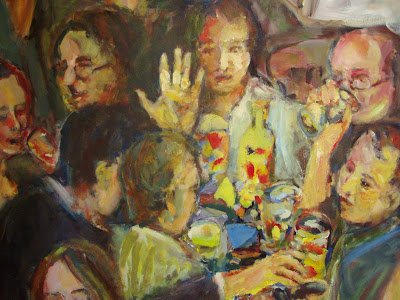
My Shirlie Guthrie painting


This painting is currently on display at the CTS bookstore and it is at such an angle that I didn't get a good picture. The top picture captures more the richness of the color and the bottom picture captures the sense of the composition. Guthrie was the latest in a line of theological personas to in habit Columbia. He studied under Barth and marks the passing of the old, conservative guard typified by Green and before him Thornwall and Girardeau, to a more modernist tack on theology. I was fortunate to have him in a couple of classes which he taught even though he was then an emeritus and needn't bother with new students. I had already been reading Barth when I came to Columbia, but in speaking with Shirlie, Barth's more important issues became imprinted on my mind. To me I have to remember that human beings trump ideology and that Jesus' concern was and continues to be with humanity and not the procrustean patterns of thought and answers that are continually brought up as universal solutions. And also, that in attending to the living word, Jesus, we realize our vocations and rediscover our vocations in our limits. Well that's certainly badly stated. Let me just say that theology has the possibility and recognizes the necessity for change. Before Barth (and Tillich, who I haven't studied very much at all) theology modeled itself on the definition of God in the Westminster catechism: infinite, eternal, immutable in all aspects of its being. And Reform theology was the apex of this perfection - especially Reform theology as voiced by Calvin through the scholastics like Turrentine and into the last century by Bavinck: the reiteration of God's eternal decree as trumping all human effort (and even any effort of God that might be contrary to God's eternal decree - some strains of calvinism actually worship the "eternal decree" and not the eternal decreer [but don't tell them that; it'll only upset them]). That's how I felt about the Reform theology I began with, Berkohf's: that it was an ultimate system that was very proud of its ultimacy. But that's the danger of any kind of scholastacism: that the system answers its questions (questions which are chosen to provide the opportunity for the very answers given) with finality and aplomb - all enemies being shown to be heretics, misguided, enemies of the faith, callow, calumnous, apostate, victims of illogic. Such a system can be wrapped around the soul for comfort - as long as there is no pain, or grief, or difficulty, or existential lack. The illusion of such a system is that one only needs Jesus for his salvific effects. Is it any wonder that this conservative Dutch reformed theology sanctions the worst evils of capitalism, and particularly the worst evils of racism, apartheid? But that is the beauty of worshiping the "eternal decree" and not the decreer: the power to steal and enslave and call it good comes from above - therefore my greed which issues in power and enslavement of you is God's perfect will. Barth repudiates all this. He points out the docetism inherent in such conservative theology and he goes back to scripture. He holds to the person of Jesus as the embodiment of scripture and exemplar of love in faithfulness, while claiming that we can not go beyond Jesus, that Jesus is more than a means of salvation, or that salvation is something separable from life in Christ, and therefore, costly discipleship. More importantly Barth says that we must be wary of imprisoning God in categories of omnipotence. That God's freedom is a freedom to limit and direct God's own activity, and that while the decree maybe eternal, it is at once working in real changeableness. That when the Old Testament speaks of God changing God's mind, that this metaphor is indicative of God's act qua act and not some play-act put on for human limitations. What Guthrie Got from this is the sense of theology has changeable: that the truth we have is a penultimate truth (which is a thought more prevalent in Brueggemann perhaps), and therefore theology is always discovering some new avenue for understanding God: feminism, liberation, process - these are all conversation partners in theology as a learning experience.
So my painting, with its deep green background and sky blue foreground, is the setting for a Lucien Freud take on the portrait: where threads of orange and blue and green weave together and knot into a likeness. It is a good enough likeness.

Sunday, May 27, 2007

fountain filled with hemoglobin

Rembrandt has a painting of Saskia (I think) wading into a stream and she's lifting her robe just like this. I've always loved this image and this is about the best that I can translate it into my own idiom at this time. Yes, the water is red, bloody. There are some wonderful cool violets that don't show up in this photo. I may have to shoot some details. In southern revivalist christianity we grow up in the cult of blood. We sing "his blood" "a fountain filled with blood" "power in the blood" et cetera. As a child I remember sitting in ill fitting clothes, in a sanctuary paneled in knotty pine, alongside my grand mother and grand father, myself drawing on the back of a pew envelope, as we broke up the turgid holiness of the prayers and loud exhortation of the sermon with hymns about blood. Somehow blood figured in why we were all dressed so much better than during the week. Somehow blood figured in why we were so stiff and formal, almost like we were afraid of ourselves. And blood figured in the sweat and the smell of sweat, sweat mingled with perfume and old spice. Blood and sweat and the acidity of our stomachs mingled in the air and rose as strange incense with our voices, through the heat of this compact frame structure, and later, as we stood on the sandy soil outside, it all lingered among the pines and oaks as the sun beat down on our heads. "This is holiness, " I told myself, at dinner with my grandparents after church "to sing about blood and then to take the long prayers and the screaming of the preacher away with us to this little catfish place out by the lake." And as I gnawed the fried cornmeal crust and skin off the bone, and ate the hush puppies, I was filled with holiness; I tasted holiness. And there on my plate the salty fries with the blood red ketchup greased upon the plate and napkin were soon reduced to crumbs and bone.

Two Views of CTS home


Above is a photo of how the seminary home in Lexington looked last Spring, and below is how it looked in the publication Colored Light, a book about the seminary's history published in the 1930s. Though the photo on the bottom is blurry, a product of my bad digital camera, you can make out architectural features and changes. The rear rooms are gone, as is the porch. And the chimney is different. It is the chimney, the fact that it is a central chimney that cinched this building and not some other as the building in the photo. Also there is a big placard on the building claiming that it is the seminary's home - but the building is in such delapidation that I found the placard beyond belief. It amazes me just how much a structure can endure before it collapses in a shambles. The soil underneath this building is 200 years old, as far as it being undisturbed soil. When this soil was covered over by flooring the Creek still dominated the area, or had only recently been removed. This is soil that last saw sunlight when Georgia was the frontier. If this building lasts another ten years in its current state I will be surprised.

Thursday, May 24, 2007

adoration

Louise, our cat, the one that loves Ocean Fish flavor more than life itself, who makes many different and strange ululations, is splayed out here, on the floor in our dining room, before my painting of a nude, pregnant, female Christ figure. Can it be that our cat is seeking release from the cycle of needs and wants that rules her life, the demands of napping and swatting at the other cats (her kitten pals in Christ), by developing her spiritual side?

At the habittat site in Budapest in Jan 2005

I have an idea for a further Harry Potter, and not in the vein of fan fiction, although any derivative work is liable to slip into that category. Something on the order of Harry Potter and the Sickness unto Death: wherein walks a more Kierkegaardian wizard, whose very use of magic fills him with despair and whose very evasion of magic fills him with despair. How can he be authentic? Who is he behind the mask of what he does? How is his interpretation of the world clouded by his projections of desire and fear? Can he comes to terms with otherness and limitations on apparent freedom?
If anything I suppose that it's fan fiction based on Walker Percy's The Movie Goer, although I might want to extend the story with elements from the Second Coming or the Last Gentleman.
Sample text:
"No sooner do I point my wand and incite the incantation, than despair floods my soul. Is there no other way to deal with this monster? And the monster's words of mockery - how typical, almost as typical as my action here. And I can't get away from it. I've tried and my search continues. But the pleasure of repetition and irony only garners me small reprieve. The very moment I believe that I am acting in freedom, I find that I''m constrained on all sides: obligations to friends, to the school and my teachers, even to my enemies - as I present myself as The Hero. I tried yoga, but that too is an evasion: the very lotus of despair."

Tuesday, May 22, 2007

Cleo from 5 to 7


Cleo is our shadow cat. She exists on a different plane from our three other cats. Cleo is not a slave to the dinner bowl, even when ocean fish is on the menu. She has maintained a lithe, supple exterior, reminiscent of a panther, prowling the jungle, springing from limb to limb, flying among the leaves of the upper canopy. She meows like a goat: mgnaoooooooaaaaaa! I've never heard a cat like this. It's a remarkable sound .
In the top photo Cleo is behind a curtain. She is atomized in air.
The second photo is Cleo re-enacting Man Ray's photo of Marquise Casati - note the doubling of the eyes.
The bottom photo is Cleo's normally intense expression as she creates her own reality through force of will.

more kitten pals

In honor of Thelma and Catelina (pictured above) and Louise and Cleocatra (not pictured now but later): this little ditty to the tune of the Tallis Canon

Which bird this is I think I know
It warbles in the bush below
It will not see me lurking here
Nor feint away a fatal blow

This fatal blow that might come soon
Is naught of kitten anger born
But more in keeping with my grasp
Of when to eat and when to mourn

I mourn this little helpless bird
Its motherless and plaintive cries
tug at my heart and give me pause
And with my paws a heavy sigh

This heavy sigh that fills my soul
Conforms to my ex'tential lot
In lieu of birds perhaps a vole
Will lapse into my cooking pot

Three blurry photos


My camera is capable of extreme out of focus effects. Here are three pictures I've taken over the last three years. At top is a photo of my homiletics professor, Anna Carter Florence (we were outside these baths in Budapest and we were waiting on the rest of our group to show up); in the middle is a photo from Troy Bronsink's ordination (I think Jami may be the figure in the background with the pink top and white skirt); and at bottom is Marc Quinn's marble statue on Trafalgar Square's fourth plinth of Alison Lapper, an armless pregnant woman he depicted nude (his rationale being that there is an underrepresentation of disabled people in art - a move on his part that I applaud. The BBC News quotes her as saying it was a tribute to "femininity, disability and motherhood.").
The blurred image provides us with mystery. A sharp focus image privileges our notion that we know what is going on in the space around us, and, by extension, in our souls. The blurred image questions our perception of space and calls into question our memory of events. Where the sharp image says, "here is definitive verifiable evidence, " the blurred image calls into question all attempts at certainty: what is solid is suddenly ephemeral, transitory, evanescent.
The blurred image is therefore more true, more existential, more open to reexamination. The sharp image is open to falsification: it is too easily emblematic of solidity and gives the viewer a false sense of certainty.

blurry photo of love

My digital camera takes some very blurry pictures. As autofocus becomes more automatic in the future, I will retain this camera for its ability to snap the shutter just after coming out of focus. Actually painting out of focus requires some work. Gerhard Richter, the most well known practitioner of this technique, achieves it, at least in the one case I've observed, by making horizontal striations through the still wet pigment. Out of focus representation is a 20th century phenomenon: until camera use became widespread there was no convention about seeing out of focuse. Unfocused seeing was wrong seeing and, even though 19th century photographers might have been conscious of it, they avoided it in their work for presentation. It could be that earlier users of the camera obscura also knew of this phenomenon, but they also avoided it: with perhaps the exception of Vermeer who used some out of focus effects such as sharp highlights and gauzy outlines. Steichen and Steigliez used soft focus in their early 20th century periodical, Camera Work: perhaps drawing on influence from Julia Cameron. Cameron is the earliest practitioner I can think of who left central aspects of her finished work unfocused. Medardo Rosso seems to use out of focus effects in his sculpture and he would be late 19th and early 20th century.
The first person to leave things flagrantly out of focus I can think of would be Man Ray and after him the surrealists. I should clarify that when I say out of focus I'm not referring to the phenomenon of blur. Blur is related and is common in photojournalism; I'm thinking of the blur we see in photos of the d-day invasion and in sporting events. Advances in technology have almost lost that effect for us. Advances in technology are almost returning us to the pre-modern visual convention where everything, even things far away, are in sharp focus with defined edges and recognizable details.
That said, I love the blurry woman pictured above very much.