Friday, October 09, 2009

a rumination on the notion of a master signifier and christianity


This morning I was reading Zizek's Parallax View and among many intriguing observations I came across his discussion of the master signifier and his assertion that such a signifier must be empty. The "nation" for instance is such a signifier in the way the concept is used. People talk about "the nation" as the rational for all kinds of behavior - but what do they mean? The master signifier must be always in the offing, never concrete, thus empty; and the reason is something I relate to Merleau Ponty's thought in the Phenominology of Perception: that the Other is transcendent to me up to the point where he speaks. Speech breaks the illusion of transcendence because then that person is just like me. And so the master signifier cannot speak ever - it must remain mute in order to have an effect or evince power. And what then is the master signifier of Christianity but Christ - between the burning bush and the Damascus Road there is a great silence - that is, for us, between the encounter with the law and the encounter with grace the Christian pivots on a necessarily empty, potential, space. And so Jesus is emptied by the believer (a phenominon we see in the church where people don't know what to say about Jesus, or Jesus is the sum of their projections, having no resemblance to the person depicted in the gospels) -What is the Christian experience: God is crucified, and thus the demand of the law is cancelled. And so we believe in an empty tomb, and we call this emptiness, this poetntial of resurrection or rebirth from death, Christ. At the Damascus Road God is reborn (a weaker but parallel rebirth would be the Emmaus Road and some other appearances - but these appearances fail to produce change, a new direction - the law is abbrogated, but people have nowhere to go - it remains for Paul to give them somewhere: the new creation). And this time instead of enjoining law, the new believer is ushered into grace.
This is Paul's discovery. This is perhaps why Paul's letters, big on the cross and what it accomplishes, are so abbreviated in painting any portrait of Jesus. Paul emphasizes the emptiness of Jesus when he says we no longer know him in the flesh but in the spirit. That is, any attempt to supply biographical content to Jesus as master signifier breaks the illusion of transcendence and robs the believer of the gift of grace. In all this Paul is not docetic - he retains the sense that God in Jesus became a man - but he empties out the actual life of that man. Jesus = 0. Marcion indeed did understand Paul, but Marcion's error is to suppose two Gods, an old one of violence and a new one of love, when what we have is the crucified law-God, the God that demands, reborn as the God of grace, the freedom-giving God who enjoins us to act "true to ourselves" in the phrase "what will you give in exchange for your soul."
The other meditation I had was a reflection on faith and works inspired by my cursory reading of Jean Luc Nancy. In considering what "my faith by my works" in James' letter might be, I inverted the Pauline/Lutheran concept "justification by faith alone without works" as "non-justified by non-faith alone." I applied an artistic prinicple of defining an object by its negative space - when I outline an object's negative space I should arrive at the same contours as if I had outlined its positive space. In this I saw that what non-justifies me is my non-faith. No work or no non-work non-justifies me. That is, the category of non-fiath has no works of sin. Sin, it seems, does not condem me. Sin as faith's opposite (where in Romans Paul says that what is not faith is sin) is put forth by Paul - but Paul does not speak of any classic "sin" as being that which non-justifies me. He doesn't say that people are non-justified by any action on their part (no matter how eggregious, perverse or outside the bounds). So I wonder if when we talk about justification by faith - and then talk about needing to quit sinning, if we're talking about two different things. Paul talks about entering the gift of grace via leaving non-justification by non-faith behind and moving into the category of justificaiton by faith and finding life - hence we are set free by the reborn God. Paul does not talk about entering this state in terms of "not sinning" - that term is the language of the dead God that we crucified. So we find life when we crucify the God of demands (the super ego, the big other, policeman) and in fact we must crucify this God so that God, when reborn, ushers us into a new life (our vocation) of grace and freedom. All this we have in Jesus - out of whose emptiness comes all abundance.

Thursday, October 08, 2009

water color


poetry magazine cover

When I don't like the cover for an issue of Poetry, I paint one I like. All my issues of poetry are amply illustrated with sumptuous pen and ink drawings and occasional water colors. I'm especially adept at integrating image and text.

4 years apart


The top drawing is from a work I did in the summer of 1978 and the bottom image is from a sketchbook I was working on in 1982.

skeleton play


The top drawing is a skeleton Annunciation I did last January durning a group meeting. You can see a skeleton fetus and, cropped out of my snapshot, a skeleton descending dove. I supposed I wanted to reify the incarnation, to describe it as an actual event, in terms of its concrete presence: there would be such armatures since metaphors don't have bones and structure.


waves, folds


Wednesday, October 07, 2009

rumination

I woke up this morning thinking, like every morning as far back as I can remember. I've been thinking of Barth's statement in CD III 3 about how are lives are bracketted by two events, birth and death, and it is these limitations that give us a history. Without ends we would have no story. I am born and have no consciousnous of before being born. I had no choice in that. I remember no felicity or torment. I appeared on the scene - things were already going on: the civil war had happened; immigration from Europe had happened; the Bible had all happened. I learned English in the American South among people who were upper working class/lower middle class; people with prejudices, weaknesses, and limitations about their own best interests - as well as good hearts, loyalty, and pragmatism with a sense of play.
And here I am, 49 years later. The old house is a used car lot; the old farm is a subdivision and day care center; the old south is now infused with diversity.
I am part of a human organism. An organism that began forming 6 million years ago; that began creating art 25000 years ago.
I am consciousness in matter and I can't say how it might be that matter is conscious. I can't say that a tree, though living, is conscious, or that a bird is conscious - the bird, like a dog or cat, is capable of attachment and recognition.
I am in ostensibly the same body I've always had - but it is not the same. My body has changed and grown with little input from my thoughts outside of exercise and diet.
The matter of my flesh and the matter of the air and the matter of this desk are all composed of energy in positive and negative charges, attracted and repelled, solid liquid and gas. Mathematically the room I'm in could be represented by a matrix of ones and zeroes. And how does this matrix change when I'm in the room and move around? Ones and zeroes are added and subtracted along a curve of time. Along that curve of time my consciousness expresses itself, and , as Merleau Ponty says, extrudes time behind.
My self itself is made up of conscious and unconscious. The unconscious does what it does, thinks what it thinks, with no prompting from my conscious. My conscous can only discover what is in the unconscious through projection and free association. If I repress anything, it is my ego's desire not to change that holds it secreted. Since I don't want to see this repressed thing, the unconscious plays about with it - perhaps the unconscious doesn't want it either.
What is the meaningfulness of life among these facts?
Am I being myself? Or am I lost in distractions?
Looking at a photo the other day, a photo of something I thought I remembered well, I was struck with how much was contrary to my memory. I thought, "life, reality is a Russian novel, and I've constructed a comic strip." Of course, the comic strip is now in the novel.
I think this is the thrust of some sayings of Christ: What will you give in exchange for your soul? for instance. Every day I feel that I've exchanged my soul for something. I once had a job that I felt absolutely ate away at my soul. When I was laid off, I felt that I'd recovered my soul, even though I'd lost my livelyhood. Another saying: If you lose your life you'll find it. Perhaps this is a contrast of the Life we find ourselves pursuing, wherein we ask ourselves, What are we doing? The life that after 30 years we ask ourselves, What happened? How did I get here? Did I just give this in exchange for my soul? What was it worth. And a final saying, Except a grain fall to the ground and die, it abides alone, but if it falls and dies it bears much fruit.
And that is the conundrum. We fight that feeling of being alone. We are part of a million year old organism, of which our part is maybe 70 years. In that 70 years we may have a few real connections. Perhaps 50 or more years with a lover, a spouse, a friend.
We abide alone, afraid to die, to give up our hold on what we think is life - a career, a social standing.
Whatever distracts us from who we are.
The question is How to have the career and social standing while at the same time being aware, living, relating.

Monday, October 05, 2009

a nearly perfect photo

I found this photo of my dad's mom, Granny Wise, and his sister, Mary, circa 1956. A photo I think dad took. The original has a smoother gray scale: that is, when I look at it I see so many different grays, more than in the typical photo. The tone and poses, the activities, all have a stasis, an equipoise that speaks to me. When I first saw it, I thought: the perfect photo. And I could be wrong, but some criteria. But to me, the balance, the solitude, the quiet implied here, were so compelling. It is not a flashy image. Nothing incredible is happening here. Just a mother and daughter preparing dinner. That table was still sitting in that kitchen 50 years later. The interior is not that different. There's now a fixture overhead, newer appliances and a sink in the corner in the back. But it's so very much the same. Well - now Granny Wise is staying with my dad and they're selling the house. Who lives in a house 60 years anymore?

Sunday, October 04, 2009

I'm turning my bible, like all my books, into an altered book


I'm drawing like mad in my Bible, which shouldn't surprise my friends. The bottom drawing is a favorite, Yahweh walking on the vault of heaven. Remember, the ancients, up through the early renaissance, believed that the earth was part of a physical reality that was within reach, that one place was reasonable placed near another - in many ways just the opposite of today's assortment of facts: we live on a rock covered with a thin atmosphere suspendend in space orbiting a sun incredibly distant from the stars, which are not intelligent celestial bodies but fussion reactions blazing away with immense gravitationally induced heat amid a cold, empty space. No gardens of the hesperdies, arcadia, golden lighted dances among the spheres, musically playing above the orbit of the moon. Even young earthers can't deny the facticity of where the earth is and how it's situation is uterly descrepent with the observation of scripture. Scripture's observation is all right with me, just like the Illiad's observation is - I'm not expecting scientific verification in ancient texts; I expect these texts to reflect the milleu they were written in. They operated with the best knowledge they had, which was direct observation. If anything, this shows the flaws in direct observation. The Holy Spirit could have been sending a zillion volts of knowledge into the minds of the yahwest and priestly source, and they would have still operated on the ancient paradigm - it's the way they had been wired through their experience and the absorbtion of common knowledge.
I still like the image though. Much like CS Lewis in his Discarded Image: God tromping around on the vault of heaven like an old man in the attic looking for some old photos; and how wonderful to think that the stars were celestial bodies filled with conscousness and intelligence, as we are but immortal and all knowing, influencing us with their various powers according to the time of our birth and time of day; that there needs be no Progress, because all is made perfectly right and decreed as such by the immutable decree of God, the unmoved mover who moves as he is beloved. It's nice to think that, but it doesn't reflect the facts. And so scripture doesn't reflect facts, as such, but retains an inerrancy, a very small 'i' inerrancy, as it exists in light of the life of Christ as revealed in our minds and sealed on our hearts by the holy spirit.
I'm having a great deal of fun with the song of solomon.


three cheers


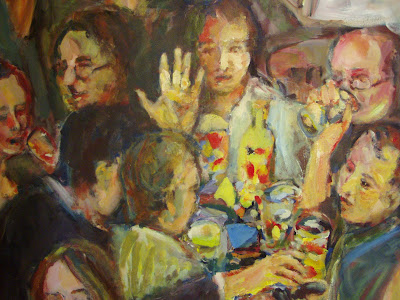
I've been drawing small pieces lately since I've run out of my standard 7 x 9 in meridian paper. I got a larger pad ordered through Amazon and I'm tearing the paper in two. Here I'm drawing in the margins of my Poetry magazine this recurring image of myself, Whitmanesque, pen in one hand, sometimes hoisting a brew, a stout, an ale, an ipa, in the environ of a bar, books handy, a plate with wings or pork sandwich half consumed. Such for me is an eschaton, the game on the TV. Perhaps Jami will come by or perhaps she's already here, and then all things are perfect. Outside on the street it's still sunny, perhaps mid summer. Maybe Bob will come by and play shuffle board.

from beginning to end


I dont' have any photos available here of Mattie Fay between 1932 and 1986, but I do have these two photos from the final 15 years of her life. In the top photo, she'd been at the nursing home for some months, having had strokes and experiencing dementia. I don't know what to call it. I remember her once saying that she felt like her head was in a knot. Eventually who she was didn't resemble anyone we'd known. We would visit but each visit felt odd, as if we were talking with a child or a stranger.

Early images of my grandmother, Mattie Fay, her family and my grandfather


The bottom photo, which must be Mattie Fay at her father's funeral in 1918, is so evocative of the 19th century South: the mule, the bonnet, taking a photo in a graveyard - who does that? And then the photos of her with her mom and siblings, alone on the school grounds that was in the mill town her family moved to. And the top photo, my grandfather courting her, in the graveyard next to his daddy's farm. I like how this set is bracketed by two graveyard photos. These photos as well are source photos for the Working on the Rail Road chapbook. My grandmother, for some reason, comes to mind when I hear the song Little Maggie. A song that seems out of character for my teatotaling, church going, grandmother. But then, as she told me, she and my grandfather lived a much rougher life when they first married.


The cover to I've been working on the rail road

It's on a much larger piece of paper, 10 x 12 or something like that. Meanwhile I continue to expand this theme. I think it is tied into my lifelong frustration with not being heard. I don't get the sense that anyone listens to me: outside of Jami and a few friends. Perhaps you [whoever might be reading this, if anyone] too have had to struggle to insert an observation only to have the conversation continue like nothing was said. Certainly there's a question of relevancy. I ask Am I relevant. Sometimes it's true I'm not. Certainly there's that verse in James that counsels us to be slow to speak and quick to listen.
And I've lived a passive life - because of this? I don't know. I could stand to be more aggressive, more assertive. And I work on that. I work on that understanding aggressive not as ranting or being thoughtless. But standing up for myself. I find that I don't often enough. Defering to others is not my problem. Speaking up for myself is.
I see other people who are good at it.
I wonder what that's like.
In the song, working on the rail road, someone asks for Dinah to blow her horn - which Dinah never does. No one hears the watchman or captain calling - all the livelong day. Do we really hear the whistle blowing? Is it too early in the morning? Meanwhile time passes away. And what is a rail road but two parallel lines disappearing on an horizon - two lines that lead forward, not backward, in time, to a vanishing point, oblivion, the eschaton. Does anyone listen to the singer's warning. Are they caught up, strumming on the old banjo. Dinah trapped in the kitchen [an early feminist critique: women could help if they weren't trapped in the kitchen] by someone - the super ego, the big other. Dinah is a huntress and her skills are being wasted by this someone. The trumpet, the horn, to be blown is the 7th seal, the final blow. The banjo, an instrument of African import, also slaves away, strummed upon, a sturm and drang, and so the Hegelian master/slave dialectic comes to the fore. The eschaton, the millenial kingdom on earth is delayed by human preoccupations with power dynamics.
In the end working on the rail road is a diversion from creativity, a cul de sac, much as my father experienced. A necessity, certainly: food, clothing, housing - such needs, but the humanistic needs, the existential need, goes unmet.
I remember the old commercial "who needs america's rail roads? We do!" which played when I was very young. But do we need this?

Saturday, October 03, 2009

WotRR image 14 and a source image


WotRR images 9-11, 13


WotRR images 4-8


Things develop and morph. By image 8 I'm letting lines go and not worrying over surface details. I'm more concerned with composition and creating a sense of freedom and energy. Lately I've been thinking about how, because of childhood trauma, I have lived what I call a disembodied life. I noticed this in Chicago, walking through the Art Institute, and then it hit me looking at the Gustons and the Twomblys - that what I'm looking for lies in the direction of putting out myself in the image. That on the one hand my super ego constrains and inhibits me toward a sense of mimesis and need for precedent - while on the other hand my id and libido demand gratification. What gets lost in this dialectic is what makes the work mine. Jung would probably put the conflict between my shadow and my persona - a dialectic that avoids integration in a self because the persona and shadow aren't directly engaged with the ego. Deleuze might talk about how I judge too much and should concentrate on bringing into existence - take whatever I find and connect it to whatever comes. There's value in all these viewpoints - all lead to a sense of freedom with materials on a surface corresponding with a freedom inside me.

I've been working on the rail road images 1-4


The first four drawings in my series of "I've been working on the rail road", a song I sing a lot lately, perhaps for it's simplicity. I alter the melody, this morning for instance singing it altered to the tune of U2's Bloody Sunday. I change the verses around and language, singing the song backwards: The banjo strums in kitchen all alone/ Dinah blows her horn to pass the time/ The watchman rails upon the road I've worked/ all day along. When I take the principle of unreliable narrator to the song, mysteries are opened up. What events does this song chronicle? Is it a veiled reference to a Pinkerton union busting activity, a miners' strike?
How do we account for Dinah's reluctance to blow the horn? That she must be asked repeatedly. Who is this person in the kitchen with her? Is there a person at all, or do we merely suspect? And the banjo strumming. An old banjo and not a new one? Does a person really work on the rail road just to pass the time away? All day long? Early in the morning?
In the second drawing from the top, you can see the banjo player's foot on a bit of rail. The only real reference visually to rail roads in any of the series.
I'm also confused about whether a watchman or a captain shouts for Dinah to blow her horn. This song has been around since I was small, singing it in 2nd grade. Yet it's not the classic that Little Maggie is (another song that as I have worked on this series has settled in; another song that has two sets of lyrics, and I wonder in the end of the song, What is this image of her on the banks of the ocean with a 45 strapped around her and a baby?)
I've been working on the rail road is almost as banal song a Polly Waddle Doodle all Day - which opens The Wild Bunch. Still while that song defies decoding, Working on the Rail Road invites it. And so: I have the dialectice of the chess match: a reference to Jung's notion that the unconscious and conscious exist in a dialectic. The characters around them are not distractions but archetypes, symbols indicating an unknown goal - as Jung also said.

Here's a typical frontpiece


Part of my series "I've been working on the railroad" - a series where I repeat the central theme objects: chess players, cat, banjo, trumpet, minister with raised hands. Through repition things change. I relate this development to Berryman's Dream Songs.

Marginalia from my copies of Poetry Magazine


One thing I enjoy about Poetry, besides the fact that it consists of poetry, is that the paper is conducive to a type of line, having a good tooth and not slick, and that the white space provided by the format of poems allows for some fun integration of image and text. For me it's practice. Sometimes I find that I do some images that I wish I had done on more artistic paper, higher rag content, more seperable, more presentable. Still I'm content with the volumes, which, when money runs low for purchase of more paper, serves twin functions: material to read and space to draw upon.