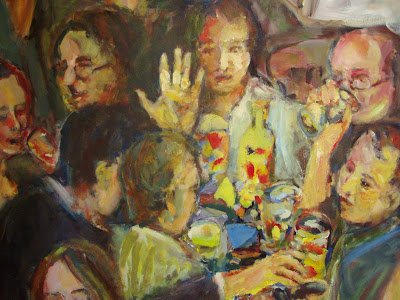
Tuesday, December 04, 2007

The CSX rolls through Decatur


I have always loved trains. Some of my first memories drawing were of endlessly figuring the curve of tracks around a bend with curly plumes of smoke. I believed the only real trains were the old steam locomotives; diesels turned me off: where was the romance? The opening credits to Petticoat Junction thrilled me with the smokestack puffing along the rails. At that age I thought nothing about the health issue of people swimming in the water tank. As I grew up I rode trains at theme parks, where fake soldiers and card sharks played out "19th century class struggle scenarios in some locale dissonant with even the slightest historical connection to the purported events" - as I reported in one eighth grade essay on what I did over the summer. Jami and I both have photos of our sojourns in these parks: Maggie Valley and Panama City and I have memories of this happening at Stone Mountain - an unlikely confederate vs yankee shoot out. What would have made sense might have been a KKK vs FBI shoot out - being Stone Mountain and all. When I think about it I am amazed at how much of the history I encountered was reified, preinterpreted, homogenized, and packaged for consumption. Amazing too is that these are the criteria for deconstruction - that is, these states of affairs make deconstruction necessary. When I hear people decry deconstruction for removing certainty from the text, I am reminded of instances where the last thing a text needed was certainty, a stamp of approval, because to give such approval would be to participate in a lie. So let us deconstruct away.
And hence, as I've grown up, I have become less fond of the steam locomotive - at least the old conical smokestack, bilging smoke, while laboriously chugging, chased by Indians, wild bunches, desperadoes, soldiers, and other trains, while gentlemen with derringers jumped from car to car. There is something to be said for the sleek, art deco, streamlined engines of the 20th century, smashing their way across the Scottish moors or the Canadian shield.
I remember when my dad began work at Southern Freight and Tariff Bureau (later called Railroad Publications and referred to as Southern Frightened Giraffe Bureau by those who worked there), when there was still passenger service: how excited I was about the possibility for a family trip on a train. But we never went. Shortly after dad took the job, passenger service was discontinued. The old stations in Covington and surrounding counties became derelict, only decades later being reborn as restaurants. Old tracks have been torn up and the right-of-way has reverted to nature. And now I love these old diesels. When I lived out in New Mexico and I drove between Roswell, NM and Lubbock, TX a lot, I would come up alongside trains or come upon trains, as the road often paralleled the tracks: great long trains traveling fast and I could feel the energy come up through the ground.
Now when I work in my studio trains are just outside my door. Here I've stopped to stand near the edge of the tracks to capture the passage of a freight train from the crossing at Chandler Road past the Carpe Diem restraunt. When the light filled up the lens it took my breath away. I had to check and make sure that I was a good ten feet off the rails. And there was one shot of exactly that, which the shutter didn't cooperate on: the light filing up the lens. And how do you take a shot of thunder? Painting sound is a real challenge. I want to paint thunder.

Sunday, December 02, 2007

psychiatric action figures

It seems unlikely that Jami's step dad would have psychiatric figurines: but here's a guy on a couch talking with a bearded guy writing. When I saw this I immediately thought of Freud burrowing into the substance of people's dreams. What if this was an early session where Freud and Jung analyzed each other. Perhaps this is right before Jung made Freud faint. But what is the guy on the couch holding? It seemed to be a musical text of some sort. I was also nonplussed by Freud writing with a quill pen.
Last year I bought an action figure of Van Gogh, which I left in its case. He came with five canvases and a french easel. A french easel is one of those things that fold up into a box and which can be set up outside. It's called a french easel because the english easel requires helpful badgers, an eagle and a donkey that is lost, away from home, on an epic journey of discovery and valor that will test their loyalty and prove their friendship. I think that's more the CS Lewis or Beatrix Potter easel.
Today in church I was scanning the hymnal and came across the hymn "there's a wideness in God's mercy" which I always read as "a wildness in God's mercy". It makes more sense to me that God's mercy is wild than that it be wide. Wideness goes without saying and the fact of it being wide is not interesting to me, not as interesting as that that mercy is wild. God's mercy is untamed, untrammeled, pristine in a natural state. God's mercy sneaks up on you, overflows its boundaries, floods, grows over, blows through. Who knows when God's mercy will bump into you. Wild!
More disturbing is the hymn misreading "while shepherds washed their flocks by night." I can see this as an action figure though: it's not surprising that ancient shepherds washed sheep at night, bonfires blazing, buckets filling troughs. All this time the cattle are lowing, sometimes hitting a C below the staff, and the deer baby sleeps - how does he sleep? Fawningly.
But the little lord Jesus, no crying he makes? Give me a break. Tell me he bawled like a baby. I'm tired of these docetic Christmas hymns. What isn't assumed isn't saved, as the ancient adage goes, and it's important for the incarnation and all that follows from it, that Jesus be typical in terms of feeling and needs.
A friend of mine is sermonizing on Acts 17 - the episode where Paul preaches in Athens. Metzger's textual commentary indicates a great textual variety in this section. The passage begins with Paul being left in Athens where he's disturbed by the profusion of idols. It seemed odd to me that he was disturbed about that: certainly idols are all over the place in that world. It may be the display and splendor of those idols that disturbed Paul. Acts is an interesting book. I think that it only vaguely reflects Paul's actual activity and personality: a memory, a trace, used for a history based on the epic form, like the Aneid and others of that time. Paul is presented as a type and acts according to the rules of honor and shame. Whereas in the letters, Paul is keenly aware of these rules and pictures himself as someone who has no ostensible honor. I'm sure that there are areas where my conjecture can be criticized: sections of letters where Paul is concerned with how his honor is perceived or passages in Acts where Paul acts without recourse to how he's perceived. I think that the preponderance of instances points to a Paul who in his letters works to subvert the honor/shame system of the ancient world, while the Paul of Acts doesn't exhibit that subversive program. The most interesting Paul of course is the one shacking up with Thecla in Spain - essentially the Paul of my imagination. The girl baptized a lion right after she baptized herself (in the only instance of baptizomai in the middle voice in koine literature) in front of friends and family at the Roman equivalent of NASCAR.
Paul and Thecla action figures would be great - accompanied by that lion. Their child, called in utero Pauline, with her full name, Pauline Theologie.

Saturday, December 01, 2007

Now December


Almost 11 months ago Jami and I were in London, on our honeymoon, and we had a wonderful time. I can't wait to go back. I can't wait to walk with Jami along the south bank of the Thames again, visiting the Courtauld and National Gallery, exploring more places, venturing further afield. Sure its cold and wet, especially in January. But cold and wet is part of the ambiance in London. Here's a photo of Nelson's pillar: it's admirable. Nelson had it made as a door stop to a country cottage he planned to retire to. The cottage itself was only partially built when Nelson sailed away for the last time. Some say that he never died but is frozen in a block of artic ice, still living, where he guides the course of the British empire through telepathy and has set up a pen pal correspondence with King Arthur and Charlie Chaplin. Legend says that when Nelson is thawed out he'll return to England, and a new age will dawn, where he'll finish building his cottage.
Speaking of returns from "Death's dream kingdom" and "Death's other kingdom", Jami took three hours Saturday to sit in Duke Chapel in order to hear the Messiah and he never showed up. I say "he" never showed up, but of course, Christ could return as a woman. If he returned as the girl in the Golden Compass that would freak everybody out. I'm all for freaking people out when they're so grounded in their expectations that they're writing God's script for Her; what are the Sinister Derriere books but an attempt to write God's script. Traditionally God takes a pranksterish view to these prewritten scripts, and so Christ coming back as a 12 year old girl and sitting on St Peter's throne shouldn't surprise us: people who are accustomed by the media to seeing only people in expensive suits, who travel with large entourages and security details, as emblematic of power, as worthy of making the 'big' decisions - as if only these people are the only ones worth listening to. Yet it's these people, educated in the world's best schools, who've got the world in such a bad place. How far are we from the monkeys banging femurs in front of a black obelisk, despite all our culture and technology, when our propensity to solve problems through violence is near indistinguishable from early primates.?
Nelson, come back and finish your cottage.

Friday, November 30, 2007

See the tree how big it's grown

This is the oak I planted from an acorn dropped by an oak growing in my grand parents' yard ca. 1965. I remember scooping a bunch of acorns into a Swisher Sweet cigar box and scattering the acorns all around our front and back yard. This oak survived, thrived and grew. The Japanese maples mom planted are gone (mom always planted Japanese maples), but this tree remains. I'm as surprised as anyone. I know that one day it will be cut down, but so far, even though it takes up the space of two or three cars, free market principles haven't brought about its demise. I didn't plant it per se: as I remarked I scattered it around, purely by chance, and this tree is the product of that chance. Chance is the foundation of my art. Well, ever since I was in high school I've found chance based art liberating. Duchamp, Cage, Klee, Pollock - all used chance elements in various constructive ways.

Today a death occurred in the emergency department. A man who'd had a gastric bypass (and he's not the only person to die after this procedure recently) passed out at home and was brought back to the ER where he died when something happened to stop his heart. His wife and sister were distraught. Their church is one of those charismatic churches that emphasize healing and miracles - that God commands us to command him and that our words, our confession brings about reality. The wife looks at me and says, "he's still warm. We can bring him back. There are miracles. You do believe in miracles!" It dawns on me, she expects me to act like I can bring him back from the dead. She expects me to begin praying demanding God to make this man live. And I'm stunned. I say nothing at first only to flatly say that yes, I believe in miracles. Inside I'm thinking, "if I bring this guy back, I'll have to bring everyone back." Once you bring someone back from the dead everyone will demand, will feel entitled - they'll say, "you brought him back, what about my husband? Doesn't my husband deserve to come back? Why isn't my husband good enough?" And then family, "you brought a stranger back, why not aunt Mildred? Isn't she as deserving as some stranger?" Then people are knocking on the door at 2 am: all demanding that someone be brought back to life. Once you start bringing people back from the dead you can kiss a ski vacation to Wyoming good bye - and I want to go to Wyoming: we're going this New Years - and I'm not sacrificing time with my wife and in-laws to raise some guy from the dead, because that's not the end of it. Then people are crashing their cars into trees and trains, once twice thrice - fifty times and more: why not, "Fred'll bring em back." And then the whole country is a Christian zombie nation, people dying and popping back up every day. And then when I die, what about me - no one's bringing me back. The Christian zombies won't care; they won't try.
Also I looked at this guy and I thought, "Jesus died. Jesus was deader than this guy, stone cold non-heart pumping, non-lung expanding, non-circulatory brain dead dead. Jesus was deaddeaddead. And to just willy nilly raise someone up who's still warm seems to dishonor the Lord's death. Death was good enough for Jesus. Death freaks us out; but it didn't freak him out. he was content to be in God's hands - even a God whom he'd felt had forsaken him. "
I'm not looking forward to death. More than ever I value life and want to keep on living; and I would be crushed if I lost Jami. I remember my mom's death, and my grand father's death, and my grand mother's death, and so many others. They all affected me but not the same way. I cried, I felt empty, I was relieved.
Faith to me is more real when it lives without moving mountains. Real faith lives in the fact: the death, the loss, the disappointment. Real faith finds joy when all is down - not a fake joy, pretending. There's something about the kind of faith that exercises the miraculous to engineer my wishes and desires when I wish and desire them that seems like a stupid faith, a dull brained dim watery faith - such a faith denies the pain, the suffering.
But who doesn't want quick results. We live in a culture of results. The free market ideology is about results and immediacies - no waiting, no long term - maximize gains, and productivity is the bottom line, a bottom line that justifies everything. There's no room for death. Death is a luxury, an inconvenience, laziness. Death is nonproductive. Death says there's something more than the bottom line. Imagine a Bergman film, the pointing bony finger of death - but imagine death being shocked at the laughing feasting figure of Jesus. And that is our faith: death sits down at the table with us, but only as a guest, only to pass the salt.

Thursday, November 29, 2007

Happy anniversary


Friday November 30th is our eleventh month anniversary. I am in wonder at this beautiful woman.

the passage of time


These two photographs are taken in approximately the same spot: Salem Rd in Newton County. When I was two we moved to this house and lived there until I was 12. The top photo was taken in 1964, note the old frame house across the road. We lived in a ranch house that I will post a photograph of later - but it looked like a typical red brick ranch house. That ranch house is still there, though painted white now, and the office of a used car lot for the last 20 years. The yard is paved, except for this oak tree I'm standing under as I take the bottom photo. 39 years ago I planted this oak tree from an acorn that I gathered from underneath an oak that grew in my grandparent's yard.
Just last year the cow pasture that had been across the road was sold and developed, all with astonishing speed. Now there's a Kroger. Three months ago I noticed a stop light, right where we used to live. And this time a road has been graded and paved.
This Thanksgiving Jami and I, on the way to see dad and granny Wise, stopped at the neighboring Shell station and I walked over into this yard, this parking lot, and stood in a spot that I hadn't stood in since I was 12, since this oak tree was a slender sapling verging into a mere ability to provide shade. I stood there and took a photograph approximate to the slide my dad took 40 some years ago. That yard was small. How did we fit here? How did it take so long to mow this lawn? How did I get lost in woods as small as a strip mall and a gas station?
More of my youth is erased. My great grandfather's farm, a quarter of a mile down the road, is now under a subdivision and day care center. This whole road, once an obscure country road with two stop signs along 8 miles south of I-20, where very few cars drove on any given day, is now crowded with traffic even at night, houses abound and stores - a McDonald's even across from my great grandfather's old home, and another McDonald's at the interstate.
Now I am resigned to change. When I was a young child my mother read me a story about a house in the country: in image after image a village and then a town and then a city grew around the house, until the house was surrounded by tall buildings. I was fascinated by this progression. I listened to this story over and over. I devised maps as I grew older where I imagined the growth of settlements into cities. I poured over diagrams of progress. Birth growth and deterioration and rebirth fascinated me. The little house in the story is eventually moved out into the country.
What did I feel while I stood on this piece of ground? Not a revelation. Not a recapitulation. A repetition? Maybe the sense that whatever was there for me is no longer there. I can never go back to some simpler time or some time before, some time where a deep mystery might be discerned in its inception. I'm a 47 year old man standing under an oak tree in a small patch of asphalt surrounded by used cars taking a photo of an intersection. Before I was here, even as a 12 year old, there was a dirt road, a dirt road that curved and twisted in different ways, that wasn't straight, and oddly fewer trees punctuating cotton fields. And even further back was there a road or even a path? Indians. Buffalo - Buffalo roamed throughout the eastern seaboard. Perhaps I can find the small road again - but not here.
Once Jami and I went to a small church way out in the country. It was spring and the scene was bucolic. The church was on a hill, overlooking granite escarpments scattered among pasture land. Picturesque. We thought, " how can we get here?" But even there, development was not far away - just over the hill and down the road.
Is it possible, like the small house in the story my mom read to me, to be returned to our beginnings, back into a place of nature's abundance and purity. Isn't this the human desire to return to the garden? If only we can find the way back to Eden, past the fiery sword brandishing angel, through the over grown gates, into a forgotten paradise? Revelation itself ends the human story not back in the garden but in a city. But any garden we might end in is not the original garden. That garden has been traced and erased many times. Like our memories the facts change and are transformed: we discover that the north facing window really faced east; the well house was wooden and not brick; the tree was pine and not ceder. Places we remember so clearly turn out to have never existed; things we don't remember, we did.
When I stand here, what am I remembering - even more so, what am I forgetting? My dad remembers that when I was 12 or younger, that I pestered him no end to go to a stunt car show at the Lakewood fairgrounds. I have no memory of this. Even having my memory jostled, I can not conjure a vague trace of a memory. I have absolutely forgotten something I desired with all my pre-adolescent heart.
The Bible is an artifact of things we've forgotten. We have here narratives recorded - but also narratives lost. The history of the Church is a history of remembering and forgetting - but remembering and forgetting imperfectly.
In the Scottish nudist camp, people are off kilter. I'm sure that pun's been made before. I thought about that this afternoon, as I sat in CPE, and I wrote it down, so I wouldn't forget it. I've thought of better puns, puns that I have failed to record, and now these gems of wordplay are lost to history.
The world is full of things forgotten. Great paintings are now lost. Vermeer painted more than 42 paintings. A van Eyck nude with mirrors, the pendant to the Arnolfini Marriage, was lost at sea. Rembrandt's only sea scape has been lost in a robbery in Boston. We have no way of knowing what the music of the Romans sounded like. Ancient writings are lost to us. What is Beowulf but the popular literature of its day - and what is lost to us from then: more stories of Grendel? different monsters, different heroes.
Under such an oak on such a bit of asphalt did once a child weld a plastic sword in a last ditch confederate stand against the Saxon invaders, saving Guinevere from the dragon, so that Lincoln might drink from the Grail and king Arthur might walk on the Moon. My parents stood in wonder at their sleep walking son under the moonlight. Why did we buy him that sword?

Wednesday, November 28, 2007

Moving into the new place

We have a new place. Jami found us an apartment surrounded by Duke Forest. The apartment is as big as our house, but it is laid out differently - in our house (which we're selling) you can get to any room via a central hallway (almost a circular layout); the apartment is laid out linearly - you have to walk back through the living room to get to the bedroom or study. I like the apartment. It is surrounded by quiet woodlands. As Jami said: there are no buses and cars and people. But we do miss being three blocks down from our church. It's unlikely that we'll find a church like Oakhurst in Durham. We like living in a neighborhood near stores and parks, but we'll try this for a while.
Of course I couldn't stay up there (not yet). I drove back to Atlanta to return the rental car. I drove in the rain all the way. All the way I listened to satellite radio's NPR and BBCAmerica stations. There's something comforting about listening to people have reasoned conversations as I drive. I remember when I lived in New Mexico: I would be driving at night, 90 miles between towns and absolutely nothing in between, and listening to people have conversations about aliens and paraphenomina. I know that that doesn't sound reasonable - but this was reasonable for New Mexico, and it was entertaining. CS Lewis once remarked about Charles Williams (a Christian writer of occult romances) that you sometimes forget about how peculiar another human being can be underneath appearances of respectability. Hearing people talk about anal probes and ESP, normal people, people who if you saw them on the street you'd say, "there's a normal person, clean cut, well dressed, not over eating and exercising, probably possessed of moderate political opinions and believing that Church shouldn't interfere in the state and vice versa," gives me insight into the the weirdness that is humanity. Take any person, no matter how rationalistic they might seem, and at some point, I believe that you'll find the numinous center, that place that they may not admit to themselves (much less anyone else), but a place of unfounded belief - that is belief that relies on personal experience, is unverifiable and non-duplicable, but is nevertheless a belief in something other, something strange, something unknowable. For some people this center is nearer the surface; for some people this center pokes out. This center doesn't necessarily express itself in religion. Religion may cloak this center in fact - especially where religion is considered a social norm.
I find drives such as this, 370 miles, SUV chugging along at 19 mpg, with a mild drizzle to light rain, to be wonderful for thinking, conducive to the creative juices; indeed, the car becomes my monastic cell, a vehicle of prayer and meditation. The broken white lines become the beads of a rosary. Each intersection is a cross.
I made it back to Atlanta, dropped off the car, and took MARTA back to Decatur. I'm back in our now catless near empty house and I can't wait until I'm able to make it back to Durham - the place that I increasingly feel like is home, the place where the most wonderful woman in the world lives.

Tuesday, November 27, 2007

Reading Rabelais


What have I been doing all this time? A few months ago I did almost three posts a day; now I'm closing in on three posts a month. Can it be that the rigors of chaplaincy, moving, painting, scheduling, cooking, devising intricate anecdotes salutary for humor and incisiveness have held me back from developing further my time folded upon blog blog blogging bloggidly? Can it be such a state of affairs that ensues and entails rigors and chaplaincy and chaplincy - and the Champlain See - take so much from me that when the time comes to write, I writhe.
Several times in the last few weeks I've had conversations where Jami or Bob or Cheryl or some one will say, "see here, this conversation we're having right now here now - this is what you need to be writing in your blog, this is what you need to be blogging." And I won't have time. I'll sit down to write and sleep, with its needs and demands, its soothing promise of eyes closed and warm covers and deep dreams, dreams of lands of warm dreams and oceans of sleep, or rest, will converge on me and remove me from this task, this writing task.
I think something similar happened to the Apostle Paul, when he was living in Spain, the lovely Thecla at his side, as he looked out over his vineyards, and read Horace, while sitting under a cork tree, while he composed songs and taught his sons Latin and Greek and the stories of his Greco-Hebrew childhood, that things just slipped his mind. He didn't write further letters telling believers to not dis the leadership of women; to not get carried away by end time predictions, but instead do some good in the here and now.
What a time to have lived. Still I would not depart this present moment to live there and then - no matter how many questions might be answered - and all sorts of form critical and redactional and canonical questions abound. But at some point the past has nothing for us. What is past is so far removed from our concerns that our will, much less our emotional strength, is lacking. We are eventually thrown back to the present, and as Ecclesiastes counseled: living in the present is our appointed task - not piling resources away for the future, nor pining away for a golden age. In the present we meet all our pertinent challenges. About each moment of the present we can only ask: Am I savoring enough of this? Am I seeing clearly? Am I drinking fully and recognizing the content of the air - such that were I to breathe it again, I would know it and relish it? am I l0ving fully or do I love absentmindedly?

Monday, November 12, 2007

Cary speaking

Cary, pictured above, who delivered the sermon for my ordination, ministers at Mountain Brook PCUSA in B'ham (the official name of the city in 50 years when the next great vowel shift in the language occurs - where English fractures into ten dialects and today's American Standard English is used mostly for official documents, reminiscent of the Church's use of Latin in Italy ca 1500). Cary preached a sermon where he used the story of the Monkey God and the Buddha. I told Shannon (who came and sang) that Cary had piqued my interest in this Monkey God and that I'd like to investigate this Monkey God some more.
Let's be clear about one thing: monkeys are not chimpanzees. I was looking at my notes from when I did my internship at Mountain Brook supervised by Cary 3 summers ago and a man who grew up among missionaries in India and worked with primates was very emphatic that chimps and monkeys are two different species. But a monkey is a primate: just like the Pope is the primate of the Roman Church. I love the fact that primate signifies such diverse things: what if one day a monkey might be elected Pope or perhaps the Curia might be sighted swinging from vines and grooming each other clean from lice and fleas. Ahh Monkey God, you'll always be, one sweet primate to me.
And what is a primate. Primate stands for first or perhaps final; then penultiMate should stand for second or as a prelude to the end. There could be postmates, trimates, quadromates - a regular mating ritual. Middlemate would be that that stands (or sits or reclines) in the middle, media res - in the media resting, wresting.
So if the Monkey God meets the Buddha coming through the rye - as opposed to the road where the Buddha must be killed, which seems harsh - but instead meets coming through the rye, which could be a great teen coming of age story, a picaresque, a gambol, a rollicking thrill ride for the summer like a Separate Peace: say the Monkey God goes to college and rooms with the Buddha, but the Buddha runs out of deferments and gets drafted and the Monkey God helps him escape to Canada, and they gin their way rye vermouth, and coming upon a camp of gypsies or counter culture communitarians or prophylactic presbyterians (it could happen: check back to my comment on Dan's comment on Gaye's comment on Jami's comment on my ordination paragraph where I talk about zombie presbyterians: it could happen); but this Monkey God and Buddha and the hippies or dead heads or simple farming folk create a utopian society only to have the cutlery division still running after 100 years (think about it: Oneida cutlery was the going concern of a utopian community dedicated to open marriage and educational and societal experimentation - but no one thinks about that when they're cutting their steak).
I think the Monkey God is the last best hope for America. We've aped sentient creatures long enough.

Saturday, November 10, 2007

Writing


Pop in fresh, dough boy, said the Germans on the other side of no-man's land, trenchantly. Enough of your tankless onsluaghts, we treaded carefully, around the subject, the subjective and the subjunctive. Or might would could've'd, co-ordinate Claus and subordinate Claus at Christmas time, a gift of speeches and cream, pyre are squared, rounded hedged and lopped sided.
We left the dough boy behind, but the painting, which I did in the Spring of 2006, is in our house and will soon be moved to Durham, where the most beautiful woman in the world resides. It's an expressionist landscape. Why don't I do more of them? My hope is that eventually I will do paintings as thick and indecipherable as Auerbach or Kiefer or de Kooning.
How I wish that I were in Durham right now, even as Jami is concocting vichyssoise of indescribable richness and warmth.

Monday, November 05, 2007

And now I'm ordained

On Sunday I was ordained to the ministry of word and sacrament. A host of people were involved: Billy and Dan came from my home church in Covington; Nibs and Caroline and Suzette from the church here at Oakhurst; Lou from Memorial Drive; Cousin Cheryl from Fellowship; Joe from Twain's aka Good Shepherd; and driving from Birmingham in atrocious traffic - Shannon to sing and Cary to preach. It was a good commission. In the service I was especially proud of paraphrasing the last few verses of Psalm 100 to make a reference to Bakhtin's discussion of time and space: human cosmogony conforming to hierarchal space in the middle ages, and to leveled out time in the Renaissance. That is: the house in which humanity finds itself is hierarchal, everyone has his or her place with no hope of going up or down - except in so far as they are subject to fortune or live in destiny; when the Renaissance comes, this hierarchal spatial home is exploded and out of its ashes is built a cosmogony built on time, a home where humans move up and down in freedom [albeit limited freedom understood as autonomy; whereas the medieval freedom might be understood as living in one's space modeling the virtue of contentment], but where people experience themselves as not moving up and down but back and forward. Hence time is a leveler: anyone can light anywhere, regardless of birth. So I wrote that God "our Creator, Judge and Defender is steadfast in goodness and mercy, the same throughout all time and in all places." How many people will have spotted Bakhtin's reference to Pico della Mirandola? A whiff of neoplatonism perhaps. But it is the remnant of my desire to create a carnivalesque worship service. There was no grotesque and no visceral laughter - well maybe a little, as I stepped on Billy's lines as he was asking me the 9 questions: "whoever in our company be dined, must answer me these questions nine."
Afterwards a group of us went to Twain's. We drank pints and ate fish and chips. Shannon called our friend Karl who recounted ribald tales of ordinations past and various legends, which refreshed us with their grotequeness and laughter. It turned out to be a carnivalesque evening after all: what with the feasting, the ribaldry, the grotesquery and laughter.

Thursday, November 01, 2007

It's November now

It's November now - Fall, the season where we celebrate the Autumn of humanity, where Adam and Eve, disAbled raised Cain. Enoch already they flooded, Aunty Deluvianne, arc de triomphefetted their babble, and ur-Urian unmenschenables adequate sacrifices of gout, frankenstein and merv. It came about in those days, along the river Euphrates, **** said "lights" and divided the lithe from the awkwardly moving amphibious landing goal tendering tofu wabohuites of Kenosha, Wisk Cosine. Sines and nomine worked wonders and all the saints weened hollow days and pumped full knights, rooked and bishop pricked fungible goods and evens, getting. And then arose a pharaoh that knew not where the remote was, not the remotest idea, and **** spoke to Moscowitz burning brush saying, "go tell that that that that that that," and so it was, and came to pass, and happened, that from that day till this and even till this day, that wherever that that that that is that-ed, that those that that that that even till this day and a day and half a day hoist a moist frothy two and a half eight and a quarter before half and a hilt halter top topped unter den linden and through the hills to grossmutter's hause wir knock dame treffen hen arf!
And then arose Shamgard who killed six full days of time with a hang nail.
Deb, the Canaan knischites bee, hailed Jael time and her trepanatorish arts, pegged barracks heading home.
Judge for yourself and they did as each did what was left of their own time and righted themselves acquitted. What the ex-honor ate.

Wednesday, October 31, 2007

All Hallow's Eve

It's been an exhausting month at the hospital and I've written few posts: it always seems that it's one in the morning when I sit down to write and my brain is tired. People ask me about the studio: was it violated? Did someone buy the whole thing as an installation piece?
And tonight was Halloween at the hospital and I was the duty chaplain. Halloween is traditionally the night when we are slammed with traumas and weird things happen: Princess Leia comes in epoxied to Frankenstein's monster, that kind of thing. And you're probably wondering: What did happen? What has Fred left out?
And I'll tell you.

Thursday, October 25, 2007

packing up

As all should go well, and it should go well, we now have a home in Durham, a fine home, a home with warmth and a yard and a great upstairs room and with a studio in the back yard: a place where we can spend the next decade or so - whatever our time in Durham - and work and create and play and entertain and live and love; and a place where the kittens can gambol and romp and practice kitten kindness with each other; all in a neighborhood where we can walk and stroll and linger and journey and saunter and jog and lag behind and leap ahead. And it's a dizzying pace to go but long over due. And what can I say right now: I have a cat sleeping on my shoulders making it uncomfortable to sit here and type. And I have to be at work in a few hours. But the weekend comes and Joe and I will have a beer or two at Twain's tomorrow - all being well. Meanwhile Colorado is about to go down two games in the World Series to the Red Sox - the team that stayed in Boston (I root for the team that left Boston).

Thursday, October 18, 2007

Come visit my studio this weekend


Above you see a photo of how the exterior of my studio looks right now. I've arranged the boxes in two stacks on either side of the entrance. This makes it a narrow passage. In the middle I've placed a stool with some blocks of wood and a paint covered mason jar. A piece of clear plastic tubing crosses the aperture at eye level, and boxes that are still folded cross over the gap at about 6 feet. I've intended that no one should get inside: unless they remove the stool and sidle in. I hope that they don't. Inside I've put all paintings against the wall, except for this one, that I did tonight. No one should see it - except people looking at this blog.
Saturday night there's an opening for someone. Typically the gallery owner turns on the lights in all our spaces - like someone might come in and buy something. I'm having nothing of it. For one thing, such a thing is unlikely. So I've constructed an environment that discourages entry. You can look from the outside - but you can't enter. On the floor are two Pellegrino bottles. There is an open box of books in my wing back chair.
I swear I know that someone, intending well, will go into my space and tun on the light. If they do, would someone go there and turn it back off - If you can't reach the switch don't worry. There is I have to stand on tip toe. If the stool and blocks of wood and painted mason jar have been moved from blocking the gap, put them back. No one must get into this space. The only person who can get into the space is the person who undoes the work of the person who opens it up. Don't worry about getting things perfect. You've joined in making the art work. All I ask is remember: lights out; stool in middle of the gap between the stacks of boxes. Put the mason jar on it and the blocks of wood. Hopefully you won't have to do this. I suppose that the show starts Saturday at 7:30 or so. The gallery is right next to Fellini's on Sycamore place. My space should be obvious.
Thanks for your help.

Wednesday, October 17, 2007

I can't wait to see Jami this weekend

Here's Jami last May at the Decatur arts festival. It is possible that she will write and complain that this picture is a bad one; I agree that this picture (like any picture) fails to give the full sense of wit and insight. I think that the one in front of Keat's house does that well. I do like this photo. What a wonderful smile.
After 19 days of living apart, I'm flying back to Durham.

Thursday, October 11, 2007

My dad's camera, which I appropriated long ago

My dad bought this camera in 1956, when he was in the army, stationed in Germany. Originally it came in a leather case: it had a thin leather strap and hung down at waist level. I have photos of dad with this camera, in its case, standing on a boat crossing Lake Lucerne.
Originally it had a light meter that was as big as four sugar cubes. This meter no longer works. It still has a flash attachment that fans out beautifully - but the cable that connected it is gone. I remember dad using the flash once, at Christmas. It seemed like a great deal of difficulty.
Eventually I came to have the camera. At some point in the 70s it fell out of favor for instamatics and other 35 mm cameras.
I've noticed though that when I use this camera I get pictures of singular quality. It's a 35 mm range finder with a 50 mm lens. Online a web review my friend Bob read referred to this camera, an Agfa Ambi Silette, as "the poor man's Leica."
It's out dated technology, yet my digital camera can't do this simple thing: click the shutter the instant, in focus, I press the button. With this camera true enough I do have to focus, and there's no telephoto (how I wish my dad had bought the lenses back then), but when I click the shutter, the picture is snapped. I know what I got - accounting for the vagaries of film development and if I got the aperture right. Compositionally I know what I have.
One thing with my digital is that I've often watched the photo I wanted to take come and go from my view finder while I wait for this thing to click.
The sad thing is that the Agfa's days are numbered: film is being produced less and less; the black and white that is used today doesn't compare to the black and white I bought 10 years ago; and labs do indifferent work.
Mechanically this camera is a wonder: an excellent lens, a great German camera, and there's no battery. Imagine no battery: too many things are dependent on battery power. The Agfa symbolizes for me being off the grid. If I knew how to develop and had a closet sized lab, I could produce my own photos from start to finish.
Painting is off the grid, as is drawing. The art of existence, as Kierkegaard talks about it, is off grid as well.

Monday, October 08, 2007

smoke pouring out of a box car door

I discovered this as a book mark in a book recently. I was reading Ricouer's Conversation and Critique - a book length interview about his life and the development of his thought, when I came across this newspaper clipping. I had clipped it away because just as I opened the page to it, Dylan's song Idiot Wind, which has the lyric "smoke pouring out of a box car door", was playing. I turned the page and almost in time with the music there was the image. It's a harsh song saved by Dylan's implication of himself: that he as well is an idiot, lucky enough to be able to feed himself: and that thinking of what might have been, he feels so sorry.
A lone soldier on the cross.
I'm fascinated by trains. My studio is near the tracks and every time a train goes by I go outside to watch. Trains continue to be romantic images to me. When I lived in New Mexico the train tracks often paralleled the road. Driving along I would see a train coming and I could tell how long it was - no trees or hills obscured it. Sometimes I would catch up with a train as it flew down the road.
Night time is when I find trains to be most mysterious: only a few lights define a massive shape moving through space. The train is almost invisible at night, yet I can feel the heaviness. In Europe one of my pleasures there was riding from Prague to Budapest. Even though it was a bit uncomfortable [the dining car didn't go - as the conductor told us- and we were forced to jump off the train at a border station and retrieve some drinks and food before the train left the station] I enjoyed sitting in our compartment and watching the towns go by, very slowly in Czech, and then, passing through Slovakia, gaining speed into Hungary as we followed the Danube. We passed quickly through rich farmland.
How nice it would be to still be able to ride the rails here. Amtrak counts only in the northeast. If I could take a train from Decatur to Athens or to Macon or Covington, that would be more of what I'm thinking of.
Next year in Chicago I may take the El to the Art Institute - it seemed so brisk running into the city next to the interstate. What must it be like inside?

Sunday, October 07, 2007

eschatological banquet


I was looking at these photos from the Oakhurst bar-b-que festival last August, taken when I'd been back in Decatur for a day, and, since Joe, my friend and colleague, was there I was looking to see if I'd gottten him in anyone of these. I would have to say that that would be shadowy. He may be there in the top photo on the right, or even further back in the shadows. What I'm considering is a further reflection on Bakhtin's study of Rabelaisian carnival: the importance of eating and defecating - all accompanied by laughter in the broad vein. Joe was vilified for sending a scatological e-mail on our last day on campus. He had to apologize and listen to a moral lecture on how adults behave and what decorum needs to be maintained. As I've read Bakhtin I've seen Joe's act in a much richer light. If there was any fault - in terms of carnivalesque - it was that he used e-mail instead of bringing it into a more feasting atmosphere. I think he was more right than wrong - especially since there'd been an experiment on campus with carnival: an experiment that did not venture enough into what popular and folk forms might already exist on campus, and instead ventured more into sketch comedy. What was being turned over? What leveling of hierarchies occurred? In terms of this attempt at carnival, Joe's claim that he'd taken a shit in every room on campus, was more spot on. In terms of carnival being a vivification of the regenerative properties of the heavenly banquet: You can't spell eschatology without scatology. I think that that might make a good Latin motto - except you'd have to look for a different word play: something like "non feceae non fecundium."
If I were working on a carnival, I would put such a feast right in the middle of things. For our little reform school there is a certain irony: Calvin hated Rabelais [ they were contimporaries], and to Rabelais, Calvin would be the very dry and humorless authority figure he targeted with Gargantua and Pantagruel. And perhaps our attempt at carnival symbolized the tension we feel in the PCUSA now a days: that something old is dying and something new is being born. That is the central purpose of carnival: to provide room and liberty for the disestablishment of the old order to disintegrate and out of its ashes the new order to be born, through the vehicles of laughter, feasting and enjoyment of the grotesque (and understand the grotesque not only as physical shapes but as to natural quantities and types of speech).
Right now I'm considering how to invest my upcoming ordination service with elements of carnival.

Saturday, October 06, 2007

Stained glass

A vestige of AMC's existence as a Baptist hospital is the chapel, along with its stained glass windows. This one is my favorite because of its creedal elements: a mystical or tailsmanic belief in the Bible qua "holy object." As you can see various white people in robes are scattered around this apparition on a rock - it is a close encounter of the third kind. What we encounter in this image is not Jesus but the Book. Jesus is just a part of the Book. The Book has all the answers; and when you follow the Book you can pick and choose - you're not limited to Jesus and his example. For instance you could say that certain dietary regulations are in force for belonging to the community of faith. Or that no one can work on Sunday. Now someone might say, "aren't you being hard on Baptists?" and I respond that I grew up among these people. My understanding was that the Bible was superior. Sure there might be a picture of Jesus (all blue eyed and day-glo anglo) praying in the garden or gazing at you. But the chief message was "if you don't do what the Bible says, you're going to hell." Jesus shed his blood and was better than all the rest of us: so if we didn't buck up, he'd tell on us for sure.
What is without argument is that the message of this window privileges the Bible. There is no mention of Jesus. And who is the Bible addressed to? White people, who speak English - the lingua franca of God's approval.
Now one oddity is that none of the people in this window are looking at the same thing. It may be that the artist used stock figures from other scenes - kind of like if a person used clip art to make a nativity. The woman on the left, who reminds me of the actress Hope Davis, is looking directly at us - which is a good strong device to bring the viewer into the picture; but then the old guy on the right is looking ambiguously at the beam of light. Also Hope is pointing at the youth in the middle, who is looking somewhere over our left shoulder.
I think the woman in the wimple on the right is looking at the Bible. It's almost as if these people had gathered around a rock and a Bible had thumped down to earth between them. I do have to say that the rock it has landed on is well done. (Years ago, someone asked me how I paint rocks, and I said that if the rock is small enough I pick it up with my hand and paint it on a table, letting the top dry completely before painting the bottom)
What is this picture saying? We were standing in line for a gladiatorial tourney and this book, with a title page in the middle, landed on this rock, trailing golden light behind it. For all the theatricality of the entrance of The Bible, I can't get over how unimpressed, how unmoved the people are witnessing it. They're just standing stupidly around, not really relating to each other, almost oblivious to what's happened (a giant book has landed from the heavens onto this rock! Doesn't that freak you out!? Why do you look like you can't wait for this to be over?) - which may be the message of the window: this is the Church.

Monday, October 01, 2007

john the baptist

The Chicago Art Institute is a wonderful museum, but it lacks one thing - or if it has it, I didn't find the room or place on the wall where it was. It doesn't have any Brueghel paintings [or Bosch ones for that matter - its late medieval and renaissance holdings are slim, now that I think of it]. But it does have some things: among them this wonderful beheading of John the Baptist. John's leaned out the window and become decapitated - which was very agreeable of him. Note Salome standing off to the side, like she's picking up some groceries. She's a long way here from Strauss's naked temptress doing a tango with the Baptist's head in fin de siecle Vienna. That's what you get in medieval painting: not much sex but lots of violence.
I wanted to find a Breughel or a Bosch because I knew that with them I'd find examples of the carnivalesque and the grotesque. I invite you to do google image searches for them. Here are two the most fervid and frenetic (as well as caustic and laughing) minds that have ever painted a painting. Between 1480 and 1569 the time was ripe for the carnivalesque, and these two exemplified it in paint.
Painting like this is what needs to be taught on PBS painting shows (as well as painting like Jasper Johns or William De Kooning). People should demand their culture give them rich complex food that demands being ripped off the haunch and dipped into vinegary sauces of mystery. Instead cold, prefabricated slices of the most undistingushed and questionable food are placed before them for consumption and the only mystery is how people can consume so much of it and not keel over from boredom. We are a country on the verge of inventing prosthetic brains because the necessity of nature is imposed upon us.

Sunday, September 30, 2007

We went hobnobing this weekend


The last time I wore a tux (or a dinner jacket for those who've read Paul Fussel's book on class and are keeping score at home) was 20 years ago and I weighed 60 lbs less than I do today. Look at Jami - she's gorgeous in that little red dress. The occasion was the Founder's Dinner at Duke (where they surprisingly didn't serve flounder: I thought "come for the founder stay for the flounder" but Jami didn't feel that was a good slogan for the evening) where, since Jami raises money, she was invited and I got to tag along. We spent a fun evening talking about baseball and living in Atlanta with the rich and powerful.
The weekend together was glorious and we both talked about how living apart is not the most fun thing in the world. In fact it stinks. I miss her terribly. I hope that I can find a call in Durham or the Triangle area soon.
Anyway, I don't look bad in a tux. I thought: wouldn't it be great to get one of these things to paint in. I could be the next PBS painting icon - me in my tux and holding a Grey Goose martini in my left hand as I deftly paint virgins and the flight into Egypt with my right: a one-two punch. I would market myself as a straight talking artist for those who want to learn to paint, painting with paint, and loving paint; who don't want formulas and tricks and patterns and tricks and little things that are "neat" - I will not use the word neat on my show, except to describe how I like my scotch. I will invite people to join me on my quest for the American Sublime. I will encourage people to paint with the top of their heads in a rainstorm while bad 60s rock plays on the stereo. I will engage people into the carnivalesque. I will introduce them to Dada and MoMa. We will exegete parables into paint and translate painting into gospel. And every show will feature a beer tasting. Or perhaps a steak.

Thursday, September 27, 2007

Cleo

The sleek black cat prowls around the house, investigating each corner, parading an air of certainty, aloof to necessity, desiring only to eat ocean fish and, if possible, be let outside, where she can chew grass under the thorny rosebush. Cleo has lost so much weight she really is this transparent. This is not a blurry photograph. As depicted in an earlier photo in this blog, Cleo is a dadaist cat, she is the anti-cat, the anti-expression of catness: and therefore, she is the echt cat. She stares into space with the intent of conforming reality to her will. Fortunately for humanity and the other cats, she has a short attention span and is easily distracted. Plus she's susceptible to being picked up and carried around the house. Connoisseurs of photography may notice that this photo has things in common with photos of Patti Hearst in her symbionese liberation army get up: seemingly blurry, muted color. This photo is also similar to Gerhard Richter's paintings of the Bader-Meinhof gang. In many ways Cleo shares some similarities with this gang. She's single mindedly devoted to the over throw of the capitalist corporatist state - with this difference: frequent naps. In this Cleo is far ahead of most revolutionary thinkers: think how different the French, the 1917, the Chinese, the Cultural, the American, the Glorious [British] revolutions would have been if the directorie-communtard-brainthrust had begun a vigorous program of naps. What if someone barged into a bank and demanded that everyone lie down on the floor and cover their eyes, getting into a nice place, a safe place, and take a break? After pondering the great issues of the day, I don't think that a national day of prayer is needed so much as a national nap time. This is the lesson Cleo has for us. A revolution. A revolution we can confidently sleep through.

Tuesday, September 25, 2007

What has become of the Endowment?


It is now Hercules at the cross roads of vice and virtue, recast in a Brechtian setting.

Sunday, September 23, 2007

Every year we go to Chicago


Jami and her mother shop, her step-father hob nobs with toy soldier enthusiasts and I go I the Art Institute. Every one is happy. The Art Institute lets you photograph almost the entire collection. Here I have taken two photos of Pinkham Ryder's Essex Canal. Ryder is a pivotal artist for modern American painting. Pollack said that Ryder was the first American painter. Seemingly effusive praise, but accurate. Accurate in that I've felt, and I've gotten this feeling from my teachers and classmates, that Ryder's mindset, his ever straining attempt at the sublime, is where our painting should be. If I err in applying generous layers of paint and going at the same canvas again and again, it is because I believe in Ryder's project and his promise. I believe that painting should land right in the middle of the heart. It should grab a person by the guts. Painting should shake the spirit. In between these two reproductions is the actual color balance of the work. It is a rich seemingly simple landscape that is over painted but still lively. I can feel the wind blow in this painting. I can hear the absent water.
For a modern referent look at some of the later work of Howard Hodgkin.

Thursday, September 20, 2007

kitten vs human

Who will win? Which will is stronger? Which is more determined? My wife, Jami, a Ph.D. trained academician in English literature, who brings in the big bucks for major educational institutions, rubbing elbows with movers and shakers, or this 7 lb kitten, (named Cleocatra by a woman who mocks my puns) who thinks only of escaping into the yard to chew on the grass underneath the rose bush and incessantly demands Ocean Fish. Who will win indeed.

Wednesday, September 19, 2007

Laughter

I love nothing better than to make Jami laugh. Look at that beautiful face, that beautiful smile. That's the woman I love. Thankfully I'm a master at crafting jokes, puns, anecdotes. In fact I am inspired right now. Reading Bakhtin's book on Rabelais I'm finally through the introduction and beginning his history of laughter. I'm very excited. Already in the introduction Bakhtin considers laughter, when combined with the grotesque (where he means with those elements that are earthy, natural, of the folk), regenerative. Laughter is regenerative.
He considers the laughter we have now, ironic, bitter, sarcastic, used like a whip, to lack that regenerative power: in fact satiric laughter "as the bourgeoise like" he considers not to be laughter but rhetoric. To appreciate the sense of regenerative laughter I think of what a belly laugh is. It feels good: it's the laugh I need when I'm feeling down. His examples are Rabelais, Shakespeare, and Cervantes - for their common folk elements, elements which he ties to the grotesque and to carnival. The Grotesque needs laughter to achieve the regeneration of the old into the new (in this way Bakhtin echoes Jung's thoughts on Alchemy, where old dominants lose energy and give way to the birth of new ones: the archetypes of the old man and the child).
Laughter is regenerative - think about that. In particular the laughter that comes from common folk: groundling humor, fart jokes; such that monsters are defeated by laughter. The dance of death, a grotesque figure on the surface, achieves a comic effect, a carnivalistic effect when we think of the bishop, the king, the peasant, the nun, the queen, the fishwife, the knight: all being lead by death in a line dance. This was the way the great plague of the 1300s was absorbed, was dented in its blow: by laughter, laughing at their situation, cavorting and dancing.
I was reading Lewis's Discarded Image tonight and was reminded that the medieval person did not think of space as cold, empty and vast, but as large (though limited), filled with beings, and festive, filled with light, that all the heavenly host were engaged in a dance.
Laughter and the grotesque level humanity, but they also reflect and offer a way of participating in the heavenly dance. We take what we are, made grotesque by sin, and imitate the dance of the heavenly host; the grace of such a thing, that not only are we allowed to, but encouraged to, fills us with joy, what Bakhtin calls "gay laughter."
Which brings me to something that occurred to me this evening, as I was in the trauma bay (what a curious phrase, Trauma Bay - who'd go there?), and I thought, what if a cargo ship carrying German cars were in a terrific storm, and in order to stave off capsizing they Jetta-soned some cargo. Now it's true, in the 1960s, VWs would float some.
See that's gold.

Monday, September 17, 2007

I'm reading Bakhtin

It's amazing what this beleaguered Soviet thinker endured. Like Akhmatova his brilliance and originality upset the very system that should have embraced him: seeing that his writing on Rabelais ramified the from-the-ground-up process of revolution. Or perhaps that's the reason why he worked in, not just obscurity, but enforced obscurity, an exile imposed by spite from academic gate keepers. His work on Rabelais and carnival is an enlightening read. I'm seeing the gospel and much else in a very interesting light. Not that it's the only way to read things: but imagine, as you read say Matthew 12 - 14 Jesus walking through a countryside peopled with lepers, outcasts, widows, dull disciples, feeding thousands, and giving anxiety to a somewhat henpecked ruler - that's carnivalesque! I'm reminded of paintings by Breugel (his battle of canival and lent); Bosch (Christ carrying his cross; man of sorrows); and Ensor (Christ entering Brussels). Chuck and Stan taught a class on carnival two years ago or so, but we didn't touch on Bakhtin this way (or if we did I didn't get it then). I think we needed more pertinent examples: Rabelais, Cervantes, Shakespeare - which are Bakhtin's; instead we focused on modern phenomina - which Bakhtin ways are watered down from the ancient and medieval predecessors. Ancient carnival combined the grotesque with the comic in a folk celebration: laughter is the key. What if today we found a way to laugh at the face of terror: terror from our government as well as the purported terror from them "over there." We should be prepared to fight authoritarianism on all fronts: not just fleeing behind the power of establishment authoritarianism in the face of terrorist authoritarianism.
Does all this talk of carnival figure in the hospital? Probably, but it is a place that strains our capacity for laughter, my capacity at least, even in the face of no lack of the grotesque. In the hospital it can be asked "what can happen to the human body?" and an answer is at the ready. Laughter though is supposed to be the best medicine; according to Ecclesiastes it strengthens the heart. Much was made in ancient commentaries that Jesus isn't recorded as laughing. But I think the one verse "Jesus wept" proves the opposite, in that the one time Jesus isn't laughing, it gets recorded. Paul now, may not have laughed.
What do y'all think?

Thursday, September 13, 2007

How green the hills are


This is a photo I took last year from Panola Mountain. In the distance, faintly, you can make out the shape of Stone Mountain, a pluton of magma that millions of years ago was thousands of feet below the surface. This same rock stretches all across northern Georgia. It's particularly noticeable in Rockdale and Walton counties, where lichen covered granite sprouts out of the pastureland.
I have been writing a verbatim about a death last night until 4:30 this morning. I'm finally going to bed. I must awake at 8. Wish me luck.

Monday, September 10, 2007

an annunciation

It seems a lifetime ago that I painted this in the CTS bookstore. Actually I began it in the summer of 2006, left if for months, and finished it up early this last June. In this photo the thermostat on Gabriel's chest is all too apparent.

Thursday, September 06, 2007

Back to the beach


Just a month ago Jami and I were at the beach with her sister, Jennifer, Grace, our niece (and Jennifer's daughter) and Gaby (mom, grand mother and mother-in-law). What a relaxing time. When Jesus talks about becoming like a child, we puzzle over that - commentators have for a long time. Like many sayings of Jesus people will will say them, nod seriously, and then go on acting as they did before. Paul, writing to the Thessalonians, early on says "we were gentle as children among you" which is quite a thing to say, but the word "gentle", if a letter is added ( as in a number of well attested manuscripts) becomes "infant." Incredible as it may seem, Paul is claiming that he and the apostles have become like infants among them. Infants is a difficult reading, but the change from "infants" to "gentle" is more likely to have occurred: gentle sounds more adult; it's easier to imagine come copyist taking away the "n" of nhepion (infant) in order to make 'epion (gentle). I think for Jesus and Paul, this use of childhood metaphor is intended not as an edict: how does one become like a little child or like an infant? The metaphor is meant to drive us into contemplation and memory - what was it like to be a child? what is it like to realize one's helplessness, one's dependence? what is it like to be at the beginning? what is it like to not know everything? what is it like to create without pretense (for children create, until an adult teaches them otherwise, blissfully unaware of what the "correct" manner of application is? A child has not adopted those codes of conduct, fear of authority and self limitation, adults use to navigate society: they don't know when to shut up; they don't know they're foolish; they don't know they're an embarrassment. They shine, naively creating wonderful works, imagining the world as a magical place. But children have their failings too: they need protection; they become angry too easily; they can be impatient; they don't now how to value things or understand delayed gratification. Could Paul and Jesus be referring to how uncomplicated love and trust are to them. In the Jungian sense the child has not developed the Persona, the mask, and so a child Is without pretense. A child is honest, particularly about herself. In Ephesians (or it could be the parallel in Colossians) where the apostle says "quit lying to each other" the injunction seems curious because lying seems to have been mentioned twice (do not practice falsehood but tell the truth to one another) [a comparison of the two passages eph 4:17 - 5:1 and col 3:1-17 places the practice of truthtelling under the rubric of being clothed with a new self - and yet the passages for their similarity do not quit say the same thing] but I think what is being asked for here is that we stop pretending to be what we aren't: and that is very childlike: a child just is (except when pretending to be a turtle or invisible - but even then, such a pretense is an exercise in humor and not intended as a life definition). I think that Kierkegaard is driving close to this when he says that we can only be ethical for ourselves, that is, that there is no ethics in general we can use as a tool to cloak ourselves in - we can judge only ourselves. We can not say with authority "I think that you are like ...."; we can only say "I am this way about that, about you, etc."
Certainly I've heard this passage about becoming as a child and in my satirical mind have imagined a Lord of the Flies scenario. Certainly Jesus and Paul were familiar with the terrible twos. But I think they chanced it to bring home this point of living without pretense, living in a way honest about ourselves.

Tuesday, September 04, 2007

I am slow out of the gate

I believe that every day I should read some, write some, and draw some - perhaps painting. Every day should evidence some creative effort on my part. Some days words come flowing. I use my time well; my mind is not distracted. Tomorrow I work till 11 pm. It's an odd time to be in the hospital: most patients have eaten and been visited by their doctors; a new shift of nurses and staff are around. The mood seems subdued. At least it did last week: there was rain and the only trauma occurred right at 10 pm. Tomorrow night could be different.
I did want to comment on something I saw at the airport the other day. Jami and I were walking out and we passed a sign that read "oversized baggage inspection." The curious thing, as I remarked to Jami, was that the oversized baggage inspection was the same size as the regular baggage inspection. She seemed to agree with me that this was so. And we speculated on what undersize baggage inspection would look like. Image the tiny bags, perhaps so small as not to be noticed by the human eye. An undersize airport with undersize planes (each flown by kittens). Anyway, this is how comedy is mined; how comedic gold is discovered: just noticing the curious things about life and extrapolating through the imagination what a fuller description of life would be like. In our hugger mugger world the existence of oversize baggage vying with undersize baggage for airspace and inspection (notice that word "inspection" has as its root "spec" the latin word for mirror; an inspection is a mirroring into, an interpretation into, the, in this case, baggage of people's lives: what do their baggage contents tell us about their lives: how are their friendships formed, what are their loyalties, their hopes, their regrets? We can inspect in an oversized way, in general, and dismiss the contents of what people are carrying through the air port, or we can inspect in an undersized way, a way where we glance into and pry apart atomizing and erecting theses and syntheses, a dialectic of baggage and life. We can posit the question "when and in what manner are you your baggage?" and perhaps help them escape their baggage. Is that what people come to airports for? We are checked but decide to carry on.) might cause us some concern, especially when we think of the little planes with the tiny kitten pilots carrying the tiny bags. But I suspect that there might be no limit to undersize baggage - and hence why I didn't see the signs for it. The signs for undersize baggage might be so small that a human eye could not see them. Such signs would be more allusive: a plant out of place, a bit of fuzz, a misplaced book in the news stand - all are signs of undersize baggage.

Monday, September 03, 2007

pommes frites


Jami came home to Decatur for the Labor Day weekend. We had a lot of fun. And somehow I have not posted anything since Thursday. I began something yesterday about the photographer Eadweard Muybridge and capturing the motion of the human figure, but I don't want to finish it right now. Instead I want to think about a time, earlier today before Jami went back to Durham, where we sat outside of the Crescent Moon and ate sweet potato fries - or sweet potato pommes frites. What a beautiful lunch it was, with just a touch of Autumn in the air. I sat and talked with the most beautiful woman in the world: terrible puns and the arcane activities of the human mind and heart. She'll be back in town for my examination on the floor of Presbytery Sept 15th. Only 12 days away. This is what my teachers at seminary called living in liminal space - or what my counselor calls, living outside of my comfort zone. It should build strong bones and healthy teeth - it's like eating carrots, like eating beets, like driving the speed limit, like doing homework before dinner, like exercising 45 minutes a day and raising my heart rate for 20 minutes.
After I dropped Jami off at the air port, I went back home, and then on to my studio. I looked at this painting that started out as a painting of the endowment but now it's probably Hercules at the crossroads of folly and virtue: the lobster, the playing card, the watermelon - all gone. Jami likes it better this way. Maybe some other day, I 'll get a lobster into a painting. I didn't stay at the studio long before I called Bob to see what he was up to. He let me invite myself over to his house to aid him in erecting this IKEA loft bed. Being with another human being was good. It was good to talk about the Braves abysmal chances. I find a great deal of comfort in their mediocrity this season: they're underachieving at a high level. Earlier this season Jami and I went to a ball game where Mark Redman gave up five runs in the very first inning. Jami saw a man searching for his dignity. Now even though he's gone, the Braves have plenty of other pitchers looking for their dignity. If the Mets were to play 500 baseball the rest of the season, the Braves would have to go 20-4. Back in the 1990s they might go 20-4 for a month; all the Mets would have to do is play one game over 500, and even that effort is rendered moot. Fortunately there is Kierkegaard. The solace of life is to be an existing individual. Kierkegaard says that such a life is an art. Dear Lord give us peace in our soul, encircle us with your love, let your spirit rest in our hearts and comfort us: that all will be well, that beyond our efforts and beyond our strength, the love that created the universe and holds all things together, sustains us; and that nothing can separate us from your love. Amen