Thursday, August 13, 2009

And then we went to Oak Island


And stayed at the end of the beach, where I walked out at low tide on a spit of sand, sand deposited by the ACE dredger Merrit to retard beach erosion, several days, and sat on the sand and drew, read, thought.
And Jami walked out with me there once, beautiful, smiling, and we felt the water lap around our ankles.
Every year we take a photo of ourselves at the beach. Here we are, smiling and happy. Into our fourth year together - content. Each moment precious.
Joy floods my soul.

Last month we went to Kiawah


Last month we went to Kiawah- Jami, Gaby, Jennifer, Grace and I. While there I built a sand figure, reclining in the sand. Our niece, Grace, helped me. It was a wonderful reclining figure with a raised knee. I was only able to get so far, though, before the sea rose and engulfed it.
That night I thought of all the wonderful possibilities sculpting with sand afforded. I pictured a monumental figure, like the sphinx, that I would craft. It would establish its presence on the beach and inhabit the space around it. But I learned, on my attempt the next day, that sand doesn't support slender images to any height and it doesn't cantilever well.


Sunday, May 10, 2009

Read Waiting for Godot


Waiting for Godot is a good read. You can go on youtube and watch practically all of it, especially Lucky's monologue, a pastische of scholarly mumbo jumbo. Still it is a wonderful play, and it resonates with life as we live it: when the grandiosity of our primary narcissism is stripped away; when our craving for admiration is abetted; when we've emerged out of the depths of depression as normalcy - then we may see; then we may be healed. Healed in a way non-miraculous. Let us leave behind our need for the miraculous - our magical thinking, our projections onto God that equate to a lesser, though "omnipotent" god. God is supremely interested that we grow up. That we get past our need to have others agree with us or to be in agreement with others - that we (in object relations terms) get past our false self, the pretense (the pretense that we exhibit a fortiori in the Garden) of being other than we are. Let us live in the Real - thinking neither too highly or too lowly (that's a shout out to you worm theologians out there - I'm looking at you Charles Hodge) about our capacities. We're much better reading Klein and Lacan, for all their antipathy, and then immersing ourselves back into Calvin and Barth with a smattering of Tillich, emerging in the clear light of Bion and Freud. Perhaps able to stand on our feet and take the gestalt as we come to it, and be, authentically be ourselves, who God created us to be, without recourse to the Text as tailesman, instead seeing in the text, what Jung points out the alchemists saw in their retorts: the mandala through which the soul's process is mirrored and integrated into the self.

Wednesday, May 06, 2009

Last poetry magazine

Had a translation by a Persian and Urdu poet, Ghalib, that I found quite beautiful and provocative. I immediately thought of those passages in the Song of Solomon that describe the lover wandering the city in search of her beloved. This type of poem, the ghazal, is ambiguously about God or a human lover - both should be held in tension.
Here I offer a selection from Russell's book on Ghalib.

"last night when I prepared to pray there came into my ears
A warning spoken from the cloak I wore upon my back

"You, a mere straw burnt in the fire of the muezzin's voice
Paule! Do not give your eager heart to these activities
You cannot put your trust in scholars or in worshippers
One vainly prattles on, the other labours vainly on

Words, words are all the stock in trade of this
censorious tribe
Mere colour is the way of those who wear the
dark blue cloak

So leave the highway, roam the wastes, and as you
journey on
Shun all the hidden snares of wine and love; remain
aware

Rapt beauty offers easy kisses? mind you do not take them
Wine-sellers offer their wine cheap? Then do not buy
from them

The song, "do not obey the law, and do not live
austerely"
The warning voice, "do not disgrace yourself. Do not drink wine"

All these "do nots" amount to only this, Forego your
being
We have no ttale to tell you, you no tale to listen to"

I empty-handed (for I had not earned the wage of
worship)
Said (heart rich with the wealth bestowed on me from
the unseen)

How shall I turn my face from colour to transparency?
"Where must I go?" The voice said, "Hide yourself from
your own gaze"

I leapt up, but with wit and wisdom going on before me
I left myself, but knowledge, action, kept me company

I came to an assembly where I saw, both in one moment
Today's wine being poured, the blood-drenched
sleep of yesterday

A hermitage all radiance, whence abstinence was bansihed
A hall all sweet spring water, full of kisses, full of wine

That hall the secret dwelling place of her who gave it beauty
Who welcomes turmoil, looks up to the sky with open arms

A sun, imparting radiance to every glittering atom
a saki drunk with wine, intoxicating all the world

Colours sprung from transparency, such that no eye can see them
Secrets that only silence speaks, such as no ear can hear

No drop falls from the vat that holds a thousand colours in it
One vat all filled with surging colours, mouth securely sealed

God can be felt entire; the mind can comprehend the world
Ghalib be silent now. This is a song no voice can sing"

This is a wonderful, wise poet. He loves wine and poetry - one almost thinks theology as well - though he is leary of what peole do with religion. He sees faithfulness to the end as a mark of authentic spirituality, regardless of who practices it, infidel or believer. Russell has also translated many of Ghalib's letters: letters that are blunt and filled with wit.
Monday, May 04, 2009

a sermon on genesis 2:25 ff, on shame and pretense

I confess. Once I was naked and unashamed in a garden. I was not quite two. My mom is planting tiger lilies and I am wandering, standing shakily, looking in wonder at the world around me, as only a small child can. I gaze at the world in wonder and everything is the same to me. I prefer nothing to anything else. I see the blue jay in the pine tree and the snail upon the rock, loving them equally. I don't care who looks at me. My nakedness is meaningless to me. Just a year or so later, I would be embarrassed to be seen naked, outside or inside. I come to feel the eyes of scrutiny upon me. I come to feel judgment.
I believe that this is a common experience. Most of us have embarrassing photographs our parents took when we were babies. Why are these photos here? For one thing: We wax sentimental over innocence: a respite from the cynicism and knowingness we live with as we grow older. We grow older and we know that we're being looked at. We look at others and distinguish between friend and foe, who we'll trust with what.
It's a process we all experience. Some of us integrate it better than others. But we all have that feeling that we've fallen from something. That behind us is a special place where all was right, a golden age, a time where people treated other people right. A simpler time than now, where you could leave the door unlocked, and we all had a party line and everyone listened in. Just one big warm fuzzy filtered through amber light and an apple pie is always cooling on the window sill.
This story in Genesis deals with such a process: what happened that we were once innocent and felt no shame but now we feel shame at the drop of a hat? What did we lose back there? Wasn't the past better than things are now? Can we ever get back there?
Imagine Adam and Eve in a more modern telling. They are home and watching TV late at night. Twenty minutes into the late show there's a commercial with a once in a lifetime life-changing offer - call now, operators are standing by - this product will fill the empty gnawing void in your existence, and your hair will always be right and you'll greet the world with confidence. They excitedly call in and give their credit card number. A week passes and finally a box arrives. They open it and turn it on. And with great expectation they wait to see what will happen, how their lives will be fuller, their hair thicker, their feet nimbler. And their lives remain the same, their hair retains its thinness, their feet stumble along as always. They can now discern good offers from bad offers. And so a trusted friend calls and says, "so how's it going." and they say that all's well. They plaster their faces with fake smiles and put on fast music. Gray skies are gonna clear up - put on a happy face - they sing. And inside they're feeling awful, they're the most embarrassed they've ever been in their lives. But their friend recognizes what's wrong and so she asks and persists. To admit the truth is the hardest thing they've ever had to do, because they feel stupid. They feel stupid because they should have known better than to believe a late night commercial promise of life fulfillment in a gizmo - the pocket deity. They feel stupid because they're lying to themselves and their friend about what has happened to them.
Of course in the story the friend they lie to is God. The spurious product they exchange their current relationship for is the promise of a relationship where they're God's equal in wisdom. But what's key in this story is shame causes them to hide. We read that they cover themselves with leaves. That is: they camouflage themselves. They pretend to fit into their environment and hope that no one will notice. That what they've just done will go away and be forgotten. They pretend to be someone and something that they're not. They are ashamed of what they've become and hope that no one, especially God, will notice.
But God, who cares more for them and us than we can imagine, even when we feel so very embarrassed, does notice. And despite their fears, God doesn't turn from them. God remains with them and talks them through their shame. God coaxes them out of their need to pretend to be trees- to fit in and conform. God helps them be themselves. The so called curses are really promises of work and family. At no point does God say that he is estranged from them. In fact, as the story of Genesis continues on into Noah, people exasperate God, but he can't quit them. God has created humanity in God's image, and it's that image God sees in each of us, no matter what we feel that we've done, no matter what our shame is or guilt or fear or anger. Finally, in Abraham, God declares that he will bless all humanity. God declares Abraham's faith as justifying without reference to an inherited guilt. In all of the old testament there's not one verse that indicates that Adam's action in the garden affects the relationship his descendents have with God. God doesn't hold fathers accountable for the sin of the children and vice versa - as the prophets say time and again.
What happens in this story is the revelation that God is separate from people - just like one day a child discovers that she is a different being from her mother. It is frightening to realize that you're on your own. A boy realizes that he is not his father or his mother and is embarrassed when he acts like an infant. Many of us learn to pretend that we are growing up. We can tell that we're pretending when our minds are clouded with thoughts of what other people are thinking about us. Our pretending is aided by how well we follow the rules and conform.
In all this we desire to be authentic, to be naked before God again, but in a more grown up way: honest about who we are. Perhaps we don't believe that God could love us. We have a notion of how perfect we should be which is in conflict with how we fear that we are. If we insist on our perfection, we are bound to fall. Reality will pull us down.
Certainly God knows the truth about us - even as we know the truth about each other and ourselves. God sees through our camouflage: how we've covered ourselves with material goods and awards for deportment.
And God doesn't leave us. In fact God comes to us and lives among us. In Jesus, God came and was an authentic human. While humans pretend to be God, God came and was a human being without pretense. Where in the gospels does Jesus pretend to be important or act as if entitled to the best seat in the house? Christ says that the greatest among us is to be a servant; that the first will be the last and the last first. He says that we must become as children to enter the kingdom of God. Where does Jesus worry about what the neighbors will think? Where does Jesus pretend to be something that he is not?
Time and again God demonstrates what it is like to be an authentic human being. He talks with the poor and outcast. Prostitutes, tax collectors, thieves, party goers, as well as Pharisees and scribes - all get his attention. He doesn't spare feelings, but he admits that he's wrong - as in the case of the syro-phonecian woman: who when she asks for Jesus to heal her daughter is rebuffed with the phrase that "we don't give the children’s food to the dogs" to which, when she answers "but the dogs eat the crumbs that fall from the children's plate," Jesus says "well said" - an admission that this humble foreign woman has bested him in an argument. How difficult it is for us to admit that we're wrong or that someone understands a situation better than we do. He is loving as well as brusque with his disciples. He doesn't put up with people who weasel out of obligations. He is gracious and forgiving. He says that he came not to judge but to heal. And he heals all who come to him.
If, like St Paul, you want to think of Jesus as the second Adam, think on this: he returns to the garden. As with Adam things go badly in the garden. He is betrayed and abandoned. He hangs on a tree - strange fruit indeed - naked and unashamed. He is laid down dead in the garden, naked and unashamed. And he leave this garden on his own. Rising up - death is swallowed up in God's victory.
God takes us back to the garden and leads us out. To him, we can expose our shame, and we can be who we are. In his grace, we can quit pretending, and be who we really are, who God created us to be in freedom.

Sunday, March 29, 2009

More stuff learned it seems

Scince this autumn, when we went to NY, and I spent 5 hours in the Metropolitan Museum, I've pondered the exhibition of Giorgio Mordani works in the Lehman collection. I find these simple still lifes and few landscapes that he did between 1920 and the early 1960s fascinating: they're grayed out, with some limited color range and contrast; the brushwork in the still lifes is is made of long strokes, left to right, with some up and down movement. In the Landscapes the brushwork is more vigorous.
What I think he does is what Merleau Ponty and other positivists talk about "describing more to understand better." To Morandi you have to look beyond the repetition of subject matter and the tonality. What he's done is limit himself. Part of that limitation is to ask himself What it is that he needs to do in a painting - what is a painting? So with this limitation of artistic vocabulary he set out to translate the intensity of his gaze onto the canvas: that is, the canvas becomes the site of a translation of the object through the subjectivity of the painter. For Morandi I think the task is that this gaze not be a glancing blow - in a way his method is the opposite of Monet's: not impressionistic though certainly not given over to detail. I feel I really know the objects Morandi paints, even though the duration of his application is belied by paucity of detail. what comes through in paint is the density and silence of the objects and their arrangement.
What I've pondered is how to apply this to myself. Certainly it's a lesson in paint - and paint is a lesson in life. I ask myself What is essential to me? What can I limit myself to? The thing is not to paint Morandis anymore than Morandi painted Cezannes or Cezanne painted Pousins. Morandi's work is entirely unique to himself. Much as Sean Scully's work is: you know what you'll get with him, but you're surprised all the same.
And so it is.
Along with this I've pondered Donald Kuspit's Art Criticism issue of the last year - a survey of the last 90 or so years of art making. I'm surprised at how conversant he is with Freud Klein and Bion; and it's that association he makes with art as healing that strikes me in his whole argument. Basically he argues against the formalism that took hold in midcentury and the ironic vantage point that brackets that formalism in the 1920s and the 1990s. I've approached art in formalistic terms for many years (the subject of painting is paint, the materiality of the materials, etc) and I have to say that something in Kuspit's argument touched me. Certainly I've thought of my art as a psychic necessity for me but have not considered whether it might heal those viewing it. Jami has helped me here, pointing out how Out of Chaos, the painting I painted in chapel, affected the congregation and her. It's true, people approached me afterwards and commented on how moving it was to watch during the week's services the painting change and unfold.
Kuspit's text has made me look more closely at Beuys and Rauschenberg and Hesse, as well as wondering what I've accepted too readily in Johns and Duchamp.

Things I think I've learned

One day Jesus casually tells his disciiples that it would be easier for a camel to go through the eye of a needle than a rich man to enter the kingdom of heaven. It's quite a hyperbole, saying more than is necessary to say that it would be impossible - for the most part. But Christ doesn't say it would be impossible, only that it would conurre up the image of a camel, somehow, passing through the eye of a needle.
It occured to me that one way to invision this, considering that a camel is in viewing distance, is to imagine someone holding the needle to their eye. With their eye looking through the eye, and being a sufficient distance away, the image of the camel indeed passes through the eye of a needle. You have to admit that this is the only practical way to get a camel through a needle's eye. Off course thte camel remains a fixed distance away; the observer can approach only so far before the camel ceases to pass through the eye into the person's eye. The person's eye was considered by the ancients to the be the window of the soul. So in my imagining Jesus is refering to wealth's relationship to the soul as a quality of entering the kingdom of heaven.
A camel is a means of conveying wealth for long journeys.
The person who would view their camel laden wealth through the needle's eye cannot ride it, cannot even get very close to it. Their wealth remains, not at hand, but at the limits of their horizon. It can more easily be used by others than by its owner.
Jesus' saying relates to his parable of the rich man responding to his abundance by building bigger barns - hoarding his wealth at hand. Through the eye of a needle we might look at our possessions, our house, our cars, our land, our cash, and ask ourselves Would you really give this in exchange for your soul?
What has value when seen through the eye of a needle? A thread perhaps that we might mend a garmet with or that we might stitch a wound with. Consider the use of the needle: how it changes the nature of the wealth, from something hoarded to something that can heal, something that can bring the fabric of our lives together.
Jesus' invitation is not just that wealth be given away, but that it be used to heal the souls of others. When used for healing wealth is taken into the fabric of the kingdom. The rich man divests his wealth not as the price of admission, but in acknowledgement of being in relationship with God and with the community of faith.
When we look through the eye of a needle we see all we have as not ours but as the warp and woof of the kingdom, a tapestry we've participated in, but which ultimate artistry is God's.

Saturday, March 28, 2009

What I've learned just a few days ago

The other night I had two insights: here is one. I was thinking about the pericope where Jesus' disciples ask to have their faith increased and Jesus' response is that if they had faith like a mustard seed they'd be able to toss a mountain into the sea through some kind of ttelekinesis. The telekinesis part is what gets emphasized in most uses of this text. Usually there is an exhortation to take risks, or some method of building faith is put forth - the focus being on the image of tossing the mountain into the sea, as if Jesus here is saying, "I want you all to toss mountains into the sea, or Faith is therefore the belief in impossible things - ergo Throw away your crutches, don't take your insulin; or else Ask for anything, no matter how outlandish, and if you have faith you'll get that rocket-powered cadilac bass boat sauna.
What I think happens here si that Jesus doesn't tell them how to increase their faith. A mustard seed could care less about tossing mountains into the sea. In fact the image Jesus crafts is of an insignificant seed growing and becoming what it is meant to be. Nothing could be less dramatic. Nothing could require less telekinesis - which is a good thing because telekinesis doesn't work.
Jesus describes a seed, and it doesn't matter if it's a mustard seed, it could have been a cotton seed - a seed is unlike what it will be and at the same time can become nothing else. A seed is more likely to be eaten by the bird than to provide a nest for it. Yet even in this event the seed emerges fertilized and able to grow.
It's almost as if Christ is telling them: Have faith to be who you are.
Eventually the mustatrd seed does grow and becomes a place of refuge for the birds that threatened to consume it.
Perhaps the disciples request springs from that story of Elijah and Elisha where Elisha wants to get Elijah's power. The disciples realizing that they're incapable of doing what Jesus does have begun to reckon that they may eventually be on their own with their own traveling messiah show and they got nothing. So they say We got nothing. Increase our faith. And Jesus is like So you'd like to throw a mountain into the sea? Who do you think you are? I'll telll you who you are: you're a mustard seed. You're not Vesuvius. You're a seed, a germ of what you could be. If you could only have the faith to be who you are you would really be something. A bush for instance doesn't seem like much. See I'm tying a donkey to one right now. I could uproot this with some effort - but why? Would I then plant it in the sea? What would be the point?
Have faith to be who you are. You are disciples. Have faith that that is good enough. Have faith that you don't need the largest house. Have faith that you lead by serving. Have faith that your life is in loving one another and sharing out of your abundance. Have faith that what you have is abundance and that you don't need to hoard. Have the faith of the birds and the grass.Have the faith to Be in the moment. To live in the present. And if you do this you will form a connumity that offers refuge to a world that now threatens to swallow you. That is who you are. That is the faith that is in you.

What I've learned lately

What have I learned? That age, wisdom, and friendship aren't necessarily enough to wean a person from the sound of his own voice. They try to teach us this in CPE, or I should say, we try to learn this in CPE. That the progression is something like presence, and wisdom and then guidance - and that "then" should be a good length. I'm still learning this.
At times I ask myself How is it possible to know so many of life's answers? Isn't this the very problem of Job's friends: Eliphaz, Bildad, Zophar and Elihu? They're all philosophers. And they demonstrate in their speech that they have no stake in their friend, Job's, life; they have a stake only in their theories, the sound of their voices, echoing wisdom that sounds so right. Their words fit like finely crafted bricks walling a magnificent house.
And this is why these words don't work for Job: he is walled in by them. He is walled behind them like the Character in Poe's Cask of Amaltiado. And his friend's have done it in the best of intentions.
So the question is How do we separate our intentions from what we do? That is How do we do the good we intend, or the best good, we mean to intend? And how do we avoid scuttling real pastoral work under the cloak of intending good? Of course the answers are well known: beginning with James' admonition to be slow to speak and quick to listen.
My wife, Jami, reminded me as well that it's important to ask real questions. She's so much more Socratic than I am: ask questions that allow the other person to express their need.
Certainly Job's friends don't engage him on this level: that he might know and be able to come to his own conclusions - and that he should be allowed to rest in those conclusions.
We all think we know best for each other. It's that log in our eye and the mote in our sister's and brother's eye problem that remains with us.
How do we ask What is this log in my eye? The log in my eye is the projection of my desire onto others: my desire to solve life's conundrums and create a world in conformity to my own speech. The log in my eye is the rehersed bits of wisdom I've cobbled together. Job brings his worries to his friends and receives four logs in essence. How can he carry them? He refuses, which causes his friends to produce more logs. They never say He must have a good reason for refusing to carry our logs.
What if we refused to carry our logs as well? I think what I need to do is develop a muscle of spirit that shuts my mouth when invitations to advice are offered. A muscle that senses the inflation of my best intentions, a sense of when I'm driving into my blind spot.
Isn't that the healing stance I would want to receive from others. Certainly the pastoral goal is not the rehersing of wisdom but the healing of souls. And so the question is What is the place of healing here? - whenever we receive an invitation to promulgate wisdom. That there is speech that heals the world, that heals our friend. It is speech that invites the person asking from their need to stretch out their own hand and to rise up and walk. It is speech that offers an arm to lean on rather than a log to carry.

Thursday, March 19, 2009

The New Year

I haven't posted in some time. I've been busy with CPE and Facebook. Also I felt that I'd become repetitive. So here is a new post.
When I was a teenager, 14 or so, I read Paul's letter to the Galatians and I was ecstatic. What good news. My mom immediately said that you have to be careful how you read that and it's easy to misinterpret. I had the experience of just as I was beginning to feel free of the law, the accuser, that there was a real joy to faith, I was slammed back into prison. Who was I to interpret Paul's "we know a person is justified not by works of the Law but through faith in Jesus Christ?" There must be some way that the Law continues to stand between us and Christ - Paul's just not very clear about it here. Otherwise I would not be made guilty by sermons leading to altar calls. And where would I be without guilt? Would I do anything but because of guilt and the sense that only by being obliged (and the very sense that I was obliged and not doing a good work simply qua selfless good work condemed even the "good" work that I might do with the taint of my own shoddy motives).
Only years later did I discover that Paul meant exactly what I thought he'd meant: Quit letting the law beat you up; quit letting the law keep you from a relationship with God.
In Christ I disovered that my hangup about God was entirely my own. God's like, "really you thought that?" Actually I had projected onto God the thoughts of my own super ego - that function of the subconscious that gets its energy from acting as a moral governor - although frequently its governance goes unexamined and expands its territory well beyond the bounds of its portfolio.
The odd thing is that as I've understood Grace I haven't lived in it. What's hampered me? mostly the good work of the super ego - that constant dripping "you don't really deserve it" that moves through my days like an ancient river.
What joy each day now when I realize that I'm living in grace and the sound on the super ego can go ignored, like a distant radio narrating a game I don't care about.

Sunday, November 30, 2008

Our house is two blocks from Bisquitville and 10 blocks from East Campus

This summer I've fallen in love with the flatest, muddiest greens. This feeling first occured to me as I walked around the Washington Duke golf course and came across the pond. What a wonderful, scummy green. I'd never felt this way before. It abosrbed light without reflecting it back, refracting light into a jewel-like grayness. This green, I thought, with its drab extravegance, is the color for our century. A century still young, untried in its possibilities. It's in mind of this pond-scum green, that the gray figure I interposed in its matrix, should be seen as an Ophelia. At first I thought a Daphne, but Ophelia, with her more recent entry in the mythic dramatic past suits the sense better.

Monday, November 03, 2008

I could spend a week in the Metropolitan

A reader, Joe, from Decatur, GA, requests that I write some more, not having published anything on this blog for over a month, devoting most of my writing to status updates on Facebook, a social networking site that ostensibly connects people of like interests and shared backgrounds, so that a synergy of creative momentum might be obtained and the world would be so much a more interesting and more fecund place.
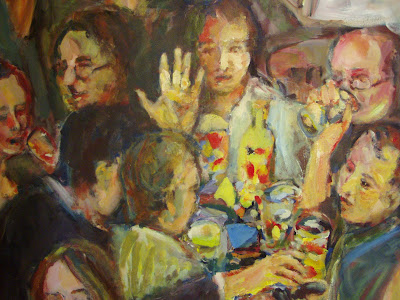
By way of excuse, I will say that my computer is busted, a stuck slash key and who knows what else, but that we can't afford to repair it right now. Well, it's low on our spending priorities and fortunately Jami's computer is faster and more nimble anyway. In the ensuing time I've visited great museums in Chicago and New York, spending 5 hours in the Met two weeks ago. I could easily have spent more. When I returned to our hotel later that evening, I painted 11 watercolors. I've been on a watercolor tear since. Note the above image, a levitating picnic I call it.
I will say that the best book I've read this Fall (a great time in history as well as a great season) is Sam Balantine's Torah's Vision of Worship. Balatine details how the torah is all about reimagining the world and establishing worship as an extension of Sabbath, emphasizing the sensual over the verbal. He uses a lot of Brueggeman or perhaps I could say that Brueggeman used him a lot in his old testament theology class. Balatine talks about art as an act of faith. But his primary focus is on how the priestly source engages us in priesthood through prayer and service - just as the priest functions on the boundaries of the holy and common, the common and unclean, so we find ourselves functioning on the boundaries bringing people on the margins of justice and faith into communities of justice and faithfulness.
I've been reading Jungel on justification and Barth as well on this topic from CD 4/1. As Barth cautioned in his Romans commentary, too often Jesus is treated as a means to an end or else one thing among others. Oddly this is so in the religious right, where for all their talk about loving Jesus, so little of the sermon on the mount, for instance, is displayed in their rhetoric. They easily point out that "liberals" use Jesus as a mere symbol, but seem unfazed about how they themselves have a 2-dimensional Jesus.

After reading through Exodus this season how astonishing it is to realize that we have a Baal right on Wall Street: America here is your god. Why is the ancient image of a bull so enduring? Baal, minotaur, Zeus and Europa, Minoan bull dancing frescos at Knossos, on up to bull fights and the running of the bulls. Meanwhile the bare chested minoan snake goddess seems to have disappeared from popular depictions.

This weekend we set up a booth at the Art Walk here in Durham. I have to say that it's difficult selling a painting of a nude toothbrush weilding colossus to people intent on picking up jewelry and other small gifts for Christmas. Looking over a list of paintings and artwork that I've sold over the years, I can see that my audience tends to be well-educated, somewhat liberal, individuals with a deep spirituality, coming from careers in the humanities, pastors or counselors. If you know someone like that, send them my way. Jami has set up a website for me at http://www.fredwise.homestead.com and there's a more comprehensive collection of images there. One difficulty is that I have over 2000 drawings in inventory - easily, and I can paint about two or three paintings a week, with an earth shattering masterpiece every so often, but I'm a novice in business and making connections.

I tend toward hyperbole, but I really could spend a week in the Metropolitan.

Friday, September 05, 2008

last sunday

When I'm not singing the hymns with added melody lines or adding language or tweaking the liturgy for humorous effect, I'm drawing on my bulletin, and last week Jami drew on hers. Here you see both of our efforts: mine on the left and Jami's on the right.
I drew an emblematic design centered on the cross given by the bulletin's cover. A female and male touch hands, with their heads centered on the cross's middle. Around them are the symbols of the four gospels - angel, lion, oxen, eagle (matt, mark, luke, john), symbolic animals mentioned in Ezekiel and Revelation. The female emerges out of the sea, symbolized by the whale or Leviathan; the male reaches down from the sky, surrounded by stars (the firmament). On the top I wrote the Hebrew YHW and on the bottom I wrote Tow hu voh bho hu. And it's in these last statements that my intricate design, containing many levels of symbolism, came into trouble. "Oh, so the female is unformed and needs the male to be made whole?" Jami said. I immediately realized the rhetorical nature of her question (statement?) and threw up my hands in surrender. No amount of biblical, mythological, liturgical, archaeological, form critical, or hermeneutical qualification and explanation would extricate me from my obvious dilemma.
Jami did a drawing of an owl and a pussycat, which I like. I think it should be our family coat of arms, along with a martini glass and a pork sandwich.
I continue to hope that I might create a set of Christian emblemata that are so recondite, convoluted, involved, erudite, spiritual, educational, erotic, cenobotic, hermetic yet accessible, that people's minds will reel around the images of the faith as on a mobius strip of wonder.

Thursday, September 04, 2008

chess match

From dark beginnings this paintings arrived at a colorful conclusion. I began with a meditation on Duchamp's last years, where he eschewed painting for playing chess. As I continued painting the perspective changed from 3/4s over-head to full on single point perspective. I added a cat, under the table, from a photograph of a family pot luck dinner at my great grandfather Stallworth's farm ca 1955. Suddenly a bull appeared, and the scene became crowded with onlookers. Perhaps there's something Duchampian about it after all.

Sunday, August 31, 2008

while Moses

The name, Jethro, has different connotations for us, who might feel that Moses had left Pharaoh's court for Appalachia, the holy mountain being Grandfather mountain (though there is a mount Pisgah nearby with attendant Devil's Courthouse). It is Jethro's sheep (often sojourning biblical heroes wind up taking care of their father-in-law's sheep - the prodigal son is the eventual declinsion of this biblical trope) Moses is shepherding when he spies a bush burning without being consumed. People see things like this in the desert. Never in a city or on a pleasant hillside in the lake country. But in a desert, a place without boundaries or habitations.
And so Moses, curiosity ignited, comes toward the bush, to see why it's not being burned up. A man of science out to discover causes. And God addresses him, when he gets close enough - or it is God's angel who speaks. Greek Orthodox iconography pictures this moment, this bush, as containing the Virgin Mary in the flame. I have to admit this puzzles me. But often the Virgin is depicted with the Trinity in her womb. So I suppose the Virgin is a shorthand for the Trinity.
Anyway. Moses approaches and God introduces Godself. God introduces Godself and gives Moses a quest: no longer a shepherd of sheep but a shepherd of people. And Moses asks, "Who am I." And God tries to console him, to persuade him. And Moses asks, "who are you?" And God says, "I am that I am - or in the Septuagint - I am existence - or in some commentaries I will be what I will be." All God's answers have enticing aspects to them. Brevard Childs puts forth the interpretation in his Exodus commentary that God is saying, "I'm here." God at least knows who God is.
Who am I? Who are you?
Moses cannot answer this question for himself. He neither knows who he is or who God is. In a land without boundaries, he perhaps doesn't even know where he is. Looking at this sight of the burning bush, he perhaps considers that the order of nature is standing on its head. So that he is less certain of who he is than when he began to lead Jethro's sheep. Less certain than when he fled Egypt. Less certain than when he killed an Egyptian, thinking it would herald his revolutionary identification with his kinsmen. Up to this point Moses has made misguided decisions, and perhaps he's wondering if God's taken a real look at his resume.
Who am I? Not much, a shepherd, a fugitive, a person with a hidden past I'd rather not talk about.
Who am I? I don't know. I don't want to know.
But God continues. Funny God. "Listen I want you to do this for me."
And Moses asks, "Who are you?"
I am existence. I'm the very thread and fabric of the world - though I'm not the world. I'm in and out, essence and form.
I am what I will be - I'm not the past, but the ever arriving future. I hold the past but am not limited by it. I am the eternal present.
I am here. I am not far away. I am right now the word in your mouth, the faith in your heart.
In short, God knows who God is and who Moses is.
God interprets Moses to Moses. The ultimate situates the penultimate.
This is Bonhoffer's idea in Christ the Center: "It is only from God that man [sic] knows who he is." Bonoffer says that the Chalcedonian definition (which explains how God became human) distracts us from the real Christological question: Who? Who are you? Who is Christ? Christ meets on the border of our existence, as with Moses. We do not know who we are or where we're going. And God sets us a task. A task that takes us out of conformity with this world, that requires a renewal of our minds. Jesus will confound us with his talk of setting our minds on human thoughts and not God's; his talk of losing our lives to save them - or distressingly, that in saving our lives we will lose them.
How unconcerned Christ is with whether we'll corner the market or have a corner office. Christ asks, "What will you give in return for your life?"
Most people sacrifice their authenticity, desiring to fit in, doing what's expected of them. If they see a burning bush, they are sure the authorities will know what to do about it.
Some sacrifice their authenticity acquiring possessions and honors. Stuffing the void in their lives with diversions.
But God asks the question "who are you" in good faith. God knows who you are and can interpret your life's curious course to you. God sets you a task among the world. To relate to people in love. To seek healing. To overcome evil with good. To mourn with those who mourn and laugh with those who laugh.
How far Christ is from a recruiter, who promises an education or travel.
How far is Christ from the TV hawker, who promises a giant home and luxury.
How far is Yahweh from the desert genii, who promises wealth and prosperity. Three wishes.
God promises that you will know who you are and who God is.
God promises that the losing of a life the world finds acceptable is the finding of a life with real authenticity.

Saturday, August 30, 2008

abraham, isaac, angel, donkey, ram (details)


It's not in the lectionary this week, but the Abraham/Isaac saga has the feel of those "deathly encounters with God" that are scattered in the Pentetuch. My painting has a folk quality about it: all the story's particulars are present - the donkey they came in on, the father, the son, the restraining angel, and the ram to be substituted. The fire's already blazing.
How must it have gone?
Abe: I want you to hold still while I tie you up. Thanks for helping me with the fire.
Izzy: What? You were going to do this all along! No way.
Abe: Come on. It'll make God happy.
Izzy: You're looped. I'm outta here.
The reality of two human beings tells me it must have been closer to this. That Isaac, no matter how pious, no matter how much a daddy's boy, must have been put out by this. Perhaps it's our need for clean pieties that makes us imagine it more like this.
Abe: Hold still while I tie you up on these sticks.
Isaac: Sure dad. Say hello to mom.
After all we are trained to think of faith as going along with authority. Following orders. Don't talk back. Go over the trenches and charge.
The Bible has a more contentious working out of faith though. David faces off with Goliath against orders. Elijah and the prophets strike back against the authorities as expressions of their faith. Jonah argues with God, as does Job. All in faith.
Even Abraham, already accounted as righteous for his faith, doesn't really need this further test. Paul writes it as an act of faith. That Abraham considered that God, the creator, could raise the dead and call into existence what didn't exist - and so Abraham was cool with sacrificing his son.
Kierkegaard finds this sacrifice, its very absurdity, the crux of faith. This story brings him into his assertion that faith has an absurdist side. That the absurdity of existence provides the augur where we prove our faith. Something like that.
The person who's really being asked to have faith here though is Isaac. He's the only one whose life is on the line. Or maybe the Faith's God's - whose plan for human salvation is on the line. Certainly what Abraham was doing was common practice among middle eastern peoples of that time. Abraham might of been thinking, "why's God asking me to do what all the other god's would ask?" Perhaps Abraham needed a sign of how this God, with whom he'd covenanted in Genesis 15:6, was different from the gods of the nations.
The angel's intervention says, "no more of this. We're not doing things this way anymore." The story read this way becomes an anti-authoritarian parable. We are breaking with the authority of tradition here, the way things have always been done, and the authority of culture, the power of doing what everyone else does. Abraham is so faithful that he would worship YHWH like everyone else worships their gods - and perhaps this is the test here, and Abraham shows himself to be just like anyone else. He's at least willing to go as far as the nations would go. But God says, "no." We're not going to do things like that anymore. No more of this top down stuff. No more will you assume that I yahweh want what the other gods want, or that I yahweh can be approached like any other god. The faith that you have with me and that I show to you is face to face, not top down.
And so Jesus calls us as a servant. He is lord, but he is servant of all. And he calls us to sacrifice our pretensions to lordship. To break away from authoritarian structures.
The world loves authority. Counter cultures are demonized. The gods of patriotism and market forces demand that we comply: put a pin on our lapel and let investment banks graze on the earth's people without restraint. But the righteousness of God, which judges a nation on how its weakest members (psalm 41, and other places) are treated, is different. In scripture we read that God's wrath is reserved for the most authoritarian of regimes. Regimes that quell dissent, that demand blind allegiance, that use violence to have their way. Authoritarianism would sacrifice the youth, the future, and the promise of God.
Here, in this story, we see God leading Abraham to a different kind of faith. Not an absurdist faith, or a "following orders" kind of faith, but a faith that approaches God as a partner.

Imperfect images of new paintings


Friday, August 29, 2008

It's possible to look so hard that substance coalesces into pure being


I've slackened in my blog responses not so much because I have too little to say, as as I have too much to say: so many things are going through my mind - art shows, paintings, drawings, Merleau-Ponty, the lectionary texts for this Sunday and last Sunday, Eberhard Jungel on justification by faith, Barth talking about Christ the servant as lord, Keck's Roman's commentary, our cats health, house buying, being a good husband, being a good friend, and many more articles recondite and mundane: all these things run through my mind, inviting me to grasp hold of them, each in turn, only to elude my real grasp. As I said before, the past eludes us and the future has no shape in space, such that we only grasp the present.
Merleau Ponty says that we are so caught in time, embodying time, that we "secrete time" we "create time" and live in a present against a future, empty, hollow; our past, conditioned by interpretation and habits, never is a present. We ask, "what am I looking at" never fully in possession of ourselves - hence our existence is penultimate. We are embodied, though and our embodied existence is a "work of art." We are thrown into things between the horizons of our past and future limits.We live by looking, by focusing - not allowing our focus to slip off into unconsciousness- we must describe what we see. At least that's as far as I've read now, and I can't say that I've absorbed everything. But I continue in hope: I am immersed in Ponty's book. I find that I've been immersed like this in only a few books: the New Testament, Barth's Church dogmatics, Calvin's Institutes, Becker's Denial of Death, Bakhtin's Rabelais and his world, Whitman's Leaves of Grass. There are many similarities between Whitman and Ponty - this keen emphasis on observation and the sense of embodiment, open to multifarious points.

Thursday, August 14, 2008

I have gone before you


I find myself reading a lot these days and pondering: what is the Real? One of the great books of art theory is Hans Hoffman's Search for the Real - and he devoted his career to this search, teaching and painting, exerting influence upon the group of artists who created Abstract Expressionism - the painterly idiom that shifted the balance of power in the artworld from Paris to New York: an idiom whose basic tenet is that the subject of painting is paint, and how paint shows the process of the artist. He determined that what is real in a painting (or sculpture) is not an ostensible subject (puppies or trees or battles) but the manipulation of the plastic qualities of the artist's materials. It's possible to represent a subject with great clarity and at the same time have a terrible painting, because the truth of the materials has been denied. This result is typically called kitsch. On the other hand, a primitive work, even clumsy work, may exhibit an emotional or personal investment in the materials, thus exhibiting the Real. This is the attraction of folk art. What Hoffmann's work does is articulate artistic freedom from mimesis. This is probably not new, per se, but Hoffmann stated it in terms that allowed artists to invest themselves more fully in the process, their process. Hence the Real does not depend on resemblance.
I think that this is perhaps one of the most difficult things for people looking at art to get. I often hear "I liked that picture because it looked like the real thing." This observation is I think related to the sentiment we feel about certain photographs: what looks real, is what we project our desires onto. Even photographs call into question what is real: photographs are subject to the same "faults" that modern paintings suffer from in the eyes of observers regarding the Real: photos are blurry, ugly, and increasingly subject to manipulation. Hence mimesis, what is casually called Real, has the characteristic of being false - a false Real.
This search for the Real is compelling. I feel that I am on to it in my art - but only because I've been on it for many years, learning to recognize the signs of what is true and what is false Real. I know that when psychiatrists like Lacan talk about the Real, they're describing not just the artistic Real, but what we might call "all that there is and how all that there is fits together." This Real is something beyond description. We fall into describing our "real" situations in terms of imaginary or symbolically.
This Real eludes description. I discover this as I've tried to come to terms with my own history and what is happening in the world today. There are many descriptions, typically labeled left and right, conservative and liberal; and these descriptions of the Real reduce human history to either/or dialectics. Is the Real the working out of a materialistic scenario? Today we hear free market capitalism enjoined as the mechanism that will usher in a world utopia - and do we not hear in this promise the Marxist promise, equally mechanistic, equally materialistic, of another kind of revolution: that human history resolves in simple ways. When the tide rises though, we see that not all boats float. The reality is more complex than either system pretends and unintended consequences (and who takes responsibility for those?) are the more lasting result. Whatever the Real is, it is more complex than the politicians of either party are likely to speak out on. Instead we get spin and marketing - slight of hand. Perhaps we most often recognize the Real in its shadow: that feeling of inauthenticity we find ourselves in when the buying spree is over, the degree obtained, the election won.
Even though the Real is more complex than something that can be described in a slogan or boiled down to a party platform, our faith compels us to investigate it and try to live lives that display an understanding of that complexity: lives that don't give into consumerism or ideology. Lives that don't settle for the imaginary or the symbolic - although Lacan would say that that is impossible. I think we can try.
One place to begin is in this story of Joseph. Joseph has been given up for dead by his family. The brothers certainly don't expect to see him here, in Egypt, in charge of who gets to eat in the kingdom. Joseph makes himself known to them and twice he says, "God sent me before you to preserve - life - a remnant." He tells them not to be angry with themselves or afraid. He reassures them. He has gone before them.
In this story the Real the brothers thought they knew has been turned upside down. They thought their lives hung by a thread. They thought their brother Joseph was dead. Think of the guilt they'd harbored over the years: the shame they felt for their lie and how that secret overshadowed the life of the father they loved. Now they have been thrust into a different and truer reality. The reality is that God has sent someone before them, into their predicament, and that their fears and anxieties are founded on nothing.
That sense of someone being sent sent before us is very present in other parts of scripture. In Psalm 77 God's footprints go before the people. And in the New Testament we meet God incarnate going before us. In Hebrews where Jesus passes through the veil of death and is called the pioneer of our faith - and in John's Gospel where Jesus tells his disciples that he is going before them.
Jesus too comes to his disciples, the first Christians, and to us. He has gone before us.
But we don't see it, Perhaps. What we see is like what Joseph's brothers saw: lies and secrets shadowing us; death of hopes, death of us and those we love. Even Christ might seem as dead to us, or as absent, as to his disciples during that first Easter weekend.
And so have we lived too much of our lives in a world imagined by marketing agents and politicians, dogmatic revolutionaries and moralistic hedonists - all with some material mechanism or materialism couched in spirituality as the paragon of the Real. An answer that explains everything and promises our desires. Like painting that isn't true to paint, the images look pretty, just like we've been trained to imagine them. Yet we live among images that are unreal. Kitsch. How can we recognize the Real?
God has gone before us to preserve us. In Jesus' resurrection we encounter nature in a new way and we encounter ourselves in a new way. We are freed from false likenesses of the Real. This false likeness springs from death. The fear of death trains us to find gratifications for our anxieties in the approval or others or in possessing what others have - either through conquest, theft or projection. And so these images are bound to disappoint. Each promise of this false Real ends in a death, a harbinger of the ultimate death.
God goes before us. Don't forget. God has claimed death, removed its teeth. And God calls us to follow Christ. Follow Christ on the path that loves. Follow Christ in the path of life, a path that restores creation.
When we are true to the material of our faith, that it is a faith in a generous, loving, tolerant, healing God (who sent Christ not to condemn but to save the world), whose wrath is for a moment and whose favor is for a life time [psalm 30], we produce a life that is a work of art.