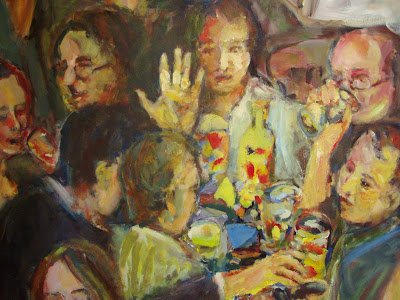
I can go months without posting. I have things I think about posting and then time slips by. Sometimes the method of getting images ready to upload is daunting. It's my perfectionist tendency.
Today, preparing to go home for my grandmother's funeral has worn me out. Every little frustration has been amplified.
Sometimes emotion floods through me like a flash flood in the desert: without warning a wall of water cavorts down a dry dusty arroyo.
I'm not posting a picture here. Later.
I think grief is like the parable of the lost coin. I've read that grief has a searching quality to it - like how a person might return again and again to an old spot. Searching for lost time, a lost feeling, a lost love.
In the parable Christ is saying that the kingdom of God is like this woman searching for a lost coin. The text in Luke 15 focuses on the woman searching for a coin that is lost and rejoicing in her rediscovery of it: likening such a discovery to the repentance of an individual. But the coin doesn't repent. It's lostness is not something it desires to change - it is the action of this woman that changes the state of the coin. So what is the subject of repentance in this parable and who repents. Could it be said that repentance issues from searching rather than lostness? Not a parable of a lost coin, per se, but of a searching woman?
While she is searching, she is spurred on by the grief of having lost. What have I lost? How could I have been so careless? She asks. She is frustrated, turning over furniture, clearing off shelves, retracing steps. She takes out and puts back in all the items of her house and her day. Does she find it "right where I left it?" Does she wonder, "How did it get there?"
She desires to feel complete again. To put this piece with its companion pieces. But does it, returned to its place, disappear into the crowd, losing its "lost" status. It becomes simply found. Desire is no longer focused on it.
Her joy is not in the coin, but in the finding. She's found her coin, which is rejoined to the other coins. But the coins themselves are just items of the household.
Parables do not lend themselves to easy correspondences.
The Kingdom of Heaven is like a lost coin. The Kingdom of Heaven is like a searching woman. The Kingdom of Heaven is like something we've lost. We are like a woman, tearing her house apart, retracing her steps, for a lost coin. We are like lost coins: we don't know that we're lost. We don't miss our companion coins. We don't miss being part of a collection. Under a floor board or stuck in a book, we're content.
Jesus in the temple knows exactly where he is, and wonders at his parents frantic searching. "I wasn't lost; I was right here," he says. Smart alleck.
Who repents in this parable? Why is repentance like this? Or instead of repentance: whose mind is changed - whose perceptions are altered? Or if not "metanoia" then the hebrew "shuv" - a turning. Did the woman turn and there it was? Did the coin find the woman? Like the coin in the mouth of the fish Peter caught - "to pay taxes for thee and for me."
A woman has 10 silver pieces and obsesses over one she lost. Her mind is filled with what she lost, rather than what she has. She has plenty. She has enough.
What was she thinking when she realized that she'd lost it? At some point she was at peace, content, and only on examination, perhaps pulling out her purse, hearing the comforting jingling of metal on metal, does it strike her that one is missing. Or perhaps she's putting them away and her grip is uncertain on one and she watches in dismay as it rolls away and too slow to respond, she doesn't notice where it went.
If she needs all ten, she is fucked. She has been careless. She lived in a false sense of security. Now she must hunt. Had she planned a nice evening? Had she looked forward to buying food, drink, a gift?
Not "I was lost but now I'm found" but "I lost and now I've found." The Kingdom of Heaven is not a passive state but an active state of searching. The first step is the shock of discovery: what I thought I had is gone! What is that? Our grief is where I consciousness of loss is. Our grief is where we begin searching. "I think I lost it" Lucinda Williams sings, "Nothing can replace it, no memory can erase it." Who knows if I've remembered her lyric right. Still.
Might this parable be about following our grief? Like Lamentations is about following grief. Naming it, not evading it, but going into it. Our grief leads us to the kingdom.
Showing posts with label Parables. Show all posts
Showing posts with label Parables. Show all posts
Thursday, April 01, 2010

Monday, September 07, 2009
taking or leaving


I love this pararble and its hyperparabolic possibilities: Matthew 24:41 (n + 1).
In the same way there will be two guys crossing the country in an old car, perhaps a loaner from one of their dad's or a friend's. At some point they'll discover the gas guage is broken and they'll be stranded in Palestine, TX. At some point a Samaritan will stop and offer them some help. So one will be taken up the road to an open gas station, and the other will be left behind to watch the car and wait.
In the same way two pigs will be feeding at the trough. One day the farmer will come and take one and the other will be left behind. Then the farmer will come back and get that one too.
In the same way there'll be two of anything, cats, zebras, jockeys, lesbians, policemen, unemployed middle managers, incarcerated businessmen, exiled cabinet officials, apocolyptic prophets; invariably differences and divergences will emerge among them that can be summed up as the taking or leaving what they have in common, a place. So it is that two of anykind, unable to exist together will find themselves displaced in relation to the initial reality they'd formed.
So what do we do with this displacement. Is it a displacement that invites replacing? Or is the parable's force in pointing out how slippery it is to label: women grinding, men in the field. One of each can be taken and one of each can be left? What does it matter in view of the culmination of the world. The coming of the son of man.
Here is prime exegetical territory: liberating the text from what it has to mean, whether that meaning is the accretion of orthodox defenses or heterodox insurrections. What is ortho and what is hetero change with the wind - more as expressions of power than of truth.
So two boys are building a tree house in the sand with rocks.
Two dowagers go to see Waiting for Godot and one is taken aback and the other is left speechless.
Two Roman legions are wandering in the forest searching for Arminius.
I think it's best to bombard the text with alternative settings, extrapolating and pushing meaning to the nth - searching for an eternal return.
The son of man is an eternal return. This time coming as a thief. The first time coming in tragedy and the cross - but this time, a thief and in farce? He comes like a flood and in the clouds and gathers his elect. Earlier he came like a mother hen gathering her chicks; now like a fox raiding the hen house.
Two hens will be brooding secure in their hen house; one will be taken and the other will be left behind. Pity the watchdog, Rex, with egg on his face.
Tuesday, July 03, 2007
Prodigal Son
 About the same time I painted the banner for the church in Covington, Billy, the minister there, asked me to paint a parable - the prodigal son. I was loosely thinking of Rembrandt's Prodigal while I did this, though there's little resemblance compositionally, I used the welcoming gesture of a father embracing his son. I added a reflection of the older son, scowling. The soon to be slaughtered calf is visible, as are a guitar and playing cards (symbols of the Prodigal's profligacy. The Prodigal Son thwarts our expectations. We side with the elder son - a pulled up by the bootstraps, nose clean, eyes dead ahead adept of moral accountancy. We look at the Prodigal through dim glasses and see only warts - he is the convenient receptor of our projections: wastrel, dirty hippie, bum - all the things we're afraid of finding in ourselves and bury deep under the surface. To embrace the Prodigal is to embrace moral failure - that is, the possibility that you're just like anyone else, in need of forgiveness. The question is: how can we be like the father, willing to break cultural norms of honor and shame and extend to the weaker position mercy. We live in a society that punishes weakness. Our foreign policy is driven by not showing weakness and projecting power. Our motto: never let them see you sweat. For all the people championing "Christian" values - the big value that Paul voiced "when I am weak, then God is strong" is left in silence. What would it be like for Christians to revel in their weakness: to parade the weakness of the church instead of complaining that we're not powerful? What would it be like for us to investigate weakness, to privilege weakness? These are the questions the Prodigal asks us.
Subscribe to:
Posts (Atom)