Saturday, October 05, 2013

more self description

he describes himself using various aides: micrometer, gyroscope, dowsing rods, sextant, x-rays, mass spectroscopy, dunking stool, anemometer, chronometer, electron microscope, and carbon paper

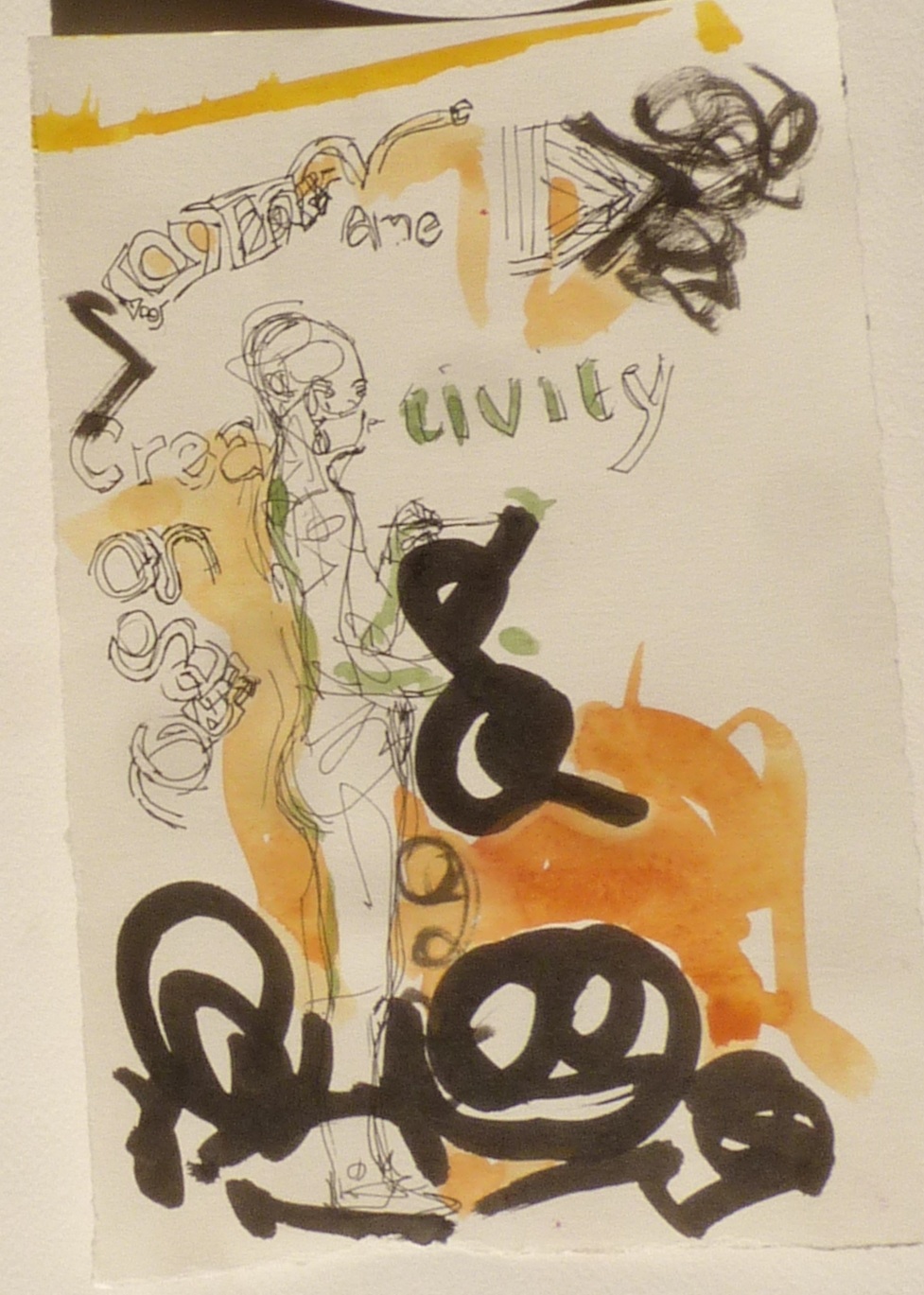
he describes himself as a collage of semi-archival material, detritus salvaged along life's way and organized into a Merzbau revival service of ironic belief


he describes himself as someone who journeys to the Himalayas for a correctly tailored suit; who learned to tie his shoes properly at the lamasery; who taught penguins to properly fix a rich fragrant cup of tea 
  • Suzanne Bell yep, that's what I thought. keep it up, Master, friend. keep it up and keep us going into new reams of thought. though I might remind you, the mind is the servant of the master, the maker, the defender of the soul. let that soul be free.
    11 hours ago · Unlike · 1
  • Fred Wise What siren song my sister, if I might say sotto voce, render you some freight of response and aphoristic shape, as supple and plain garbed to my ashplant signaled musings on sandymount bank on the outer rocky montebanks, vouchsafes rhythms and tonality to my soul?
  • Suzanne Bell look to the highest point in the photograph. some twin towers of the soul been torn down to show you its heart, its song-sorrow, its plight in the wicked wind of mind's eye, and men.
    11 hours ago · Unlike · 1
  • Fred Wise our skyline is a hodgepodge of architecture's fads over the last half century, and set in the midst of it, a polite salt cellar, the golden domed capitol - the only regret in the view is that the blue domed Hyatt, with its rotating restaurant, is now boxed in, like a childhood Christmas ornament, by newer more serious structures.
    10 hours ago · Like · 1


he describes himself as someone whose driving is academic: there's the passing lane and there's the failing lane

he describes himself as intoxicated with life

he describes himself as a topographic map


he describes himself as someone who gets too excited, too eager, to be the smartest, the most correct, but he's learning to live through his anxiety, to find some quiet within, some point of grace to stand on in the symbolic world of humanity

he describes himself as spinning


he describes himself allusively as a catalog of traits and anecdotes proffering vignettes of imagined and unimaginable events, episodes, follies, parties, engagements, soirees, sorties, and schedulings where he acted out, enacted, proacted, protracted, detracted, transitioned, and perorated.


he describes himself as invisible, negligible, a shadow of his future self - unlike his take no prisoners hell bent for leather alter ago who's in all the papers and passes via word of mouth through the loftiest perches of society

he describes himself as someone who is grateful for kindness


he describes himself as someone who's struggled most of his life to obtain the express written consent of major league baseball

he describes himself as a battle of wits, a game of chess played with monopoly tokens, souvenir shot glasses, and origami swans

he describes himself as becoming better with some set backs, puzzling along finding open doubt preferable to fake certainty, daily grief preferable to bottled optimism

he describes himself as a labyrinth: minotaur pasiphae theseus ariadne minos dadelus all rolled into a trifle for the gods

he describes himself as someone who doesn't like description, who lives a nondescript life, under the radar at the dew line


Monday, September 30, 2013

magnum opus


I've been working on this autobiographical piece for 20 years now, almost. The material in it crosses back and forth from 1981 to the present day. It is 90 per cent loose leaf. 


This began as a simple sketchbook. At some point I cut several pages out: probably under the influence of fundamentalism. Fundamentalism is a disease - I didn't lose it simply by switching one set of beliefs for another - one signifier for another.


GR thinks I should write, as did JB. 


Julia Kristeva writes of the paralysis of depression. Questions that begin Why aren't - those come from the ego fantasy of our lives. Paraphrasing Blanchot: Why Aren't is the question that kills all answers


I am a man talking to himself. Sometimes people join me. 


I walk through the garden alone, while the dew distills on the roses, and, hearing a noise, I run naked through the thorns. The terror there as they pull my hair, as they shed my skin ...


we may be left on our own : we may be right on our own


as a child I was left naked in the woods by friends - as a child i was not adequately able to define what a friend was


I could be a poet


I thought for a while that Duchamp was what an artist should be


I created my own box, my own large glass, my own standard stoppages


in the dream i am flying and i am clothed with birds


i sit down to take a test and discover that it is a test of wills


i am clothed with railroads and i have learned the time tables to 1105


i am swimming in blood in a submerged hospital
near the elevator i see my mother
she smiles at me
she is no longer dead
from out of her mouth flies a horse
the elevator teaches him how to sing


a man holds up a store with a poem
in a world that defines righteousness in terms of commodity value
only criminals will have poems

I feel like I need help

Lacan insists on the end of therapy enlists the patient in becoming alive in the symbolic. People often think that some kind of cure involves living in the real - yet the real is something we never know. We always live in a symbolic world. The Bible, for instance, reflects an ancient cosmology; our current knowledge of the universe reflects truer facts - but is still lived out in a symbolic way. 
How to describe this? I know that there are people who equate what they know about themselves, their ego, as who they are. They fail to acknowledge - sometimes violently resist acknowledging that there is more to themselves, but observers discern that these people are seemingly unaware of how their judgments of others are actually projections of their own personality that they refuse to admit. Frank, for instance, might say that Pam is easily provoked, while those around Frank might think to themselves "you should talk." Frank is not seeing the person, Pam; he's using Pam to, if only he could see it, reveal his own "easily provokedness." 


Prayer is a dialog. Often we discover God is silent - listening, we hope. We grow silent too. Our pain cannot be articulated. I burst out in anger at God. How abusive I am, meek sheepish me. God's distance is intolerable. Like Job I find no comfort from friends - who all seem to be auditioning to be God's PR representative here. If I know they're faking, surely God knows. They should talk. I should talk. (those last two sentences will provide a difficulty in translation: they proffer an imperative but are meant to be understood in the opposite sense: They should shut up; I should shut up.) 


he describes himself

he describes himself as affable though sometimes painfully overly jocular; cautious with bouts of intemperance; sensitive in understanding while oblivious to social surroundings. he evidences a sense of experimentation in his art and theology, yet doggedly avoids chance and change. he needs to be more patient

he describes himself as someone who comes home from travelling 1000 miles and, no sooner sitting down with a beer, has a cat in his lap

He describes himself as an avid sportsman, expert in recondite and arcane manners of hunting, trapping, stalking, shooting, netting, arching, bowing, springing, lying in wait, sitting, standing, racing, procuring, detaining, hopping, jumping, skipping, dashing, crashing, anchoring, blasting, mashing, scrambling, basting, veronicing, lancing, dancing, maneuvering, gamboling, chancing, escalating, descalating, skimming, diving, squeezing, punching, laboring, finessing, hobbling, enabling, and dueling. In fact, he has been known to entertain his fellows and mates and interlocutors with repartee and confabulation well nigh into the nocturnal dawning drawn morningward noonish dinnertide.


"I am a process of perceptions and sensations generating memories and anticipations around a desiring self in concert and in response and relation with other embodied processes along a plane of physical description interlaced with mystery and numinosity; all finding its way into a symbolization of speech set over against intractable reality."

"He describes himself as ten feet tall, with nuclear hair and a spinal curvature that mimics the Gulf Stream; a husband, a father, a son, a lane hogger, a plane clogger and a sideman to a combo duo concerto. With the strength of ten ordinary men he has achieved over easy and below and above what few would dare: the circumnavigation of every shower drain in the city. He's just finished his eighth book which laboriously quotes his tenth - from which he'll be miming excerpts tonight.

"He describes himself as middle aged and balding, having fallen short of early promise and generally coasting along on modest talent immodestly through several failed careers. I met him as he was preparing for the bar."

knowing things without saying them, he describes himself as the shade dodging around the sun light in early autumn and memories of salamanders in streams and lizards in spring houses, visiting his great grandfather's farm across from the church, seeing the mules that still pulled a plow, and chickens pecking at freshly raked earth, acorn strewn

he describes himself as someone who likes buttermilk and cornbread - separate or together in a glass; the very peaty single malt Lagavulin; medium rare NY strip steaks - who likes movies where "nothing" happens; art that doesn't depict anything but the formal constructs of its materiality; music that disdains so called tonal centers and regulatory pulses


He describes himself as someone who might post too much on facebook, as someone who may have too much time on his hands - but a fortiori, it's merely an extension of the conversation he has with himself while he's drawing or reading: he's that guy who sits by himself in the dining hall immersed in his own thoughts, arguing with invisible interlocutors, confabulating with the shadows of light, as if, as in Wings of Desire, a Falknian angel might be listening, admonishing to enjoy this plane of existence while he has it

he describes himself as a collector of keepsakes and a keeper of collectibles ; a hoarder of hordes; a canvaser of canvas

 he describes himself as inconsistent and contradictory, but still getting used to it


we all need people who build us up - friends, family or colleagues - when we are able to exercise kindness and listening with each other, we might discover the death grip of our egos loosening its hold on the greater part of our being.


he describes himself as someone who draws; who believes that the great temptation is commodification of ourselves and others. We are taught to believe that humanity and each particular human is valuable - but experience shows that most people are closet marxists - according to my college professor's paraphrase, "show your pocketbook and show your soul." When Christ asks, "what will you give in exchange for your souls?" the unspoken answer is that for most adults the answer is in the past tense. Perhaps a corollary to the kind of child we are admonished to become like - unlike the childish adults who always seem to yell the loudest.

he describes himself as a science fiction series that differs a great deal from the pilot: suddenly he is an orphan and clean shaven; my mother the car on mars meets the muppet show version of the invaders


 "I remember my youth mission trip. We went to teach them, but instead they taught me: I learned what it was to be a pharmacological guinea pig for a large multinational corporation. I'll never be the same. Every time I look in the mirror and see that third eye looking back at me - What is it thinking? God's creation is mysterious and wonderful. The eye sees the stitching on a 100 mph fastball - and it sees the child who sews that stitching in the baseball factory. It sees the child returning home and it's already dark. She has only time to eat a bowl of stew and practice some rudimentary lessons for a school that is only sporadically open. At night the eye sees terrible visions and I wake in a cold sweat. I remember nothing: only that we are all running in the rain, it is cold, our clothes are plastered to our flesh"


I seem to have pulled all my books off the book shelves again, covering every available surface with paper and books, much as each shirt eventually attracts a spot of ink or paint.
Thursday, August 22, 2013

a further attempt at saying something meaningful

Feuerbach points out that our speech about God is really about ourselves. Theology is hard pressed to get around this observation. If that startles you, dear reader (or deer reader), consider this: even if you don't recognize this state of affairs as applying to you, certainly you've seen it in others (and they in you by the way). Zizek points out that, even as we are not able to exit our own subjectivity about God, so also we cannot really speak about others, without merely talking about ourselves. And here's the corker, Lacan would aver that we cannot even talk about ourselves. I point out all this to say that we can and must speak of God ourselves and others. We must be careful with our speech though: not taking it for granted; not assuming universality; and understanding ours and other's frustration at communication.


Jung, at the same time he is saying that God is a projection of ourselves, is careful to say we must avoid the "nothing but" - to write off concepts as "nothing but" - because even though things are subjective and interior objects, they are nonetheless real. What you believe about God or yourself or your friends or country originate in and struggle with internal states peculiar to you (for instance, you cannot Know my grief, I can only display it to you, and the same from you to me).; it is all marvelously real. 

Human beings and human cultures exist in symbolic worlds. Our bodies are colonies of bacteria, various organisms, cells that have evolved together symbiotically; our consciousness is not just in our brain but extensive throughout our bodies - though we fall into the illusion that our thoughts are just in our brains. Each of us, in our thoughts, is a nomad in place. We cannot explain consciousness nor our singularity in the vastness of space. We might imagine alien cultures as superior or friendly or threatening - but in reality they are probably as bad off as we are. We recognize our consciousness even as we see organisms similar to ourselves and we assume that they must be conscious too. If an organism or object doesn't move or signal in some way an intention, we might assume it is not conscious at all - even a flower, with all its beauty, if it were conscious could not signal it to us. 


Monday, August 19, 2013

merzbau


Living human document: 

Red


lots of red

I have opinions and sometimes I tell people, but a lot of times I don't talk to people. I have ideas about how to introduce art into the seminary environment - not at all they way they're doing it at Columbia. I say what I think they should be doing, but it doesn't resonate. I know that I don't bring it up correctly, even that my solution may not be the thing they want. Still, I just want to say here, the room is too pretty, too organized: Prayer/potter's wheel and creative area/display and dance mirror. I say rip all that stuff out - display work somewhere else; remove the prayer kitsch - creating itself is prayer. Everything in that room right now distracts from the act of creating; it's pretty and it's set up to fail.


Speaking of prayer kitsch - there are other spaces set up like this all around campus: comfy chairs, incense, "prayerful atmosphere", "prayerful books". Perfectly Victorian. I want to bring a cow patty in from the field and place it on the table; throw the furniture out on the curb; cover the coffee table with 100 demitassen of espresso (partially consumed). When I say prayer kitsch I think my reader must have some idea of what I'm saying. I'm referring in part to the whole industry in Christian publishing that offers up easily digested devotional compendiums that proffer pleasant thoughts for the junior league; there's a breakfast tray or coffee cup on the cover. There's incense and smells (someone somewhere read about how our cognitive faculties are spurred on by smell, so we've got smells in abundance - pretty smells). I think it'd be more authentic and prayerful for people to write their own devotional while they're sitting there; bring in a wheel barrow of red clay and mulch and wildflowers - cart it in yourself. Prayer kitsch is all pre-packaged, pre-thought out, pre-theologized mass produced, hands off, mind off paraphernalia and it all functions to clog up the pipes while giving the aura of having prayed. 

A room like this should be Merzbau. 

Saturday, August 17, 2013

I embrace my delusions


This is the power of the signifier: that no matter which side I realize that another side thinks I'm stupid, or evil, or bound for hell, or shrugs the judgment of indifference - and that if I took up those opposing causes and became the UberIdealist, the UberFundamentalist, that those same reactions would still obtain. The signifier holds out the promise of being declared righteous which is summarily removed [through sleight of hand] at the same moment as it's position is accepted. 

Someone may say, "you write about this signifier a lot and I don't understand what a signifier is - or I don't see what the big deal is."  I can only remark from my own experience that people live their lives under banners, as it were: as Christians (who only selectively read the Bible and that in a kind of pre-interpreted way); as Patriots (who are anti-government and yet endorse government sponsored violence); as Rebels (who endorse conformity with society and the group); as FreeMarketeers(who endorse socialized arrangements for corporations). These are examples. Lacan says that the signifier swallows up the subject, from the inside out as it were; and you may have noticed this where a person talks about the Government, for instance, in great detail as to its faults, especially in group settings which are wonderfully inflating for the ego (but they cannot talk about themselves with any of the same clarity or objectivity - though, like the Government they also spend too much, abuse those under them, welch on their obligations, and seemingly make up rules arbitrarily to suit their disposition). 

The rule of the signifier is one reason perhaps that Jesus admonished "judge not or you'll be judged" or James in his letter opines "by the same judgment you use, you'll be judged". 


Anyway, I find it difficult to write about myself. To speak about myself. And most people would say the same. Perhaps it is embarrassing. Perhaps it reeks of egoism (though in context only shows how fragile the ego is feared to be). Lacan says that the end  of therapy is when a person can speak about themselves to another person - that is, that I, for instance, could speak about myself owning my own history as a series of choices I made, rather than events that happened to me.  It helps to be able to speak this narrative to someone who can hear it. Sometimes even friends are incapable of hearing this - in so far as they also cannot speak of themselves.


I am trying to find a way to carry on. Jung points out that what we see in our lives, how we judge the world around us, is more the projection of our unconscious desires and conflicts and an accurate assessment of reality. This was brought home to me be an article in the Onion: http://www.theonion.com/articles/father-teaches-son-how-to-fly-into-rage-over-compl,33487/?ref=auto 
Father teaches son how to fly into rage over completely inconseqeuntial bullshit. 
The part I find compelling in this article is the mention of interpreting slow drivers and slow people in the check out line as personal affronts. 
I find this liberating.

My problem is an object relations problem: I want to please people and have them approve of me, even as I want nothing to do with them, as I anticipate their rejection from the get go, as it were. In doing so, I have no idea what I want - I cannot even say and it seems a moral imposition -  there is a bone in my throat at the thought of saying what it is that I want.


I speak and words fall out of my mouth onto the ground
I cry out that I need help
and cannot say what that help might be


Where is your faith, he asked
I had it just a bit ago
Here are some tokens of appreciation though


victory march
flag on a marble arch


I'm exhausted. I enjoy meeting people. I feel out of place. When I was very young, playing musical chairs, I often didn't make it to the chair when the music stopped. I feel that way - that I'm frozen, unable to move. I didn't understand the rules of the game I was compelled to play. I did as I was told. And then I was yelled at for just standing there. Then I was yelled at for being in the way. 


I don't know what chance or opportunity is out there. It's important that I make some money. When I say that people's eyes glaze over. They have no idea. I'm 50 and needing a job, if only to interact socially with people. I used to have this job scoring essays and math tests back in Durham. Its virtue was its intellectual challenge. People say that reading these tests is boring - but I feel the contrary: I find myself connected to these kids - even as they make errors or fail to develop ideas. Sometimes they would show great feeling and ingenuity. Sometimes the test question would be written poorly, so poorly that bizarre alternative answers would be admissible. These questions were usually thrown out when they didn't yield predictable results or were predictably misunderstood.
Atlanta doesn't seem to have work like that.

Friday, August 09, 2013

more delusional ravings


Three dense drawings these last days. The top is a St John Baptist in the wilderness; the middle is a subterranean kitchen; the bottom is a Jesus in the wilderness. In the last one I've pictured Jesus, having built a lean-to for shelter, holding a long stick. I don't know why - I like the gesture. I like the thought that he may have played around in the wilderness, thrown some stones, chased after some local fauna.

When I titled this post, I thought I had more melancholy meditations on the absurdity of faith and the brevity of life and the necessity of love - but I forgo that. I could say that I wish I'd had more success in my art - in terms of business. I have the experience in my life of being the best read - thinking that that would find approval; I've been the most conservative; the most orthodox; the most charismatic [in terms of that kind of religious fervor]. When I was young, 9 years old, a minister's wife shamed me for my incorrect theology (now imagine that!) - so throughout my life I've done everything theologically correct; I know the venerated book better than the most rabid venerator. And it simply doesn't matter.

I now read Deleuze, Lacan, Zizek etc because they meet a need for my own intellectual and spiritual rest. I woke up one day and discovered that the faith of my youth (even the faith of that correcting minister's wife!) is heretical down to the core. Truly amazing.

What matters, of course, is love. There is a way to respond to the inchoate enthusiasm of a child other than making him or her feel small and stupid. There is a way of faith that exists beyond tendentious creeds and proof texting - and it is a way of seeing the humanity of each person, to get at the core of Christ's peculiar enjoinder to love one's enemies (the golden rule is common, but that statement takes the cake as being his alone).

I know for myself - I can't answer the question what it is I want. My whole life I've been inculcated to have others tell me what that might be. The fact is subtle. Lacan says that the frustration of the ego is that we've constructed it for another, an other that doesn't care - that doesn't exist. That's a lot of frustration isn't it. I may say that this is a product of growing up in a mill town - basically working class, where the attitude that prevails is of being told what to do. In some churches even it's a sin, the height of selfishness to "do just what you want."  And so, when I was asked what it was that I wanted to do in an interview for a chaplain residency I was caught off guard. I responded with some language about being in the team, doing what needed to be done. But I knew and he knew that I had no answer.

And that's what I carry with me each day now. This puzzle. Lacan locates ethics in this discovery of desire and not giving ground relative to it. Mark de Kesel posits that what Lacan's getting at is for the analysand to arrive at the point where she might act, can act, will act.

Deleuze and Guatarri locate the production of desire on a line of flight. A line of flight is a rhizomatic activity. Rhizomatic in that it remains firmly on the surface - giving in neither to the temptation of finding security in a large organizational hierarchy as well as avoiding the temptation of finding meaning bracketed into the certainty of small cells. The line of flight is creative when it seeks connections, fascist when it abhors connection and seeks its own destruction.

I'm sure I've left something out. Feel free to engage me. Perhaps we can help each other discover what our desire is, to find that line of flight.

I'm delusional


In  Ernest Becker's Denial of Death he comes right out and says that we create an illusion of purpose to do anything - that we can only make things and live life by believing that we will not die. Most people will admit that they're going to die - that all die and that they're no different - but their very mode of being denies it. The reality is that we don't believe we're going to die. 
Some days I have to work through this more than others: I need to convince myself that my life has some meaning and purpose.
When I was a child teachers and parents were fond of chanting bromides to the effect of how unique and special I was - as all children are averred to be. Jesus loves the little children. How special that infant bundle seems - even as he grows into that awkward little person: an air of singularity hangs over his head. Certainly some adults take the opposite tack - they feel their job is to take every one down a peg and sometimes they like to start young. For the most part I, and most people I notice who grew up with me are not too different - we grew secure in our possibilities. 
In truth the possibilities hardly meet the challenge of being alive, of justifying existence. 
We are barred subjects trapped on a signifying chain - as Lacan might say: our hopes and dreams are coupled with meeting the demands of The Other. An Other, by the way, who doesn't exist, but demands our castration (figuratively) all the same.
He's paraphrasing Ecclesiastes and St Paul for the un-initiated. (Why shouldn't St Paul be the first preacher of the death of God - when we become dead to the law, we are effectively dead and all obligations with that law's maker are dead too - that is: the Law is dead because the motive force behind it is un-manned, as it were, by Christ's death on the cross; that is: the actual death of the messiah testifies to the impotence of the Law, which is revealed to be a fortiori, an idol; and in so far as an idol, a testimony to its giver's absence.)
Mind you: I believe - and believe more fully than most. A curious trick of mine. I believe because it is absurd. Absurdity recognizes the delusion of life, of the chance occurrence of conscious life on this obscure planet. What is certain is that out of 107.7 billion people who've existed (according to a recent New Scientist where statisticians apparently calculate such things) each of us is a  drop in the bucket - there is no amount of money anyone can accumulate; no amount of celebrity or articles published or success earned that will stand up in the great flood of entropy and nothingness that is life. 
So I believe because it is absurd. Kierkegaard is succinct in Fear and Trembling that one hallmark of faith is that it is unspeakable - it doesn't make sense, and the moment you try to make it make sense, give it some plausibility, it is no longer faith. It is just sad.
Deleuze in Difference and Repetition remarks that each believer contains a  closet atheist and each atheist harbors a secret believer. This is Becker's point: there is no escaping the conundrum - we are delusional in order to live - cold rationalism leaves us with no point in living. We all have faith in order to survive - to continue working and loving and making and planning (perhaps the militant atheist is the strongest believer of all, even though he might deny it; while the militant religious person is the only true atheist - their ardor to act for God simply proves that that God is dead). A god who coerces belief through violence from that god's adherents upon infidels testifies to divine impotence - coercion through force (whether violent language or action) simply indicates the insecurity and impotence of the coercer. The violence may succeed in its coercion, but in doing so the faith of coercer and coerced is unbelief. 
Rene Girard tried to get this point across, as well as Hauerwas in his Peaceable Kingdom. 
I live it out, albeit imperfectly. The god of my own impotence is strong.
Some days I feel it stronger than others: there is no point! My work, my thoughts, my art - are all pointless activities; and so are yours. 
We may either act in love, which is creative, or act out of our anxieties, which is tied to the death drive. That is: we're either connective or disconnective. In connecting there is some small shred of relief from the prison of subjectivity.

Friday, July 19, 2013

a sermon


Our passage in Colossians today is a hymn. Scholars, studying scripture over the centuries have noted how this passage is different from Paul's typical writing - and that it has a particular rhythm, a lot like poetry. It's no surprise that the early Christians had hymns. Paul doesn't however say he's quoting a hymn, perhaps because people hearing this letter would already recognize it.  Paul  includes this affirmation of the Godness and humaness of Christ that was current in the early Church as a reminder for this congregation of who they serve. Throughout his writings Paul says a lot about Christ and God, but here he's using words that are already available and are very familiar. It's a point of connection with this congregation - as it would be with any congregation at the time. These people can't read, but they can hear and they can sing. They may not know Paul, but they know this song.
Now:
I'm going to tell you something, and I ask your forbearance with me: these hymns - the other one we have is in the letter to the Philippians - act like portraits. We may not think of portraits as acting - they usually seem passive sitting there on the walls of banks and schools, but they act on our imaginations. Portraits depict someone who is absent, so they can be remembered or represented in different places. Through time artists have painted portraits as a way for people far apart to meet each other. We have wonderful portraits from the Roman era, but Paul didn't use painted ones- that we know of. What does seem to have been used are these hymns and confessions. "I'd like you to meet Jesus - this is what he looks like." He's the centerpiece of the cosmos - the firstborn of creation - who holds all things together - all rule and authority and power."
I'm an artist and if  Paul came into my studio and said to me, "I want you to paint a picture of Christ." I would have said, "OK, what does he look like?" Expecting to hear some standard description, some stock features: He has curly hair, almond eyes, a swarthy complexion, a dark pointed beard. When Paul starts singing this hymn I'd realize we were in different territory. From the content of the hymn, he's describing a god, Apollo perhaps. That's fine, I can paint that. And then Paul would throw me a curve: "firstborn from the dead, making peace through the blood of his Cross."  Blood of his Cross - well that startles me. Now I don't know what I'm painting. A cross is a form of execution and people executed on a cross, by the state, don't merit commemoration. Portraits are finally about honor. Parents are honored; benefactors are honored; and the emperor is honored - especially on money - which demonstrates imperial ownership of the state.

This portrait of Christ in this hymn directly confronts expectations: Who is honored; What the character of the honoree is.
The portrait of Christ is no ordinary portrait.
The Christ we meet is no ordinary God.
The God we meet is an ordinary / un-ordinary human.

If you accepted an invitation to come to Church back then - early in the morning, the first day of the week, you might have heard and even joined in singing this hymn. Whatever effect it might have on you - you could only notice the effect it had on others in the congregation. Paul's description in Colossians of what you would see - people who were once hostile, engaged in evil - would testify that something of the character of this image had changed these people. I believe that the character of this image - its power for change - is healing. This image is meant to heal humanity. As Jesus says in John's gospel, "I came not to condemn but to heal." What is the content of this healing? The Christ who is at the center of creation, resides there not by force, but, as Paul says elsewhere, in weakness. At the heart of creation we find mercy not punishment; kindness, not blame; understanding, not indifference. In singing this hymn the congregation becomes part of this image. This is what the Church is, a place of healing for souls - souls that feel the burden of anger, the sting of misunderstanding, depression, fear, weakness, guilt.

This portrait is different from portraits seen on the walls of institutions. The images of long passed powerful people, usually white men, are pinned powerless to the walls. When I was in seminary I enjoyed looking at the portraits of presidents and teachers from long ago. The images themselves don't say much about how to live or give much hope. I realize what I'm looking at is what the institution intended me to see. And that may be another feature of this hymn - it presents an image from before an institution existed.  This language about Christ rose spontaneously from among early worshippers. How spontaneous is difficult to say - certainly there was no committee like we know of them; there was no agenda to get the theology right. They just sang it; it was already present. This portrait is a living portrait. We are all part of it. The Church is not separate from this image.

When we gather for worship we create something. We create something and when it is created, we must create again. The process of being this healing image is continuous. The unique power of the church is that it expresses the love and presence of Christ. This love is always there and it is always healing.

I say this aware of problems. The history of the Church in time is rife with suffering and pain inflicted on people high and low. I've been in churches that specialize in saying the right things - and felt wounded and miserable. I've felt alone, broken, unheard in the midst of praise songs and orthodox liturgies. In these churches, Christ may be entombed in the center but he is not alive and ruling the center.  This image of healing prevails, though in spite of this. I believe it is as accessible for us today as it was for these 1st century believers. Our context and circumstances are very different - but the elemental human nature is the same. With the Holy Spirit's help we seek it out and work to create it. Creating this healing image is a struggle. We remark on its confessional truth when we say "Christ is the Center" - the center of our lives, our faith, of creation - but if we are merely content with saying something that is correct - without investing our lives, then we miss the healing in this image.

How do we get at this healing? How do we embody this? How do we create this?

Paul, in this passage attests to how this image is lived out when he remarks that "in his flesh he is completing what is lacking in Christ's afflictions for  Christ's body, the Church." He  is not talking about atonement here - Christ's washing away our sins. Paul is describing how he lives out his faith. Paul's gaze into this portrait of Christ has altered his life - from persecutor to preacher, and this alteration has healed him. Looking at Paul's life, he has changed from a person seeking out people to hurt, carried on by rage, to a person who seeks out hurt people - who wants to bring people in rather than exclude them.

One aspect of creativity is openness, the willingness to make connections rather than to close off. That excites me about Edgewood: the decision to be a More Light congregation. The early Church practiced that kind of openness when it accepted gentiles instead of remaining exclusively Jewish. They endured some criticism and lost people who wanted to remain closed off and exclusive. Embracing change is like that. A church I am part of back in Atlanta, Oakhurst Presbyterian, embraced the changing demographics of the surrounding neighborhood and began to thrive and grow - becoming a racially diverse congregation that works for social justice and racial reconciliation.

When a church is open to change and open to the input of new people healing occurs. People who had been silenced find a voice - that's healing. People who had been excluded are empowered - that's healing. Healing is a creative exercise. Because it is creative it involves our spirits at a deep level. It's in our spirits that crises are easily masked. We can spot a damaged body, but a damaged spirit - that takes some skill to notice - or some surrounding love to talk about. The world exhibits this spiritual damage in its advertising, its inequalities, its consumption - the earth is scarred and peoples are scarred.

What the Church does is limited, perhaps, but still significant. Our worship tells forth the central image of our text today: Christ in the center binds together what is broken, is present with the grief and loss that mark human lives, and creates peace in a broken world. This is an image that invites us all in to feast at the table - a table where the Holy Spirit lifts us up and seats us in a place where the nations are healed.