Showing posts with label laughter. Show all posts

Wednesday, January 30, 2008

Laughter


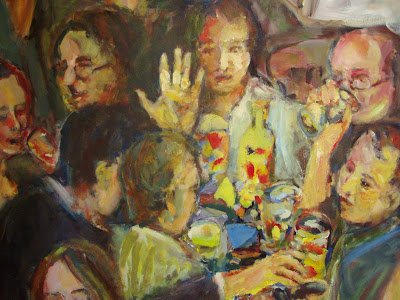
Rabelais said that laughter was a philosophical statement: not derisive laughter but good, straightforward belly laughter. Somewhere in Proverbs I think it is said that laughter cures the bones. From Top to bottom: me, laughing at Rabelais; Jennifer, my sister-in-law, laughing at something profound; Bill, my father-in-law, laughing at a story; Jerry, my dad, laughing at the fact that I have too many books; and Jami, at Carpe Diem, laughing at something her friend Genie said. There is nothing better than being with friends and family laughing. Is there anything more human?

Thursday, September 20, 2007

kitten vs human

Who will win? Which will is stronger? Which is more determined? My wife, Jami, a Ph.D. trained academician in English literature, who brings in the big bucks for major educational institutions, rubbing elbows with movers and shakers, or this 7 lb kitten, (named Cleocatra by a woman who mocks my puns) who thinks only of escaping into the yard to chew on the grass underneath the rose bush and incessantly demands Ocean Fish. Who will win indeed.

Wednesday, September 19, 2007

Laughter

I love nothing better than to make Jami laugh. Look at that beautiful face, that beautiful smile. That's the woman I love. Thankfully I'm a master at crafting jokes, puns, anecdotes. In fact I am inspired right now. Reading Bakhtin's book on Rabelais I'm finally through the introduction and beginning his history of laughter. I'm very excited. Already in the introduction Bakhtin considers laughter, when combined with the grotesque (where he means with those elements that are earthy, natural, of the folk), regenerative. Laughter is regenerative.
He considers the laughter we have now, ironic, bitter, sarcastic, used like a whip, to lack that regenerative power: in fact satiric laughter "as the bourgeoise like" he considers not to be laughter but rhetoric. To appreciate the sense of regenerative laughter I think of what a belly laugh is. It feels good: it's the laugh I need when I'm feeling down. His examples are Rabelais, Shakespeare, and Cervantes - for their common folk elements, elements which he ties to the grotesque and to carnival. The Grotesque needs laughter to achieve the regeneration of the old into the new (in this way Bakhtin echoes Jung's thoughts on Alchemy, where old dominants lose energy and give way to the birth of new ones: the archetypes of the old man and the child).
Laughter is regenerative - think about that. In particular the laughter that comes from common folk: groundling humor, fart jokes; such that monsters are defeated by laughter. The dance of death, a grotesque figure on the surface, achieves a comic effect, a carnivalistic effect when we think of the bishop, the king, the peasant, the nun, the queen, the fishwife, the knight: all being lead by death in a line dance. This was the way the great plague of the 1300s was absorbed, was dented in its blow: by laughter, laughing at their situation, cavorting and dancing.
I was reading Lewis's Discarded Image tonight and was reminded that the medieval person did not think of space as cold, empty and vast, but as large (though limited), filled with beings, and festive, filled with light, that all the heavenly host were engaged in a dance.
Laughter and the grotesque level humanity, but they also reflect and offer a way of participating in the heavenly dance. We take what we are, made grotesque by sin, and imitate the dance of the heavenly host; the grace of such a thing, that not only are we allowed to, but encouraged to, fills us with joy, what Bakhtin calls "gay laughter."
Which brings me to something that occurred to me this evening, as I was in the trauma bay (what a curious phrase, Trauma Bay - who'd go there?), and I thought, what if a cargo ship carrying German cars were in a terrific storm, and in order to stave off capsizing they Jetta-soned some cargo. Now it's true, in the 1960s, VWs would float some.
See that's gold.
Monday, September 17, 2007

I'm reading Bakhtin

It's amazing what this beleaguered Soviet thinker endured. Like Akhmatova his brilliance and originality upset the very system that should have embraced him: seeing that his writing on Rabelais ramified the from-the-ground-up process of revolution. Or perhaps that's the reason why he worked in, not just obscurity, but enforced obscurity, an exile imposed by spite from academic gate keepers. His work on Rabelais and carnival is an enlightening read. I'm seeing the gospel and much else in a very interesting light. Not that it's the only way to read things: but imagine, as you read say Matthew 12 - 14 Jesus walking through a countryside peopled with lepers, outcasts, widows, dull disciples, feeding thousands, and giving anxiety to a somewhat henpecked ruler - that's carnivalesque! I'm reminded of paintings by Breugel (his battle of canival and lent); Bosch (Christ carrying his cross; man of sorrows); and Ensor (Christ entering Brussels). Chuck and Stan taught a class on carnival two years ago or so, but we didn't touch on Bakhtin this way (or if we did I didn't get it then). I think we needed more pertinent examples: Rabelais, Cervantes, Shakespeare - which are Bakhtin's; instead we focused on modern phenomina - which Bakhtin ways are watered down from the ancient and medieval predecessors. Ancient carnival combined the grotesque with the comic in a folk celebration: laughter is the key. What if today we found a way to laugh at the face of terror: terror from our government as well as the purported terror from them "over there." We should be prepared to fight authoritarianism on all fronts: not just fleeing behind the power of establishment authoritarianism in the face of terrorist authoritarianism.
Does all this talk of carnival figure in the hospital? Probably, but it is a place that strains our capacity for laughter, my capacity at least, even in the face of no lack of the grotesque. In the hospital it can be asked "what can happen to the human body?" and an answer is at the ready. Laughter though is supposed to be the best medicine; according to Ecclesiastes it strengthens the heart. Much was made in ancient commentaries that Jesus isn't recorded as laughing. But I think the one verse "Jesus wept" proves the opposite, in that the one time Jesus isn't laughing, it gets recorded. Paul now, may not have laughed.
What do y'all think?