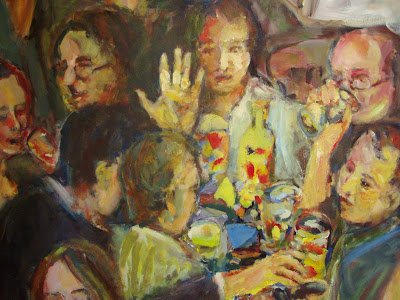

 Isaiah 25:6-10 6 On this mountain the LORD of hosts will make for all peoples a feast of rich food, a feast of well-aged wines, of rich food filled with marrow, of well-aged wines strained clear. 7 And he will destroy on this mountain the shroud that is cast over all peoples, the sheet that is spread over all nations; 8 he will swallow up death forever. Then the Lord GOD will wipe away the tears from all faces, and the disgrace of his people he will take away from all the earth, for the LORD has spoken. 9 It will be said on that day, Lo, this is our God; we have waited for him, so that he might save us. This is the LORD for whom we have waited; let us be glad and rejoice in his salvation. 10 For the hand of the LORD will rest on this mountain
1 Corinthians 5:6-8 Do you not know that a little yeast leavens the whole batch of dough? 7 Clean out the old yeast so that you may be a new batch, as you really are unleavened. For our paschal lamb, Christ, has been sacrificed. 8 Therefore, let us celebrate the festival, not with the old yeast, the yeast of malice and evil, but with the unleavened bread of sincerity and truth.
The feast in Isaiah 25 is presented as a future event. It is an event of generosity and abundance. The Hebrew text is about fat and dregs, really good marrow-filled fat and decanted-dregs. The centerpiece of this feast is the removal of the shroud of death, the shroud that shrouds all the nations and peoples; the swallower is swallowed up. The flow of tears will cease and the disgrace will be removed from all the people of the nations. The hand of God rests on the mountain, the mountain of the feast. That this takes place on a mountain is a sign that this feast is a heavenly feast. This is the salvation that the people of the nations have waited for. It is a salvation that they have not found in the valley of death's shadow. And it is only when they are brought to the place where God's hand rests that they find salvation.
In 1st Corinthians 5 we are invited to another feast, but it is a feast right now. We are told to clean out the leaven that disqualifies us, that we should be a new loaf. Isn't it interesting that the Church is asked to imagine itself as a loaf, clean, unleavened. Christ our paschal lamb has been sacrificed, and we are asked to celebrate, having cleansed ourselves, the Church having cleansed its body of malice and evil, and presenting itself authentic and truthful.
We live our lives in the now and not yet. The feast at hand and the feast to come. This feast at hand is practically the Eucharist, the Lord's supper that we eat. Indeed it is a common liturgical phrase: Christ our paschal lamb is slain; therefore let us keep the feast. But this feast at hand is not necessarily the Eucharist in this passage. Paul, talking about the lives of the believers in Corinth, has chided them throughout this letter for their factionalism and for their lack of concern with sanctification. The Corinthians don't seem to differentiate between their life before knowing Jesus and their life after knowing Jesus. Their lives continue to be leavened with their old ways; they do as they please: they defraud each other; they compete against each other; they tolerate behavior not tolerated in the pagan world. What makes their church different from any other social association?
Paul says that the difference is to be found in Christ, who sacrificed for them, for all humanity, has brought them out of the fear of death, and brought them into the presence of God. Paul uses festal imagery here, as if echoing this Isaiah passage, as well as Jesus's parables about the kingdom being like a great feast, where all the poor, the outsiders, the lame, the blind, the leperous are sought out with great effort and compelled to attend and to feast like royalty. I am unaware that Paul uses this feasting image anywhere else in his letters. Its use here is brought about by the singular issue that the Corinthians pose for him. The issue is this: What binds us together as believers in a world where competing claims and narratives vie for our loyalty outside the fellowship of the Church?
Paul encounters them as people who bring the world's methods into the fellowship of the Church. Not only that, they bring the world's narrative in as well. The world's narrative is this: that matter is all their is; that we must fight to have access to scarce resources; that people must watch out for themselves; and those who falter have only themselves to blame. In the world robbery, permissiveness, greed, gluttony, and pride, especially when conducted under cover of legality, may be winked at; in the world of the Church, a communal world in those early days, such actions harm the body - as if the body were attacking itself. As believers we have to trust each other - we have to trust each other with even the most intimate concerns of our lives. This became especially true in the years after Paul wrote this letter, when during persecution Christians had to trust each other for their very lives. The Christians who live in Iraq and the West Bank and Gaza are living out this intimacy of support right now. They live under threat of losing their lives- and they cannot afford leaven in their midst. Perhaps if we allow our imaginations to think of their struggle, we can taste something of what action and what fellowship Paul is extolling the Corinthians to in his phrase "let us keep the feast."
Let us feast in the eating of the bread and the drinking of the cup: realizing that this feasting is a sharing. What we share together is Christ, and we share Christ with Christians all over the world. This sharing does not come cheap. Throughout the years and to this day men and women suffer for the gospel. They suffer because they follow Jesus who said something about taking up a cross and following him to the place where crosses end up: exposing us, rendering us weak, taxing our endurance.
When we feast we share a cross. We don't fear being executed on our way back from church, or having our land confiscated or being denied the ability to travel to work. Our cross is located in our comfort and our affluence. We fear being uncomfortable and being poor. We hold onto what we have with a fierce grip. You can guess what Christ would put on your cross can't you?
"Let us keep the feast" in our being together, in our sharing, in our discovery of what God's abundance means for us and for our world. The world needs to see this story of God's abundance translated into a living paradigm. The story of scarcity is very strong in the world we live in. How can we increase our imaginations in acts of "faith working through love" that would demonstrate the truth of God's generosity versus the lie of scarcity that leavens the world's discourse?
First we must remember that without the Holy Spirit we can do nothing. When we embark on making this feast a reality, we do so in faith, that what seems impossible, can become actual.
Second we must remember that a feast is not for a single person but for many. And so our churches are not made up of single people but of groups. This very thing is the topic Paul begins with - that we must do away with factions and recognize that in the faith we have common cause. This common cause springs from our relationship with Jesus.
Third we must use our imaginations and not be afraid to act on them, to join together in creative endeavors.
And we must be patient and forgiving of each other. Certainly toes will be stepped on, and it is in this process that we must be open to laughter and graciousness.
There is a feast to come, to be sure, but our task here, as an expression of gratitude for all that Jesus has done for us in bringing us from the mire and blindness of our sin and the sin of the world, is to practice the principles of this feast here in the world.


