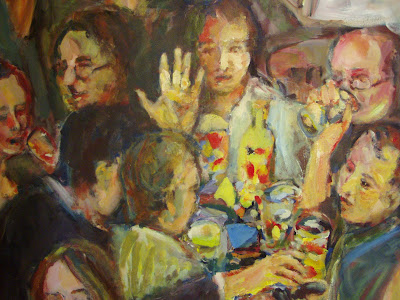
Tuesday, March 26, 2013

I thought about talking about something on my mind


But here are photos of our cat, Cleo, sitting on top of a pile of books instead.


a person waits a long time to be born


you dont know when

and then you find yourself living life. people hand you a name and a host of signifiers. If you are fortunate, you get it sorted out - you understand what your projections are - that even God (the way he's described by family and ministers and such) is a projection: a fantasy of omnipotence and omniscience. God (and there is God) is elsewhere than in the accumulations of propositions people throw up around him (look at how things, doctrines, icons, symbols, money hoarding [and kind of hoarding] are used to maintain power and status). Jesus tried to show that we meet God in loving service - this is the faith and these are the works. That widow, that prisoner, that debtor, that broken man.  Jesus even showed that it's alright to kill God. God, the true God, can withstand death; can die - and it's OK. What a wild thought. What a wild reality. When you are with the God who dies, you don't need war, or hate, or exclusion, of abusive relationships to be the human being you are called to be. People who need these things don't know God - though they may talk about God a lot: mostly to hide their ignorance in their authority. When they talk about the Bible - think of the Bible as kidnapped, held hostage and sedated in an undisclosed location. They are afraid the Bible might become known in a critical way - and then there's noting for it. The Bible goes on about how messed up people are - not because of the "fall" which isn't in there - but because we want what other's and others' have. Cain and Able are the human story: violence followed by remorse and fear of revenge. The Bible also talks about love and courage and generosity - if you would know the living and dying God, let those be yours. That is the life of faith.

God, like Jesus, is met on the Road - as the Emmaus bound disciples experienced. They saw their friend in the sacrament - that is, they saw their Lord and friend in the hospitality of the Meal. Eucharist - give thanks. Give thanks, not like the Pharisee, who fenced the table and said, "I'm glad I'm not like those sinners." Give thanks like the woman breaking the ointment jar on the feet of the dying God. The living God is the dying God - incredible isn't it. But why should this make us happy? We want a God who expresses our power, our triumph - not weakness or humility. Our God kicks ass and takes no prisoners. And that is where you are trapped in your projections - the demand of the Other. There is no end to appeasing this God: whose power is without end - as it is closely followed by his impotence; whose knowledge knows no confounding - as his stupidity closely follows. The Kick Ass God cannot show kindness and can never grieve with you. But don't fear him. The God of scripture is the God who lives and dies and lives again, who works his power through weakness - even yours; and displays his wisdom through stupidity - even yours. Faith working through love: that is how you'll recognize Her and recognize yourself around Her.

The living and dying God is the true parent: the Father who connects and the Mother who nurtures. Human beings are made to be nurtured and to nurture, to connect and to be kind. Our history is one of misuse and abuse: human beings are captured by signifiers of nation, race, class, religion and family - and they find themselves stuffed by them; cowering behind the barriers of their egos, they are too easily inflated by groups, parades and dogmas.

I once took issue with people who didn't believe correctly. I learned my Reformed theology precisely and loved its intellectual quandaries (supralapsarian or infralapsarian). I felt that anger and violence that come from wanting to enforce credal conformity. What got into me? I asked myself. Again and again. Why did a religion that promised freedom have me feeling caged up; how did a faith that promised love fill me with bitterness? I look back and say that a group got into me (but that shifts the blame - I let them because I wanted their acceptance, and that was the price I paid). I say that a signifier (Reformed Theology - as absolutely defined by Berkhof and Bavinck and Hodge et al) got inside of me. And I swallowed it whole. To the point where I mused, "how does knowledge of God that should bring me closer to God's love, God's blessing, God's presence actually seem to be pushing me further away?"

So now I say, "that's behind me." A little bit each day. Now I'm free to find what I want to find in the Bible. Free for Rumi and Deleuze and Whitman and Lacan and Freud and Jung (just as you are free not to - the important thing is that you are free - free from needing the endorsement of a "teacher" for instance). Free to paint what I want to paint (as people are just as free to not want it or to be offended). I feel that in my last 10 years I've pulled a Houdini. Thrown into the water I'm twisting out of my straight jacket. The years I have left are really too short to go through these tricks again. How will I avoid this? James in his letter talks about how we recognize the wisdom from above: that it brings peace and love and not scorn (those people don't know true theology, what idiots) and devaluing human beings.  Importantly I recover a sense of my own agency each day. If my depression tells me anything, it is a clue to how much of my own value I've given over to an other.

I see this dilemma in other people. I know others who struggle with this. They don't trust themselves to use their own mind and investigate deeply themselves. On the one hand, they accept the debasement of critics and intellectuals - and so cut themselves off from the thinking tools that have been developed. Foucault's analysis of Power - that's very liberating; Deleuze's investigation of fascism and delineation of the liberating line of flight -- I would say people need that. Paul, writing in Galatians says that Christ set us free for freedom - and reading this, understanding that they are free - they seek ways to curb freedom in others - quoting Leviticus, for instance, and very selectively. And on the other hand, they are easily taken in by groups where they experience an inflation of ego (Jung is so right about this, an inflation that contains an infantile regression - "teacher think for me") and where knowledge is presented in too simplified and desiccated a form.

I was once there, among them, and now I'm free.

It seems like I've written variations on this before in this blog. Certainly there's more to come. But I am getting better.

salome with john the baptist


Or it could be Judith and Holefernes at the beach. 

devotional sentences

Have you ever found yourself going down a street at night, anytime between 11 and 3 (which are really the same time as people are going to and out of the music clubs - I'm assuming a college town ambiance), and caught yourself, "what am I doing out here?" And you don't even feel like a human being, but you feel like an animal: a wolf, for instance. Perhaps you've "become wolf" in some Deleuzean way, and you don't even know who Deleuze is. That's all right: you'll figure it out, when you've time to study and reflect. But you ask yourself, "what am I doing out here?" And you have the uncomfortable realization that "normal" people are in bed, at home, and,  if up at all, reading a volume of literature or philosophy, sipping scotch. You are aware of people being normal as you pass the houses: most without lights but some with a dim light on - testifying to what you've just thought. There's normal life to be had - or quiet life to be had. Right now, that is not the life you're exemplifying - not as your walk down the street in the dark and the street lamp above you times out. Suddenly it's very dark. And you think, "I need to get back. I need to turn around." Is it already too late. Afraid of meeting a stranger in the dark; you are that stranger. You're suddenly strange to yourself. 

When you get back to your room and your bed, you marvel at how cool and wet your skin is. The days are hot but the night is cooler but very humid. You are covered in dampness. Your heart is beating loud and its sounds fills your ears. "What have I just done," you ask yourself. You look for reassurance: your books and music testify that you are a serious person. Finally your pulse slows down. Your clothes and skin dry out. Was it really that important? Putting yourself in such a state. What did you hope to encounter? Did you think you'd find some answer or get an answer? But you are left with the same desperate questions. Are they really that desperate? Is there nothing in your past that you can't think back on and ponder how it is now different?  That you've already survived this crisis. 

Now you are back in your room and you are safe. You have time to consider how emotions dominate even the coolest thinker. You had been a wolf. At the same time people were out who were birds or rabbits. Some of them, like you, have encountered the uncanny sense of meeting themselves. Fearing strangers, they realize that they are the strangest people that they know. In the past people would sit atop pillars or hide away in hermit caves for this experience. Now the hermit caves and pillars are inside of us. Now the loneliness wraps around us, clothes us, like dampness in the night.

In the past people might open a Bible, hoping to reread a passage of comfort. Now the Bible seems strange. Passages that once comforted seem like wolves or birds or rabbits let loose upon the world. Or else people open a Bible and it is like they opened an out of date cookbook. No one prepares this anymore - this recipe is for a wood stove! Or else they pull a volume down and read, Hegel for instance. And they find a Bible - the story of David and Jonathan, Deborah and Barak, Elijah and Gehazi, Jesus and Paul. I should have used a cookbook as my example, of course, because that would make a fine idea to bracket this concept. It is no matter. The question is how, having summoned your strangeness, what you will do with it. 

Our strangeness is like the Golem - a creature from the clay of our souls. On its forehead Truth and Death - depending on where we strike out from here.


Monday, March 25, 2013

nipples of the high


I held off writing in this blog for so long. Perhaps it was the feeling that each piece had to be a stunner - or else a well crafted, well wrought urn. Like a wee cuppa blether. A wee cupola cuppa blotted blethers. I am glad drawing and painting have been so good to me. I keep going. That's my plan. On Wednesday I'll see Dr Patton and he'll ask if I found any work and I'll say not yet and he'll say that he can't see me until I do. O oui wee cupola couple of blotter blethered breather. 

another set


Where might that next small step be. The thing is to not make things for the other some other - the pain of the too-strong ego is misleading in that respect and cannot be assuaged. It is a question of desire. Of asking the right question. Of solving the right problem.Continuing the line of flight, making connections. Experimenting, not judging.

learning from writing


A blog is read in an odd way, where you read the last installment before the penultimate and that one before the first. In the previous installment I began with a critique of someone's teaching and meditated on my own. I will say that I enjoyed my education courses - I took them so I could be a librarian at this military school. But actually teaching, that was difficult. I got better. I certainly understood the philosophy and styles of teaching better. I think I wanted to see myself as a "great books" style teacher - like I was going to lead my class in some mass recitation of Whitman. But I'm not that, and my students weren't that either.

I felt that I failed as a teacher. I could not convey my love of art history and art to my students - nor a love of learning things for their own sake. Since most of them thought they were going into the military, I wasn't faced with the question of how this would prepare them for a career. You might think they would ask how this would prepare them for combat or logistics (they all think they're going to be SEALS or fighter pilots - no one thinks they're going into logistics or that they'll be driving a truck). Instead I found it difficult to maintain discipline. Later, speaking with my therapist, she told me that my failure had more to do with the environment, that in a liberal arts college I'd have experienced more the classroom I'd wanted to set up: an atmosphere of delight in art and history.

That was kind of her. The way I learned art was somewhat unconventional. My teacher in high school placed me in a studio course - all self directed. Aside from a ceramics class I never took an intro. I learned basic skills on my own, as if they were inherent. And I was successful as far as it went. I went to Governor's Honors here in Georgia, received some honors and scholarships. Then off to college, where things seemed promising.

To describe what happened is difficult for me. I've discarded odd journals from that time. Suffice it that I faced a crisis - probably a narcissistic crisis of some kind, a crisis of ego formation. I floundered around for three years, before I tied my resolve together and went to UGA. I had to make up a lot: science, literature, language - it was a year before I took another art class. The funny thing is that I only had to take a quarter or two of art classes and I had my BFA. I'm still not certain how I did that. I enjoyed taking the core for a year. 

I decided to get an MFA at Georgia. Why not just stay? There were several professors I'd not had the chance to take. Just stay in a place where I'd begun to feel at home.The MFA went by too fast. Before I knew it my show was up on the wall in that barrel-vaulted gallery we had in the [now] old building on Jackson St. After having resolve and drive for a few years I was again without a next step. I never plan a next step. I just assume I'll find something. 

For some reason I had it fixed in my head that I had to stay in Athens and take a job at the library. I just wanted to catalog books and paint and hang out with friends in bars and coffee shops. I don't think I'm alone in that aspiration. Eventually I did all that - but not without  difficulty. I paid a price - a long wait, frustration, surrounding myself with people who couldn't make sense of me. That last phrase is telling. Because they couldn't make sense of me (at this church I was involved in: and that shows how you have to be careful of these things), I assumed that something was wrong with me. Lacan writes that the ego is not just a defense but a frustration - since it is constructed for an other. When I think of my ego, I do realize this, that it is not "for me" but "for you." When "you" don't accept this thing I've constructed (this thing I call Me, my I) anger resentment frustration ensue. Why is this? It may be that a strong ego (and Freud says that the Ego's problem is that it is too strong [see Inhibition Symptom Anxiety] that the ego needs flexibility], being constructed for an other, meeting rejection, is out of touch with the subject's desire. That is, the demands of the ego are exactly where you (or I) give ground relative to desire - since the subject is Desire. The unconscious is a producer of desire - but we can't hear it.

Suffice that my journey to library school at UNC CH began a long odyssey. All the while I'm drawing and painting, even in class. I'm making art the whole time. You'd think I'd take this hint from my unconscious. But the ego, the need to have this supreme creation affirmed, trumped that insight.Again I surround myself with people who don't get me. Let this be a lesson for you, reader: don't settle for people who seem friendly - If they make you feel that something is wrong with you. Think how deeply invested your ego construction is in their opinion. If possible develop flexibility in that ego, and try to understand what unconscious is telling you about your desire. That's a tall order. But when our ego is too very strong and inflexible, the chances that we've surrendered our own agency (as witnessed by depression anger frustration) are high. 

And suffice it that I feel like I'm on the other side of a long journey. Jung critiques our early life that often we don't know how to live, that we confuse living with dying; and that as we near life's end, we don't know how to die. That is to recognize that death is a process too. Not a crisis. 

At 52 all my gifts are still with me. I'm better as a person and an artist. I'm that thinker I fancied myself as. Still plenty to work on, but I feel that I'm going in the right direction. 

How do you teach that? I doubt it is the kind of thing any college or accrediting agency would endorse. Being human is not something that can be measured. It is not wielding logic or doctrine or ideology or emotional panaceas like a weapon. Humanness is measure in kindness. An ability to hear an other but also to hear yourself. To achieve that flexibility of ego that is able to let go of its demands, its need for affirmation. 

Sunday, March 24, 2013

learning


The other day I overheard a teacher indignant that a student inquired how they might find a job - there was so much more to teach, and this, this cheapening of the process. Maybe the student should try google maps, the teacher's friends chortled. Whatever the motivations of either party: maybe the student is craven or stupid or earnest - but she was "just" a student - the actual consumer (and someone who could say, "I determine what information my education pays for: I'm paying you for information."). I certainly took classes from "rock star" professors - some of whom could be pastoral (that is, they remembered the uncertainty of studenthood) and others who felt the student was lucky to be paying them. 

But I think what happens in such a situation is what Deleuze describes in his book on Bergson: asking the wrong questions: mis-identifying the problem. For the student, the answer to her problem is not finding the job, per se. But she doesn't know that, and, perhaps because she has parents hectoring her to major in something with proven financial rewards, asks this question (that is so offensive of the purity of the study). 

I can see something like this working out: 
Student: [a question which content is How do I justify my existence?]
Teacher: [an answer which content is I am only prepared to justify my own existence.]
Student: How do you justify your existence?
Teacher: I'm being paid for this [which is usually framed in language which describes the echtness of procedures or some variation of work ethic or some engagement with coded valences of alien/suzerain/subaltern agency in postcolonial speech.]
If the student follows up, the teacher might admit that they don't know. 

This is the truth. That turning education into a living is a crapshoot. The people who don't realize this have won enough that they entertain the illusion of skill. There are people with skill scattered all over our society. Many of them are not winners per se. They are surviving. They know what it is to miss - to be sent back without being called up again.


So something more is desired from education. The need to ask the right questions, to recognize the right problems. The teacher here is caught in the same problem as the student. A problem neither recognizes. So the teacher comes prepared with his own justification, his own rules and accomplishments - as if that is the Thing he is teaching. The student wants to learn How to be justified (that is the root of all questions from home and peers: How will this class get you a job, or make you a better person - or failing that get you a job [which is also called a career when speaking from a nonworking class vantage point]). 

Lacan and Jung would say that what the teacher wants to teach and what the student wants to learn are being missed by both parties. Lacan would say that they are both operating on their demands - and that for either of them to give the answer the other wants, or accept the question the other asks, would be castration. Jung waves off the reduction of education to an exchange of information. He might say that the teacher must be prepared to teach an example: this is different than telling "how I do things". It is being willing to be and to fail and to discover again - it requires a vulnerability, a willingness to be intimate: as in, Yes, this is the way I am. I am showing you how I look when I fail, so that you needn't be afraid of failure.

Lacan frames these things in terms of competing desires - which are not the same as the demands - think of the demands as defenses, and then think of the desires as the gap in subjectivity of both teacher and student. In some ways the student would learn better if she could accept the fact that she will not learn what she demands to from this teacher. The teacher would do better if she could accept that her demand to be venerated, accepted as the example qua example, by the student will be a failure. [it is another kind of failure when the teacher does receive that veneration - because such veneration proceeds from a lack of knowledge on the venerator's part. The venerated is only venerated for her persona].

This seems to require a collegial model of learning. In this sense, the "teacher" is in the same position as the "learner". What Paolo Freire attempted is more sensible to me. The thing is: this anti-banking method (banking method = I, the teacher, fund your ignorance with my knowledge - you have nothing to give me but your attention. Freire abolishes this division) of Freire's is the way most of us learn outside of a classroom - we share information; we share successes and failures; we relate to each other on a human level. There seems something de-humanizing about the way education is set up. Whether it is in terms of the adept filling students minds with facts or the technical advisor inculcating the material of a vocation, there is the assumption that the person behind the podium is More Than and the pupils sitting at desks or easels or benches is Less Than. As Blanchot points out - The distance from teacher to student is not equal to the distance from student to teacher. 

palimpsest zeus