Sunday, June 14, 2015

piano quintet


[I needed to park this thought somewhere; so why not here - I began responding to a facebook post and thought - not here - no one really talks on social media]
Jesus isn't a device or mechanism we need - that's what's problematic (among other things with most atonement theories [for a good run down of those check out Peter Schmiechen's Saving Power]). I don't know if you were using "need' in that kind of "means to an end" kind of argument. Still, consider what you need anyone for - or better yet, what you need lungs for. Knowing Jesus is the end or goal of Christianity for each person.

reminiscence of gardenia


I began painting in a one room log shack erected on the banks of the pleistocene inland sea that became the drainage sluice behind my grandfather's store - in those days pigments had to be mined and ground to a fine powder - usually by thorough mastication and mixing with turpentine and berries.When we weren't minting our own currency we dabbled in ham radio - which were actually made from sheep - lined up on hill tops during thunder storms in order to generate enough static cling. One year, in order to visit Florida for spring break (where we fixed broken springs) we sold magazine subscriptions to the dead - who preferred Life over Time 2 to 1. Those kinds of wild adventures are far behind us now. Now I find myself and my colleagues vexed by the quotidian meal plan casserole of beans and chilis and beets


Thursday, March 26, 2015

the infinite mind


oh sure, I could fall in love with my brain, its immense resources of ratiocination and inquiry - like many before me - only to see it vault forth from my skull, like a renegade gastropod; taking up residence in some Macy's thanksgiving float, manhandling its way down the great white way: which happened once to a woman I knew, her brain taking over an air traffic control tower and diverting all flights to Rio:


Saturday, March 21, 2015

what feels like my last sermon


John 12: 20
Now among those who went up to worship at the festival were some Greeks.
 They came to Philip, who was from Bethsaida in Galilee, and said to him, "Sir, we wish to see Jesus."
Philip went and told Andrew; then Andrew and Philip went and told Jesus.
Jesus answered them, "The hour has come for the Son of Man to be glorified.
Very truly, I tell you, unless a grain of wheat falls into the earth and dies, it remains just a single grain; but if it dies, it bears much fruit.
Those who love their life lose it, and those who hate their life in this world will keep it for eternal life.
Whoever serves me must follow me, and where I am, there will my servant be also. Whoever serves me, the Father will honor.
"Now my soul is troubled. And what should I say -- 'Father, save me from this hour'? No, it is for this reason that I have come to this hour.
Father, glorify your name." Then a voice came from heaven, "I have glorified it, and I will glorify it again."
The crowd standing there heard it and said that it was thunder. Others said, "An angel has spoken to him."
Jesus answered, "This voice has come for your sake, not for mine.
Now is the judgment of this world; now the ruler of this world will be driven out.
And I, when I am lifted up from the earth, will draw all people to myself."
He said this to indicate the kind of death he was to die.
The crowd answered him, "We have heard from the law that the Messiah(1 remains forever. How can you say that the Son of Man must be lifted up? Who is this Son of Man?"
Jesus said to them, "The light is with you for a little longer. Walk while you have the light, so that the darkness may not overtake you. If you walk in the darkness, you do not know where you are going.
While you have the light, believe in the light, so that you may become children of light." After Jesus had said this, he departed and hid from them.

This may well be my final sermon. I'd like to begin with a polemic - perhaps an harangue. A rejoinder to the easy theology of the day. A kind of validation of the Bible as a thing in itself - a reification of divinity absorbing all necessary human devotion. 
The purpose of scripture is to bring us into fellowship and life with Jesus. In my life and reading I've encountered people who've used at as an instrument of divination - holding a needle suspended on a thread over a passage in Ruth to see if they should marry. This practice of Bibliomancy - yes, that's the word, and it has a nice article in wikipedia is ancient and varied in different cultures, running the gamut of sacred books and poetry. Some people pretend to find a history of the world or the world's end - setting forth an amusing array of world leaders who must be the anti-Christ. There is often a a clamor to make the Bible's law the law of the land. As if this would usher in the golden age - like existed back in Neverland at no moment in history; as if Christ ever endorsed a political party or took policy positions and sent emissaries to local officials with bureaucratic proposals. Or as if the apostle Paul, in writing to the Galatians, concerning their appropriation of circumcision, tells them that the desire to be justified by the law (and therefore to use the law in place of the Holy Spirit) cuts them off from Christ - removes them from grace. 
This desire to use the Bible as an authoritarian instrument is strong in our culture. The solemn intonation of "the Bible" with its attendant predicate "is clear" - and then, the appeal to emotion under cover of logic - a logic rife with ad hominems, false dilemmas, slippery slope fallacies - such cognitive dissonance that were it set to music would rival Schoenberg's late work. Yet invoked with such a straight face and earnestness of spirit: a certainty that if we don't heed their edict - as indicated by its preface "The Bible ... is clear" - then we are doomed to the lake of fire, social ostracism, and death by hangnail. 
And I am here to tell you this morning that the testimony of 2000 years of church and world history - on down to histories of local institutions and individuals - testify to the fact that the one thing the Bible is not, is clear. Not for lack of trying. Not for lack of attempts at one size fits all - from papal infallibility to fundamentalist notions of inerrancy (which make God into a Schrodinger's cat - imprisoned inside an inerrant box, awaiting the inerrant key welded inerrantly by the inerrant individual, who, believing inerrantly inerrantly unlocks at the inerrant time in the inerrant way and delivers to us the inerrant word that cannot be misunderstood - once for all for all time - until which time we are left to speculate whether God is alive or dead inside - in thrall to the minions who guard the way - who like the Pharisees in the gospel, do not go in themselves and who get in the way of  those who try).
And when I say that the purpose of scripture is to bring us into fellowship with Jesus, all this I've just said, is what I feel must be fought against. People use the Bible for everything but knowing him. How heartened I was years ago, when reading Calvin's institutes, that he said that Jesus remains unknown, hidden and idle from us until the Holy Spirit waters our minds and hearts. That the act of knowing Christ is not the act of assembling propositions but of encountering him along life's way. With his emphasis on the work of the Holy Spirit, I'd almost think Calvin was a pentecostal!
A manner of encounter pictured for us in the Emmaus road encounter, where he opens the disciples minds to understand what scripture says about him - not what scripture (and back then, before the epistles and gospels had themselves been written - but what is called the septuagint) - not what scripture says about the topics of the day, or how to be happy and fulfilled, or how to lose weight or plan your retirement or get out of debt. None of that. It is after all Christianity - not bibleanity, not financial services-anity, not getting my way-anity. No seven or twelve or 3 habits of successful wishfulfillment. 
My whole life, I've thought, there must be something to knowing Jesus - but how? 
Certainly, when we read the gospels, we encounter a man - who doesn't present himself as something other than himself - no press releases, no marketing. He says things that seem counterintuitive or intentionally dense - and this text today is like that.
Central to this passage is knowing Jesus as someone who draws all people to himself - while casting out the ruler of this world. On one side of this statement is an adage about the necessity of a seed to fall and die in order to bring about fruit; on the other side is truism about how impossible it is to work in the dark and the necessity of finishing work before sundown.
"Unless a seed fall to the ground and die, it abides alone." 
I find this a requisite in hearing the scripture - to set aside the urgency of fitting the word into some preconceived understanding - to try hearing it, as if I'd never heard it. How easily we become trapped in our own cannon. When we get around this, we discover a richness we'd unsuspected was there. I find this works in painting and writing - the notion of killing your little darlings: otherwise the story stalls, the image becomes labored and contrived. And in life too - we have to let go of how we imagined our selves, imagined our lives. We let go of some fantasy to finally use the things we have - to say that what we have, how we are, is good enough. In object relations, they say that the theory must die before you can use it. Certainly in this passage, the notion of what a messiah was, what a son of man was, had to die - had to die, in order for Jesus to be that. 
And the ruler of the world - the ancient rabbis didn't think of the "ruler or prince of the world" as the devil or Satan, per se, but as death - the fear of death - and how the fear of death rules our lives. The fear of death tightens us up inside. A miser fears the death of his fortune - and so tightens his grip on the money bag; a bully fears impotence and so tightens his grip on those who are weaker. In this gospel's final chapters - when Jesus is being questioned by Pilate, the real "ruler of the world is invoked" where Pilate is accused of not being the emperor's friend if he let's Jesus go, as well as a scene where all the rulers and people proclaim that they have no king but Caesar.  And how isn't that the fear of death - because not being the emperor's friend isn't some unfortunate turn (well Pilate Caesar's just not that in to you) but is death itself: a political death at least and actual cessation of existence, probably in a painful way, at worst. 
The promise here is if we let Jesus be lifted up (not on our terms or according to some worldly end) then we will truly live - like the seed that fell to the ground we'll no longer abide alone. The promise here is for thriving in our lives and living in God's abundance - or perceiving God's abundance where our first thought isn't "what is this among so many." 
I think part of turning toward Jesus and away from the death that rules the world is that not only do we see our selves but we see others. Frederich Schleiermacher spoke of such fellowship as "stepping beyond the limits of [our] own personality and [taking] up the facts of other personalities into [our] own."  Such an image bespeaks the hard shell of the seed being broken and allowing the nutrients of the earth to come in. It is a death - a death of going my own way, of believing the image constructed for me - letting the mask slip. 
Finally there is the image of working in the light - and I suggest more so, letting the light work in you. In the Holy Spirit we hear with new ears and see with new eyes - as Calvin said. And what was the inert letter of scripture comes alive. What comes alive is Christ in our hearts and reaching out to Christ in each other, in love, in freedom. We find our redemption in growing into the multiplicity of God's image in us and in creation.
This image is ever expanding. As we see in this passage it is an image that kills our expectations while bringing to life realizations we could never imagine. Dead is the conquering messiah - who makes Jerusalem the new Rome; alive and active is the son of man who passes through the pale of death and returns - triumphant in love, subduing violence with healing the human soul. And throughout church history we see this, beginning in Acts - where Gentiles become part of God's image - a scandal in its time that baffles us today. Again and Again the Holy Spirit opens doors for groups formerly sequestered and denied - slaves, women, gays. 
It is in God's generosity that the hope for all of us finds fulfillment. In our own strength, our own prejudices (no matter how affirmed by sellers of impotence medication), we abide alone. This passage give me hope; Jesus' words here meet the hunger of my soul - that I might be released from the buttons that have been pushed throughout my life - buttons that make me hate this person, buy this drink, read this book, vote this line, fall in line and take orders. What a world we live in - we're sucked in and blown out with barely time to think our actual thoughts. All this time we've been thinking mom's and dad's and grand pa's and the Sunday paper's and the TV's - but not our own thoughts.  And this is the Messiah's promise - Jesus, the author and finisher of our faith, that in him we find the space to be ourselves, finally, and live, even in dying.
As Sam Phillips sings:

Broken like a window
I see my blindness now
And I need love
Not some sentimental prison
I need God
Not the political church
I need fire
To melt the frozen sea inside me
I need love


In today's passage Jesus stood on the shore of that frozen sea - the frozen symbols of political and social stratification that freeze us up from going beyond ourselves, emerging from our living deaths and feeling the light on our face for the first time perhaps. And seeing that light in another - perhaps a prisoner, perhaps a lonely person, perhaps some homeless stranger - or someone known too well and too long. Lift up Jesus and cast out this world's rules.
I can't stand here all day. We must be on the way.
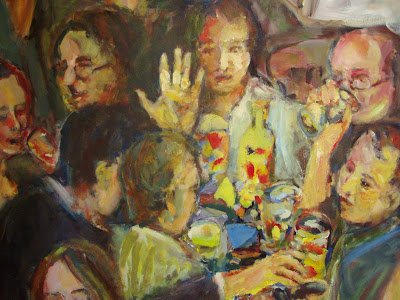


Monday, January 05, 2015

a newer year, still in sequence


I used to walk and never get tired - I clambered over mountains in North Carolina and Colorado - I've jumped gaps in beaver dams and waded across streams - I slowed down, but didn't stop


When I was very young, I would spend hours playing in our dirt and gravel driveway digging holes and burying toy soldiers and cars - there I discovered that when I placed a magnet in the soil all these filaments would organize around, tiny speck of iron - who knew! I began to draw lines of filaments back and forth across the driveway - I was proto-magnet


If we chose to, the lives of others proffer no end of material to judge - the comforts afforded by this material are deceptive; it is better and healthy to examine the lives of others for material to love, to find connection with.


My family stories don't go further back than my grandparents and their childhood reminiscence of perhaps older family - who were most noted for not having teeth or for being very feeble. The census reveals lots of farmers with some military service - people dedicated to doing nothing special and not talking. Following my great grandfather through the census (a notorious drinker and womanizer) I think the census captured him in a brothel in Griffin - which the census taker refers to as a boarding house, where most women are in their 20s and the men are older. My ancestor left with three other men "before information could be obtained." Which is circumstantial, not proving anything, only that the process of elimination says this could be him, who otherwise would not show up in the census at all - not entirely outside of possibility


I notice two kinds of people who approach me as an artist: there are those spurred by paranoia who are suspicious of what I could be doing; and there are those, many more, who are curious, who seek to engage imaginations and connect


What glorious fun, where life just grabs and carries me along for a bit, without analysis or critique, only delight

a picture story at bed time


stories I tell myself


When I was seven, I embodied the pop ethos of the day: Batman on a bike with boxing gloves - I had only begun to face off with the army of signifiers that "want to stuff the subject" in Lacan's terms. Inherently I understood the truth of Tao - to do without doing - that the very act of attempting consciously would be defeat. Taoist Batman doesn't use violence to fight, instead acting deferentially he undermines the kingdom of violence through strong kindness and moral imagination

my great great great grandfather was crossing the Atlantic when he was swept over board in a fierce storm. When he regained consciousness he discovered himself in a house in Philadelphia - being cared for by Quakers. He had forgotten his family in Devon, forgotten the wife and infant son left on board the Intrepid (which eventually reached Savannah). He grew up trading in dry goods - eventually marrying and raising a family - the first 25 years of his life a mystery he never penetrated


I developed a method of test taking where I ceased studying at some long interval before the test; I realized that anxiety took energy I needed for thinking and recollecting. The answers were always there when I let my mind relax. Frenzy, obsession and worry are too often credited as studying - I found staying clear of people psyching themselves out to be helpful. Finally I discovered that I could love any subject, no matter how foreign, and loving it helped my mind embrace even the obscure and difficult elements, so called. It helps to stay away from people who complain how they hate a class or a teacher. At test time, take a moment, breathe, listen for the first seconds of frenzied scribbling and paper shuffling, close your eyes and descend with pencil upon the page like a swallow landing on a sill

I wait and move the brush along; waiting should not preclude painting, making marks; waiting moves even as I wait - that I should find something more than a mere answer. Blanchot's remark that the answer is the malady of the question obtains now more than ever: the world is full of answers for questions only half understood; we are fountains of answers for people we only half know. Alexander's answer to the Gordian knot cut short the beauty of the knot - why people in all their problematic existence find in the problems beauty? Stroke after stroke, wash upon wash, lines hatching thoughts.


visiting Cezanne again today to see what he has to tell me - last week this watercolor told me of its life on the wall, how it tried to translate the state of nature into broken planes of color with slight over laps and gnawing fissures - it alluded to something Deleuze said about sense and surfaces - and non-sense. I was reminded of a time in my youth, alone in the woods behind my great grandfather's farm - an odd path where the road went before it was re-routed and paved: and it told me that we're always having to learn to see and how important translation is in that seeing - to find the proper sequence, the tonal phrase: so that I might describe what I see, not vaguely repeat what some ancestor said

he describes himself as flowing from the promitories of habersham to the diversionary canal of the intercoastal waterway in glynn gary glenn ross


This morning I put on a beige sock and a brown sock; when it was pointed out that my socks were mismatched, I responded, "yes, I believe that they are on the wrong feet."


On the way to the farm in Tennessee, aware that we'd need bloody Marys during the holiday, I surmised that the Krystal we stopped at must be near a liquor store. My intuition proved correct. When I was telling my sister-in-law, she remarked that Krystals seemed to be located near liquor stores in Nashville. So it could be that I have this intuition because for whatever reason there is a symbiotic relationship between tiny hamburgers and vodka - still, correlation is not causation: or so I tell myself after a bloody Mary or two

Washington was famous for chopping down cherry trees. The story goes that valley forge was clogged with cherry trees, wagons couldn't get through, people were trapped - starving, whole families - and then Washington, like a beaver with his wooden teeth, buzz sawed a path to freedom for the beleaguered forgers. No lie

after many years I can sit in a room full of people and the thing is loneliness is not even a factor - instead I feel a satisfaction, a completeness; Part of that is the realization how weak anyone is, myself included, as a placeholder of personal validation: most authorities hope to weld power over the child in us - in the end, as imposing as they seemed to us when young - they can send no one to hell, their sweaty, arm around your shoulder in confidential manner was scant cover for the seething impotence birthed inside them - and that is your principal, your preacher, your scout leader, your first boss, the dean of students et al - even as they're "bringing down the hammer" they've got nothing. Grave on their tombstones - "this is going on your record"


It's odd how Schleiermacher has come to be my favorite theologian - reading him, he's nothing like what others have described ; when I was very conservative I used to read "the other side" on a slippery slope too. A slippery slope is no where to live. I used to point out how other people's ideas put us on a slippery slope - then I discovered that I was the person on a slippery slope. What if everyone's favorite fallacy used as intellectual bludgeon turned out to describe themselves more than their targets. This holiday season I'm using the "excluded middle" so I can wear my favorite pants again.


Thursday, October 30, 2014

an entry


Some time ago I was reminded of all those reproductions of praying hands. For myself, I thought, I'd just as soon have an emblem of praying feet.  Praying feet is an alternative to the cliche praying hands have become. I would rather not say what praying feet mean or be satisfied with any meaning that might attach to them - other than "these are not praying hands." I hope one day that praying feet might become as much a cliche as praying hands.

Friday, October 24, 2014

he describes himself as a vessel, a container of symbols


he describes himself opening his mouth: like a pod expelling seeds into the wind


he describes himself as painting over there, sometimes writing, sometimes reading or staring out the window or across the lawn or at the clouds


he describes himself as the boy left alone in the woods, who got off the bus to a locked house, who walked through the rain down a dirt road when the bus ran in a ditch, who forgets what he's told to forget but remembers everything - who remembers the smell of sweat and cotton on a millworker's skin, who remembers air conditioning only in town (otherwise lots of fans, in every room), who remembers light bulbs hanging from the ceiling on cords with string pulls.


he describes himself as floating, separating, coalescing, forming, distilling and solidifying in a protean display of nuance


he describes himself as someone who thinks a horror movie set in a coffee shop called "save room for scream" would be a delightful freakish romp among the urban haute bourgeoisie


the human body is a canvas, a rollering body is a film - what movie do you want to project as you loop about, bumping banging grinding - and all for glory


he describes himself as making friends with his demons and the bitter angels of his nurture: it's taken years with many sing a longs, pool parties, outings, workshops - but all worth it in the end as well as the front


he describes himself with panache and elan, subtlety subtitles and sub rosa - which he's never understood and needs reminding, as a fluffy cat settles in his lap for an extended nap, the pledge drive enters its Nth day - like the Bach cantata, the pledge drive, which he heard performed in college - such a terrible bout of allergies that day - reveal to me lord your will - and sure enough Will did just fine - he, on the other hand, chased away rattlesnakes most of the night


he describes himself as an observation of time and the passing of space, caught up, rended, winded, cooked up, concocted, spun dry, folded, pressed and delivered with a slight bell tone vibrato beyond ear-range reverberating across the skin, settling into wrinkles and creases like a gypsy band


he describes himself as a ten-way intersection of three-way streets with a super-highway parkway overlook vista of the industrial park near the post-colonial village where children race their soapbox super tankers down the steepest hill for incredible prizes: matching socks, prescription lenses, and clip-on bow ties


he describes himself as a Finnegan's Wake style flow chart, not just Yes or No options but Why Not, What Difference, 20 Sided Die, Might, Both/And, Either/Nor, Ether/Noir, Yet, Noh, ... , Then, There, That, That'n, That'n'll - as I remember my grandfather saying, "that there'n'll there'll that'd then ull make a right smart'n'll there'n all" And we all knew implicitly his directions, even as drawn out on the back of receipts, over roads and down back ways, highways and dirt tracks - there there in a clearing was a stump near a mule grazing under the small clouds of summer with flies buzzing languidly among the bee addled pea vines. Here is where it happened as sure as I'm standing here talking to you as sure as you're standing talking to me.


he describes himself as a natural process: cell division, neural connections, consciousness shooting along pathways mostly embodied, filled with the legacy coding that informed life in semi-arid plains, glacial alpine valleys, and temperate zone estuaries


he describes himself as an orphan of orphans, an exile of exiles, a wandering one-off of wanderers, orienting himself with scraps, texts, images, snatches of tunes - birdsong and worm song - the feast of famine, the sage brush, the dogies punching back, the cattle rustling in the leaves, the deer baby sweeps


he describes himself as part of nature: not a force of nature, perhaps an off shoot, a tendril curving in a space-shaped human, like a mainspring in a watch, composed of odd tics


he describes himself as a constructivist composition, all diagonals and blocks of color with graphic elements, repetitions and active negative space


he describes himself as not knowing what to do - as doing things that don't work out; but still, witty, insightful, imaginative. Once there were millions of mules in the South - durable beasts, smarter than horses. I never see them now as I did in my very youth. In their place are orange pylons and high voltage wires. The river is a culvert now, the spring under a parking lot; the meadow where stills once glistened in moonlight is now a 24 hr pharmacy.


he describes himself as blue green, violet, pea green, pea red, sea foam black, burnt white, sky yellow, sparkling gray, flake red, tartan pink


he describes himself as caught between the opposed facts of "no one can tell me what to do" and "no one can tell me what to do"

he describes himself as stumbling, darting, crawling, striding, clambering, drifting, hastening: in a loop, a series of repetitions, like a satellite orbiting an invisible yet dense point of reluctance

he describes himself as a wanderer on the surface of the planet, through subtle terrarium vaults, along mountainous escargotments