Sunday, October 04, 2009

I'm turning my bible, like all my books, into an altered book


I'm drawing like mad in my Bible, which shouldn't surprise my friends. The bottom drawing is a favorite, Yahweh walking on the vault of heaven. Remember, the ancients, up through the early renaissance, believed that the earth was part of a physical reality that was within reach, that one place was reasonable placed near another - in many ways just the opposite of today's assortment of facts: we live on a rock covered with a thin atmosphere suspendend in space orbiting a sun incredibly distant from the stars, which are not intelligent celestial bodies but fussion reactions blazing away with immense gravitationally induced heat amid a cold, empty space. No gardens of the hesperdies, arcadia, golden lighted dances among the spheres, musically playing above the orbit of the moon. Even young earthers can't deny the facticity of where the earth is and how it's situation is uterly descrepent with the observation of scripture. Scripture's observation is all right with me, just like the Illiad's observation is - I'm not expecting scientific verification in ancient texts; I expect these texts to reflect the milleu they were written in. They operated with the best knowledge they had, which was direct observation. If anything, this shows the flaws in direct observation. The Holy Spirit could have been sending a zillion volts of knowledge into the minds of the yahwest and priestly source, and they would have still operated on the ancient paradigm - it's the way they had been wired through their experience and the absorbtion of common knowledge.
I still like the image though. Much like CS Lewis in his Discarded Image: God tromping around on the vault of heaven like an old man in the attic looking for some old photos; and how wonderful to think that the stars were celestial bodies filled with conscousness and intelligence, as we are but immortal and all knowing, influencing us with their various powers according to the time of our birth and time of day; that there needs be no Progress, because all is made perfectly right and decreed as such by the immutable decree of God, the unmoved mover who moves as he is beloved. It's nice to think that, but it doesn't reflect the facts. And so scripture doesn't reflect facts, as such, but retains an inerrancy, a very small 'i' inerrancy, as it exists in light of the life of Christ as revealed in our minds and sealed on our hearts by the holy spirit.
I'm having a great deal of fun with the song of solomon.


three cheers


I've been drawing small pieces lately since I've run out of my standard 7 x 9 in meridian paper. I got a larger pad ordered through Amazon and I'm tearing the paper in two. Here I'm drawing in the margins of my Poetry magazine this recurring image of myself, Whitmanesque, pen in one hand, sometimes hoisting a brew, a stout, an ale, an ipa, in the environ of a bar, books handy, a plate with wings or pork sandwich half consumed. Such for me is an eschaton, the game on the TV. Perhaps Jami will come by or perhaps she's already here, and then all things are perfect. Outside on the street it's still sunny, perhaps mid summer. Maybe Bob will come by and play shuffle board.

from beginning to end


I dont' have any photos available here of Mattie Fay between 1932 and 1986, but I do have these two photos from the final 15 years of her life. In the top photo, she'd been at the nursing home for some months, having had strokes and experiencing dementia. I don't know what to call it. I remember her once saying that she felt like her head was in a knot. Eventually who she was didn't resemble anyone we'd known. We would visit but each visit felt odd, as if we were talking with a child or a stranger.

Early images of my grandmother, Mattie Fay, her family and my grandfather


The bottom photo, which must be Mattie Fay at her father's funeral in 1918, is so evocative of the 19th century South: the mule, the bonnet, taking a photo in a graveyard - who does that? And then the photos of her with her mom and siblings, alone on the school grounds that was in the mill town her family moved to. And the top photo, my grandfather courting her, in the graveyard next to his daddy's farm. I like how this set is bracketed by two graveyard photos. These photos as well are source photos for the Working on the Rail Road chapbook. My grandmother, for some reason, comes to mind when I hear the song Little Maggie. A song that seems out of character for my teatotaling, church going, grandmother. But then, as she told me, she and my grandfather lived a much rougher life when they first married.


The cover to I've been working on the rail road

It's on a much larger piece of paper, 10 x 12 or something like that. Meanwhile I continue to expand this theme. I think it is tied into my lifelong frustration with not being heard. I don't get the sense that anyone listens to me: outside of Jami and a few friends. Perhaps you [whoever might be reading this, if anyone] too have had to struggle to insert an observation only to have the conversation continue like nothing was said. Certainly there's a question of relevancy. I ask Am I relevant. Sometimes it's true I'm not. Certainly there's that verse in James that counsels us to be slow to speak and quick to listen.
And I've lived a passive life - because of this? I don't know. I could stand to be more aggressive, more assertive. And I work on that. I work on that understanding aggressive not as ranting or being thoughtless. But standing up for myself. I find that I don't often enough. Defering to others is not my problem. Speaking up for myself is.
I see other people who are good at it.
I wonder what that's like.
In the song, working on the rail road, someone asks for Dinah to blow her horn - which Dinah never does. No one hears the watchman or captain calling - all the livelong day. Do we really hear the whistle blowing? Is it too early in the morning? Meanwhile time passes away. And what is a rail road but two parallel lines disappearing on an horizon - two lines that lead forward, not backward, in time, to a vanishing point, oblivion, the eschaton. Does anyone listen to the singer's warning. Are they caught up, strumming on the old banjo. Dinah trapped in the kitchen [an early feminist critique: women could help if they weren't trapped in the kitchen] by someone - the super ego, the big other. Dinah is a huntress and her skills are being wasted by this someone. The trumpet, the horn, to be blown is the 7th seal, the final blow. The banjo, an instrument of African import, also slaves away, strummed upon, a sturm and drang, and so the Hegelian master/slave dialectic comes to the fore. The eschaton, the millenial kingdom on earth is delayed by human preoccupations with power dynamics.
In the end working on the rail road is a diversion from creativity, a cul de sac, much as my father experienced. A necessity, certainly: food, clothing, housing - such needs, but the humanistic needs, the existential need, goes unmet.
I remember the old commercial "who needs america's rail roads? We do!" which played when I was very young. But do we need this?

Saturday, October 03, 2009

WotRR image 14 and a source image


WotRR images 9-11, 13


WotRR images 4-8


Things develop and morph. By image 8 I'm letting lines go and not worrying over surface details. I'm more concerned with composition and creating a sense of freedom and energy. Lately I've been thinking about how, because of childhood trauma, I have lived what I call a disembodied life. I noticed this in Chicago, walking through the Art Institute, and then it hit me looking at the Gustons and the Twomblys - that what I'm looking for lies in the direction of putting out myself in the image. That on the one hand my super ego constrains and inhibits me toward a sense of mimesis and need for precedent - while on the other hand my id and libido demand gratification. What gets lost in this dialectic is what makes the work mine. Jung would probably put the conflict between my shadow and my persona - a dialectic that avoids integration in a self because the persona and shadow aren't directly engaged with the ego. Deleuze might talk about how I judge too much and should concentrate on bringing into existence - take whatever I find and connect it to whatever comes. There's value in all these viewpoints - all lead to a sense of freedom with materials on a surface corresponding with a freedom inside me.

I've been working on the rail road images 1-4


The first four drawings in my series of "I've been working on the rail road", a song I sing a lot lately, perhaps for it's simplicity. I alter the melody, this morning for instance singing it altered to the tune of U2's Bloody Sunday. I change the verses around and language, singing the song backwards: The banjo strums in kitchen all alone/ Dinah blows her horn to pass the time/ The watchman rails upon the road I've worked/ all day along. When I take the principle of unreliable narrator to the song, mysteries are opened up. What events does this song chronicle? Is it a veiled reference to a Pinkerton union busting activity, a miners' strike?
How do we account for Dinah's reluctance to blow the horn? That she must be asked repeatedly. Who is this person in the kitchen with her? Is there a person at all, or do we merely suspect? And the banjo strumming. An old banjo and not a new one? Does a person really work on the rail road just to pass the time away? All day long? Early in the morning?
In the second drawing from the top, you can see the banjo player's foot on a bit of rail. The only real reference visually to rail roads in any of the series.
I'm also confused about whether a watchman or a captain shouts for Dinah to blow her horn. This song has been around since I was small, singing it in 2nd grade. Yet it's not the classic that Little Maggie is (another song that as I have worked on this series has settled in; another song that has two sets of lyrics, and I wonder in the end of the song, What is this image of her on the banks of the ocean with a 45 strapped around her and a baby?)
I've been working on the rail road is almost as banal song a Polly Waddle Doodle all Day - which opens The Wild Bunch. Still while that song defies decoding, Working on the Rail Road invites it. And so: I have the dialectice of the chess match: a reference to Jung's notion that the unconscious and conscious exist in a dialectic. The characters around them are not distractions but archetypes, symbols indicating an unknown goal - as Jung also said.

Here's a typical frontpiece


Part of my series "I've been working on the railroad" - a series where I repeat the central theme objects: chess players, cat, banjo, trumpet, minister with raised hands. Through repition things change. I relate this development to Berryman's Dream Songs.

Marginalia from my copies of Poetry Magazine


One thing I enjoy about Poetry, besides the fact that it consists of poetry, is that the paper is conducive to a type of line, having a good tooth and not slick, and that the white space provided by the format of poems allows for some fun integration of image and text. For me it's practice. Sometimes I find that I do some images that I wish I had done on more artistic paper, higher rag content, more seperable, more presentable. Still I'm content with the volumes, which, when money runs low for purchase of more paper, serves twin functions: material to read and space to draw upon.


Monday, September 28, 2009

folds


Deleuze emphasizes folds as a metaphor for how concepts open up, how life opens up. Merleau Ponty uses folds to say that "unfold time behind us" or that time folds up behind us. There is this sense that as with a crease, we both sense and nonsense reality. Things are folded away from us. Things fold out. We have a sense of expansion and contraction, as with an accordion, that things can seem temporaly near but spatially distant, or vice versa. Like a gag trick folds indicate that more is nested in a problem than we supposed, or that more can be pulled out, as with the magician and the handkercheif, one after another. Or sentences in Tristram Shandy, containing subordination within suborination, parenthetically paranthetical and apositive alongside apositive.
Artistically folds give us clues to the contour and mass of an object. A flat surface tells us nothing. As the surface becomes scarred, creased, differentially rubbed, more is disclosed. So a fold discloses even as it hides.
Deleuze uses the french Pli and its prefixes and suffixes: complicate, explicate - to describe how folds fit into our concepts of description.


Sunday, September 27, 2009

a visit to the museum


I spent Saturday in the Art Institute of Chicago and most of it in the new wing where they've moved contemporary and 20th century art. I couldn't photograph the Twombly exhibit (which is gorgeous - and I've not been warm to Cy in my life - but here: here are large panels of greens and reds and yellows, where the paint is allowed to course down the surface). Instead I was drawn to the Richard Gober - whose work I'd never seen as a total installation before. The Nasher here in Durham just displayed the litter bag - why show that at all if the rest of the installation is left out? The Guston - I fill more Guston as I grow older. I understand what he's doing. And the comparison with late Morandi - so apt: the hesitancy, the letting things be (a quality I discerned in the Twombly) and the confidence to just let them be. I found this in the Charles Ray who recapitulates Smithson's installation of a tree filling a gallery - although he carved the thing and hollowed it out. So you could say Ray did one more step in the repetition. And the Picasso head of 1927 - perhaps the most Klee like image Picasso did. I went back to this again and again. I couldn't leave it alone.

For me, the art institute is a spiritual experience - as are most great museums: the MFA in Boston, the Metropolitan and MoMA, LA's museum, and Atlanta's - though my home museum is a poor relation. The sad thing is is that the three here in the Raleigh Durham area don't amount to one gallery of either of the first three museums. And don't get me going on what London has to offer: the Courtauld, the National, both Tates.

I go to church for something. Oh yeah.

Friday, September 25, 2009

creation of eve and stuff

[an addition from the codex beaze, a palimpsest in a margin, underneath the text, aside a rubric and a cartoon of a donkey riding a rickshaw]
"And not just wars and rumors of wars but peace and rumors of peace
and price hikes as well as discounts
and there'll be adjustments for inflation
and people will lose money
and people will make money
people will be getting together for lunch and dinner and eating too much and laughing too much
and many people will not have enough to eat but will still find ways to laugh
and enjoy human relationships.
Basically things will be predicatable
Even moreso, to the point of cliche
and veneration of kitsch and the wrailings against them in all high-minded quarters.
And there'll be plenty of stupidity to go around: two blind men will fall in a ditch, for example, and one will be taken to an infirmary and the other will be left behind
because he was unseen and unheard by the blind rescuers -
oddly enough, he'll be the one to survive. So there'll be lots of irony
And some will get it and others won't,
and some will confuse irony with coincidence
and others will take it or leave it.
As it was in the days of Noah
When the whole earth was flooded and all life destroyed, except for the sea creatures and microorganisms, especially those things that have been living in arctic glaciers all this time,
So it will be in those days.
And pray that your flight isn't delayed
and you have to make a connection at DFW
cause then you're SOL.
The thing is, I said, "no one knows the day or the hour," so quit trying to pin down a day or describe a scenario that means it's just got to happen.
Remember the ending of the book of Jonah: God changed his mind and Jonah was left hanging.
Let that be a sign to you: God talks about fire and cataclysm and armageddon, but She lilkes reconciliation, rebirth and slavation a whole lot more --
a lot more than you probably do.
In fact if you're in this because you want a front-row seat to witness the wholesale destruction of what you hate - you'll be disappointed."

In Luke's gospel for instance, when the disciples think it would be a good idea to rain down fire from heaven to consume unrepentant villages, Jesus thinks otherwise. God doesn't get caught up in projections and countertransference like we do. Whether stuck in rush hour traffic with nothing on the radio and late for an appointment or putting back a cold one at the local pub, God's pretty much the same even-kelned, unflappable Guy/Gal, trinitarian perichoresic being, simple and one and three and complex. Of course that's just one of the ways we're different.

Thursday, September 24, 2009

Self portrait with mackeral

Cartoonishness is the most difficult critique of my work that I grapple with. Sometimes the lines are too facile. But is it not also a strength. A strength when pushed in the right direction - when pushed into or along with my imagination.
I can only go in the direction I am. In the past I've gotten into cul de sacs: places where I fall in love with a principle. For instance, there was a time 31-28 years ago that my work consisted of dots with really faint lines linking them. I am now uncertain what I thought I was doing. The positive thing was: I continued to make images. That's what I can say: every day or so I make a drawing or two or three or four or five or ten.
So Here is a fine drawing of me holding a mackeral.

Sunday, September 20, 2009

ruminations


The bottom drawing needs to be rotated counterclockwise. Sometimes things come out sideways and I don't catch it in the tiny thumbnails.
I love the top two watercolors, perhaps the simplest things I've done.
Blanchot, in Waiting Oblivion, repeats the phrase, which I misremembered later: the phrase - act so I may speak to you. I remembered: Speak so I can hear you.
I like both. I felt that what I misremembered was helpful for CPE.
So much of our speaking is framed such that we are unheard.
Do people really believe that they'll be heard for their rants. The the person being ranted at and the people being ranted among, are actually attuned, listening?
It feels good to the ranter. And certainly I've ranted plenty. And my ranting has done me no good.
The rhetorical tradition doesn't have a category for ranting. Nor bloviation - a wonderful word that depicts what it sounds like: imagine a fat jowled speaker, hand on chest, red faced, other hand gesturing wildly, the heat and light.
It's what I imagine CS Lewis was implying somewhere where he indicated that people become their sins, and in one instance describing someone has having become simply a complaint. I think it might be in the Great Divorce.
Speak in such a way that I may hear you.
Blanchot is like that. A writer engaged by a variety of French philosophers: Jean Luc Nancy, Levinas, Foucault, Deleuze, Derrida. I'm almost certain that I'm going to pick up some new volume and someone else will be refering to him.
Blanchot and Celan speak to the issue of our relationality and silence and waiting.
I'm just beginning to read him myself.
Meanwwhile I'm picking up Rauschenberg and Smithson again, after years, both artists exemplifying association and entropy. Ah, to rediscover entropy after all these years: the principle that the work we create is deteriorating the moment we sign it.
How our world tries to live as if entropy did not dog our every move.
Yet even we wear out.
It is hard to grapple with, that one day I won't be here. Just like my mom isn't here, or my grand fathers or my mom's mom, and one day my dad's mom, my dad. My wife. Beautiful and smart.
Quick eyes under earth's lid - Pound writes about soldiers, but about any human being it would suffice to say.
Of course I just appeared in history as well.
A history where certain things had already happened: Babylon, Rome, Charlemagne, Lee and Grant, Washington and Cornwallis, the Devil and Daniel Webster.
I just happened, came to consciousness in the body of a boy growing up in north Georgia in the 1960s, speaking English, seeing with one eye, going to school and being miserable. Trying to piece together reality from fragments: why my dad was aloof, why we read these books and not others, why are we moving, why am I alone.
What a wonder it is to be alive. To breathe air and to feel the sand under my hands at the beach. To touch a branch and shake the leaves, listening to their rustling sound. What a wonder to see light touching a table in a dark room early in the morning, while even the cats are asleep.
How can it be that any of us may have this and then it is gone?
Ecclesiastes, Job, Lamenations, all testify to the early Hebrew belief that this life is all there is. The Psalmist writes, "the dead will not praise you" in more than one place. Only with Daniel in 165 BCE do we get an inkling of resurrection. Isaiah 26 as well - but what is that? 400 BCE may be, 3rd Isaiah. Resurrection and heaven: not Greek Ideas but Persian.
Christ turns the Psalmist's words aside with his assertion that "all live to God. He is not the God of the dead, but of the living." Christ's words here have a hint of Berkeley to them: esse est percipi: the tree in the forest makes a sound because God hears it. God actualizes all our existenses by virtue of her creative omnipresence, infusing time and space in infinite and sinuous ways, we do not fail to Be and are held in Beingness by a God who is Being and Becoming along with us, behind us and before us.
Barth, Jungel, the reformed tradition, are great in emphasizing that the sole purpose of Believing in Jesus is that the most important thing about life after death is being with Jesus in the inter Trinitarian relations, the divine perichorises.
That Jesus is not a means to an end, a ticket to continued existence, where you get to meet great people and converse with them, play basketball with rejuvenated hall of famers, eat fried chicken with the family again on the old porch under the shade trees on the old farm while Rex cavorts in the yard and it's perpetually July 10th.
Jesus promises that we'll be with him. And he and the early church thought that that was a good enough reason for people to leave all, take up their cross and follow him.
This being the case - and it's the strongest case that can be made from scripture and from Jesus' words, it is astonishing the elaborate end of world scenarios and heaven as the apotheosis of free market capitalism memes running afoot.
Again, even in Revelation, the purpose of eternal life seems more to do with worship of God and nothing, not a shadow of a trace of a palimpsest, about self actualization, self realization. We'll be with Jesus.
What does that mean? Some 1st century wandering apocalyptic prophet, resembling a cynic, throwing out cryptic lines like "love your enemy" "the first will be the last and the last first". Victor Furnish points out that Jesus seemed to command love - he didn't inspire it - a phrase that grates on our need for the seamless hero, the docetic Jesus.
So this guy? Paul writes that we knew him in the flesh but now no more; now we know him by faith in the spirit.
Paul is not speaking of Christ in the vague way we might speak of someone being with us in spirit. Paul believed that Christ was physcially present and real, as real as he was or anyone could be. More so.
To me, this is where faith becomes difficult, but the most rewarding. Take away the projections, the wish fulfillment fantasies, and ponder a question without answer: a question that requires rephrasing at every step.
Yet I am drawn ever in. Great is the mystery of Faith: Christ has died, Christ is risen, Christ will come again.
Live in such a way that I may speak to you.
Speak in such a way that I may hear you.
Listen in such a way that emptiness is filled over flowing.
Saturday, September 19, 2009

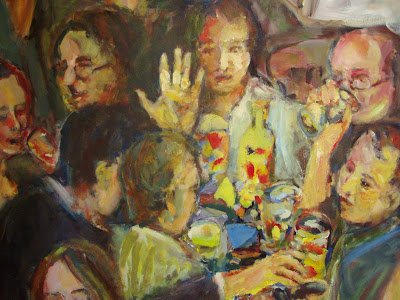
two drawings


The top drawing is myself, painting, in a mode implying a puzzle.
The bottom drawing is not an image of Eve (though it's all right if people think so, or nearly all right if they think it - however, it's not right that they assert it). It is an image that is polysemous, sure, but in an hellenistic way: either Europe and Zeus (the bull) or queen Pasiphae and the bull of Poseidon (the sire of the Minotaur). Other clues are incorporated: a tortoise and hare, a fluted Greek column in the background. What about the snake (and this seems to tip people off in the garden of eden direction: nude woman and snake - gotta be Eve and the serpent [note serpent, not Satan - who is not in the garden episode; yet people seem to insert him into the garden episode frequently])? The snake refers to the Greek god of healing, starts with an A, sounds like Aesclypius but I'm not sure, as well as to the Cauducus that's part of the Doctor symbol you see on various medical buildings and stationaries. All ancient peoples loved snakes and naked women. For instance: well known minoan figurine is of a topless woman weilding snakes in her hands like thunderbolts. Snakes and naked women - not just confined to the Hebrews - who probably got the idea from the Persians anyway. If this was the garden of Eden, I'd have put a ziggurat, not the greek column, in the background, and included Adam, or a canvas of Adam being painted by St. Paul, who invented the way we see Adam now out of whole cloth supplied by the book of Maccabees.
Anyway, I really like this drawing. I did it on CPE day as some speaker rhapsodied on about Evon Agazarian and system centered group processes. Benzene molecules and various chemical diagrams are in this drawing. And it has a nice overall tonality - I've saturated just about every 1/8th square inch of it with my quick tiny darting pen strokes. Rapture.
A whole segment of christiandom awaits rapture - conspicuously that segment that seems most divorced from knowing what rapture is or being capable of it.
What if some sect decided to make a central doctrine out of the word orgasm. The climax of God's kingdom here on earth. Jesus shall come ...
I'm sure that's been done before. It's cheap. Cheap and beneath me.
Still I like both these drawings. The top one hasn't had quite the career in generating misconceptions yet.
Misconception - there's an interesting word.
I would hate to misconceive the immaculate conception.
That would be like misconstruing flowers at a wedding.
Garcipara's wife - that's a misnomer. An eggregious pun dependent on people knowing Redsox shortstops.
I like both drawings. They exhibit intricacy and inventiveness.
And the stars around the head of the nude woman refer to the stars around the virgin in the immaculate conception, and the virgin's prior identity with Aphrodite, the stella maris, the star of the ocean, as she was called, which ties the greek and hebraic symbols together. Another image that ties early christian with ancient symbols together is the image of Isis holding Horus [I think it's Horus, it's Isis' kid anyway]: looks just like a madonna and child. Much christian iconography makes use of precursors, Roman, Greek, Persian. These associations are mostly lost in the kitschified world we live in today.
Sigh.

Thursday, September 17, 2009

free associations


Freud reports that in the process of free association, the most important thing is not what is voiced, but what remains unsaid, where the resistance is. In a way, an idea from negative theology: the most important and true things about God are the things we don't say, that remain unvoicable. And in our society where we expect solutions and things being ready at hand, the notion that the important thing is eternally out of reach cuts against the flow of our desire.
And what we desire fails us again and again. The push through to satiation, to climax, finds us back again, in the land of want. What would the attainment of desire be? Immolation?
Perhaps this underscores the rational the ancients, including St. Paul, developed against desire; instead they counseled contentment. "Godliness with contentment is great gain." That sums up the attitude of the early church. To be content is to live in the present - whereas desire inflames and calls us to some other place, beckons us to the future before we get there - a future that takes us out of the present. Whereas contentment is a present that carries us into the future. Perhaps I simplify too much.
Outside my window the backyard is soaked. A cricket chirps, and there are more greens than usual. I see one and wonder why I haven't gotten it into a painting yet. Lately I'm seeing more greens and grays than I ever suspected. I could be the influence of Morandi. Morandi whose simple still lifes and landscapes haunt me. And I think I know what the connection between him and late Guston is: the awkwardness of presentation. Both exhibit an awkwardness front and center: presentation and line, color and composition, awkwardly there ThereTHERE. And what intrigues is that this is what most other artists strive to hide. Even De Kooning and Pollock present chaos and violence, but with a polish, an authority. There is nothing awkward in their work. But Morandi and Guston: how awkward and uncomfortable.
I'm listening to Boulez's Pli Selon Pli. My favorite piece of classical music. It folds upon folds, covers and discloses.
Otherwise I listen to Eric Dolphy's Far Cry. How I wish when I was buying CDs back in 1999 that I'd bought more Booker Little. Booker Little and Freddie Hubbard - my favorite trumpet players - more so than Dave Douglas now or Clifford Brown then - who I was more immediately attracted to. More than Miles Davis (except for Bitches Brew - an exemplary jazz album and I increasingly think, Davis' best). I also like Dolphy's Out to Lunch.
David Markson is onto something in his recent work. Work that resembles a literature major's notes. But something solid but hidden lies at the center. The great unnameable in his work.
Jung, Freud, Lacan, Klein, Bion: all agree. Not to cure, to fix, to make go away - but to integrate, to contain, to hold opposites in balance - that is the aim. The goal, the conclusion, is something else, a logical end point.
Desire whirls around a void, the drives, according to Lacan, for whom all drives are death drives seeking to break through the pleasure principle, regardless the cost. Deleuze would say that the drives are not voids but plenums, bursting with abundance. Neither concept invites touching - it would be like putting your arm in a turbine. Why would you do that? Isn't the point that you're getting energy and that it's the energy you should be using.
But this is what we get for thinking that our human predicament is something that needs fixing. We spend too much time trying to fix, to put into place, to fit in, all the conflicts and incongruities of our life. The question is What gives us energy? What takes away energy? What empowers? What deflates?
When Jesus says love your enemies, what if the scribe had asked, as in another place, And who are my enemies? And Jesus had responded with the parable of the good samaritan. Or would Jesus have held up a mirror?
Listening to Jesus, you'd think that his family, his disciples, all were enemies - except the Romans. He never says anything bad about them. Or the samaritans either.
We often take God's speech that she held out her hand to an ungrateful people as a complaint, but what if we hear that as discription. This is what God does: He holds out his hand to ungrateful people.
God doesn't seem to have enemies.
The very people Jesus is harshest with are the ones who insist that they're on his side. "lord lord didn't we do all so many good things in your name." These people, these early volunteers, he tells to scram.
Perhaps God would rather hear, "fuck off."
Perhaps he goes not to those who are well but to those who are sick because these people seem to have a clue.
The people who think they've got it licked, figured out the system: these are the ones who're off. He tells them, "since you say 'we see!' your sin remains."
I'm now listening to Andrea Parkin do weird things with the accordion: fold upon fold.