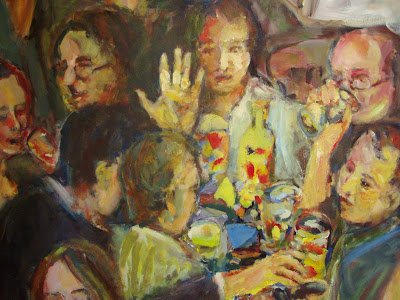
Monday, September 07, 2009

taking or leaving


I love this pararble and its hyperparabolic possibilities: Matthew 24:41 (n + 1).
In the same way there will be two guys crossing the country in an old car, perhaps a loaner from one of their dad's or a friend's. At some point they'll discover the gas guage is broken and they'll be stranded in Palestine, TX. At some point a Samaritan will stop and offer them some help. So one will be taken up the road to an open gas station, and the other will be left behind to watch the car and wait.
In the same way two pigs will be feeding at the trough. One day the farmer will come and take one and the other will be left behind. Then the farmer will come back and get that one too.
In the same way there'll be two of anything, cats, zebras, jockeys, lesbians, policemen, unemployed middle managers, incarcerated businessmen, exiled cabinet officials, apocolyptic prophets; invariably differences and divergences will emerge among them that can be summed up as the taking or leaving what they have in common, a place. So it is that two of anykind, unable to exist together will find themselves displaced in relation to the initial reality they'd formed.
So what do we do with this displacement. Is it a displacement that invites replacing? Or is the parable's force in pointing out how slippery it is to label: women grinding, men in the field. One of each can be taken and one of each can be left? What does it matter in view of the culmination of the world. The coming of the son of man.
Here is prime exegetical territory: liberating the text from what it has to mean, whether that meaning is the accretion of orthodox defenses or heterodox insurrections. What is ortho and what is hetero change with the wind - more as expressions of power than of truth.
So two boys are building a tree house in the sand with rocks.
Two dowagers go to see Waiting for Godot and one is taken aback and the other is left speechless.
Two Roman legions are wandering in the forest searching for Arminius.
I think it's best to bombard the text with alternative settings, extrapolating and pushing meaning to the nth - searching for an eternal return.
The son of man is an eternal return. This time coming as a thief. The first time coming in tragedy and the cross - but this time, a thief and in farce? He comes like a flood and in the clouds and gathers his elect. Earlier he came like a mother hen gathering her chicks; now like a fox raiding the hen house.
Two hens will be brooding secure in their hen house; one will be taken and the other will be left behind. Pity the watchdog, Rex, with egg on his face.

good grief


I've slackened my pace of writing on this blog. I write in many other places. Sometimes I write on facebook, which is not satisfying. At times I've been dissatisfied writing on the blog here: no responses; responses that miss the point; responses that are spam - though there have been responses of understanding, appreciation, and encouragement.
I do a lot of writing on small scraps of paper. Paper scraps that I arrange in a collage of seminarrational resemblance. I don't want to write a narrative so much as the feeling of a narrative.
I think now that no one is reading what I'm writing here, except perhaps Jami or an occasional friend, or someone who types a google search looking for something else. I think that it's a good thing to write in order not to be read. There are many things written for an audience - think : what is your audience. And so minnisters for years are encouraged to write for a group of 8th graders.
I don't know what it says for us that the intellectual development hoped for in our country is 8th grade. Or that the emotional develoopment might be even younger. In clinical pastoral education (CPE) I've learned that emotional deveelopment is muich more important for behaviour and wisdeom than intellectual development.
It's amazing what we can think. Yet the complexity of what we're capable of thinking is belied by the simplicity of our emotional reactions. Most people in our society are reactive. If our politics is a reflection of us, then we see, we feel, in a polarized manner.
So the question is not knowing more: it's knowing what we feel and why we feel it.
What can be done? How can we move beyond reactivity to, as W Bion might say, containing our good/bad feelings together when thinking about others: that a persoon can be good or bad, a mixture, and that our reactivity toward them, our desire to act out, to pull the passive/aggressive thing, is not in ours or their interests: that such reactivity forestalls communication and growth and relationality.
I recommend a mass reading of Alice Miller's Drama of the gifted child.
Our child rearing methods invariably induce trauma prior to cognitive devevlopment. When parental love is not provided in a nurturing manner, the child faces the crisis of the mother being bad. How to get the good mother back, he thinks. He discovers that when he pleases her, the good mother comes back. What happens here, though, is that many times, what is discovered is the mechanism of pleasing: where admiration, compliments, take the place of love. The child still craves love, but gets compliments instead. When the child wants love, he does behavior to get the compliments (this is where he gets the good mother). Over time a split develops, many splits really, where good and bad never reside in the same object at the same time. The child may grow up and his manner of compensating may lead to high levels of accomplishment. If not, it may lead to high levels of grandiosity. The child cannot face the fact that he is ordinary, neither good nor bad in absolute ways. Still the child has a chasm of unlovedness - a chasm that gets deeper and more secret as he becomes an adult.
Miller, Klein and others discuss this development of narcissism much more thoroughly, and I recommend them. But this is my basic understanding of what takes place.
Certainly I see this grandiostiy working in me, a grandiostiy that masks shame and that needs further accomplishment to substitute for love not received as a child. It's not that parents intentionally don't love their children: but I believe that often they don't know how. The baby gets quuiet when they threaten it - mission accomplished; the child behaves when he is spanked - mission accomplished. The child wins a prize, gets all A's, a scholarship, hits for the cycle - all is perfect. Except when the chld strikese out, gets all B's and C's (or that first F), flunks out - then the need is still there, to cover up that empty hole (where the shame of being the bad infant or the guilt of being the hurtful infant) that's still there, and now there's not a compliment, a plug of praise, to substitute for the love the child doesn't know how to ask for, has only sporadically received, and doesn't know how to give or receive (except that it binds with an object of enough emotional umph! to replace the original object that failed).
So what to do for this child. This is where the process of grieving comes in. I think a book like Kathleen O'Connor's commentary on Lamentations "Tear of the World" is helpful in this regard. Though I've found it helplful to read lamentations straight through in one sitting or the book of Job. These books deal with grief in complex and let it all hang out kinds of ways.

Sunday, September 06, 2009

solitude


While at Oak Island this year I experienced solitude in a very personal way. I was not lonely; I was not merely alone; I was not escaping companionship. I was sole, dwelling in myself and resting in myself. I found a place to do this: a spit of sand extended into the sound at low tide. I would walk out at low tide, through shallow water, and sit on this extension of the beach that was made available through the dredging efforts of the Corps of Engineers and the pulling back of the Atlantic. I brought my books, pen and paper, binoculars and camera. I read Blanchot's Waiting Oblivion. I drew in the sand. I observed the distant birds and boats. I looked back at our beach house. I felt equipoise. And when we left the beach I discovered that I retained it in me, independent of location.


Saturday, September 05, 2009

Point taken


 There's not enough time, every moment of time is too precious to spend being reactive, nurturing resentments, ranting ad nauseum. Every day in the hospital I see people in distress, nearing their limit, grieving - and it seems, ...that there is no time to waste in any endeavor but love, in any position but in hearing and speaking to our mutual wounds.
I posted this recently, and I think it's an important reflection of mine, born of almost 2 years in different hospitals - I should say, 2 stints in hospitals: it's only a little less than a year now.
What I hoped to get from CPE was a sense of how I am and how people are in limit situations. As Kathleen O'Conner says in her Lamentations commentary, "to extend a gentle reception to the pain of others, we need familiar knowledge of our own pain, grief and doubt. [92]." She also talks about how denial (where we deny our grief through consumerism, escapism, addictions, or violence) blocks our creativity and ability to flourish.
Blanchot reflects this sense of nurturing solitude in order to be with others. In his Awaiting Oblivion, which I read at the beach, I found that lines like "narrow the presence, vast the place" and "he feels liberated by waiting for waiting" and what would happen if my speech were suddenly to make itself heard by me?" - this is all good stuff, and the effect on me was to craft an interior space where I could be with the other.

Friday, September 04, 2009

a wonderful fall


The story of the Fall
is that we can go out
into the world and fail:
ourselves, each other and God.
god doesn't desert us
nor do we
even the snake has no
hard feelings
There'll be blame and
attempts at covering up
and scapegoating.
But it's not the end of
the world.


The Fall is like the fall, in that it seems like the end, but is actually a beginning. We don't begin until we fall, and the year begins, in some calendars, in the fall. So I could mean both.
 Failure characterizes creation; until failure occurs, the creation subsists in a merged identification. With the initial failure resistance is set in motion
 The figure distinguishes itself from the ground. In the Fall we know we are not gods; and in the Falling leaves, we see that god's view of perfection is not uninterrupted stasis. That is: failure is the perfection of creation. The text enjoins us, invites us, to tread with confidence into the world of fall. Perhaps a folly age [foliage] imposes on me.

On the notion of being left behind

I began a reflection on those verses in Matthew 24 that talk about one of a couple being left and another being taken. A common enough worry among us - that the one we love will die before we do or that we'll die before them. How will we handle such an event. It is too big for us to imagine. Somehow, Jesus says that the kingdom of heaven is like this: that we don't know what will become of us or our loved ones. The question of being left behind is addressed by Jesus at the end of John's gospel, where Peter askes of the "beloved disciple" What about this guy? Jesus says basically, "whether he comes before or after you, what does that matter to you and me. You're following me - not him."
Knowing the popular mythology that has accreted onto this parable and especially how it induces emotional wrecks to respond to altar calls, I thought, let's take this in another direction.
I began with a joke.
Matthew 24:41x "Likewise there will be two virgins attending a feast/ one will be taken and the other .../ the other will be taken as well."
Which is a bit juvenile, as Jami points out to me. But I gamely continued.
Matthew 24:41y "In the same manner there will be two men sitting in a bar, after work, and they'll be eating hot wings with blue cheese drerssing, watching a sports call-in show - they'll drink several beers, some with high gravity, and laugh at increasingly odd jokes, and one will take home an extra order of wings and the other will leave behind a tip."
41y "In the same manner two hillbillies will go down a river with class 3 and 4 rapids, in a rubber raft, with a gallon of moonshine, their favorite coon hound, and a box of cherry bombs, on a night with a full mooon under a cloudless sky. And they will be thought to have taken leave of their senses by all they've left behind."
41 [symbol for pi] "In the same manner there will be an indeterminate number of people, men and women, engaged in a variety of activities, entertaining each other, teaching and learning, sharing the joys and struggles of life, in solitude and in crowds, family groups, freinds and strangers, all attempting to live good lives or to discover what the good life is, at once happy and dissatisfied, carried away in the moment or settled in contentment. And one or more will be taken in by artifacts left behind. And one or more others will leave behind artifiacts taken up for reasons no longer remembered. One or more of either group may be taken behind and left. One or more of either group might be behind, and though for a bit left, eventually taken up again. Of those in all groups and in the group of those conditionally excluded there might be behind those left or taken while some are taken from behind that others had left, through no fault of their own.
The key thing is this: it is difficult to say whether being taken or left is good or bad. It's like sometimes when there are mass layoffs, one guy is taken from the widget line and is retrained and gets a better job, while the guy left behind continues to make a steady salary - both are happy. Sometimes a kid, for instance in school, is left behind and blossoms - sometimes not. Results can be mixed. In both being taken and being left behind there are opportunities. The difficulty in being taken is a kind of resting on your laurels where you cease to learn and try and you just mail it in. Likewise the difficulty in being left behind is that you get depressed, you dwell too much on how others are passing you by, and you begin sabotaging the process.
I underscore this ambiguity here with this observation from my days as a wood worker. We would go among the trees and I remember my dad pointing to various ones: we would take a certain tree for a chair - even though it might be small, but the wood had the right spring to it. Others we'd leave behind, because they were more suited to a table or a plow that we knew we would be building later."

Thursday, August 13, 2009

And then we went to Oak Island


And stayed at the end of the beach, where I walked out at low tide on a spit of sand, sand deposited by the ACE dredger Merrit to retard beach erosion, several days, and sat on the sand and drew, read, thought.
And Jami walked out with me there once, beautiful, smiling, and we felt the water lap around our ankles.
Every year we take a photo of ourselves at the beach. Here we are, smiling and happy. Into our fourth year together - content. Each moment precious.
Joy floods my soul.

Last month we went to Kiawah


Last month we went to Kiawah- Jami, Gaby, Jennifer, Grace and I. While there I built a sand figure, reclining in the sand. Our niece, Grace, helped me. It was a wonderful reclining figure with a raised knee. I was only able to get so far, though, before the sea rose and engulfed it.
That night I thought of all the wonderful possibilities sculpting with sand afforded. I pictured a monumental figure, like the sphinx, that I would craft. It would establish its presence on the beach and inhabit the space around it. But I learned, on my attempt the next day, that sand doesn't support slender images to any height and it doesn't cantilever well.


Sunday, May 10, 2009

Read Waiting for Godot


Waiting for Godot is a good read. You can go on youtube and watch practically all of it, especially Lucky's monologue, a pastische of scholarly mumbo jumbo. Still it is a wonderful play, and it resonates with life as we live it: when the grandiosity of our primary narcissism is stripped away; when our craving for admiration is abetted; when we've emerged out of the depths of depression as normalcy - then we may see; then we may be healed. Healed in a way non-miraculous. Let us leave behind our need for the miraculous - our magical thinking, our projections onto God that equate to a lesser, though "omnipotent" god. God is supremely interested that we grow up. That we get past our need to have others agree with us or to be in agreement with others - that we (in object relations terms) get past our false self, the pretense (the pretense that we exhibit a fortiori in the Garden) of being other than we are. Let us live in the Real - thinking neither too highly or too lowly (that's a shout out to you worm theologians out there - I'm looking at you Charles Hodge) about our capacities. We're much better reading Klein and Lacan, for all their antipathy, and then immersing ourselves back into Calvin and Barth with a smattering of Tillich, emerging in the clear light of Bion and Freud. Perhaps able to stand on our feet and take the gestalt as we come to it, and be, authentically be ourselves, who God created us to be, without recourse to the Text as tailesman, instead seeing in the text, what Jung points out the alchemists saw in their retorts: the mandala through which the soul's process is mirrored and integrated into the self.

Wednesday, May 06, 2009

Last poetry magazine

Had a translation by a Persian and Urdu poet, Ghalib, that I found quite beautiful and provocative. I immediately thought of those passages in the Song of Solomon that describe the lover wandering the city in search of her beloved. This type of poem, the ghazal, is ambiguously about God or a human lover - both should be held in tension.
Here I offer a selection from Russell's book on Ghalib.

"last night when I prepared to pray there came into my ears
A warning spoken from the cloak I wore upon my back

"You, a mere straw burnt in the fire of the muezzin's voice
Paule! Do not give your eager heart to these activities
You cannot put your trust in scholars or in worshippers
One vainly prattles on, the other labours vainly on

Words, words are all the stock in trade of this
censorious tribe
Mere colour is the way of those who wear the
dark blue cloak

So leave the highway, roam the wastes, and as you
journey on
Shun all the hidden snares of wine and love; remain
aware

Rapt beauty offers easy kisses? mind you do not take them
Wine-sellers offer their wine cheap? Then do not buy
from them

The song, "do not obey the law, and do not live
austerely"
The warning voice, "do not disgrace yourself. Do not drink wine"

All these "do nots" amount to only this, Forego your
being
We have no ttale to tell you, you no tale to listen to"

I empty-handed (for I had not earned the wage of
worship)
Said (heart rich with the wealth bestowed on me from
the unseen)

How shall I turn my face from colour to transparency?
"Where must I go?" The voice said, "Hide yourself from
your own gaze"

I leapt up, but with wit and wisdom going on before me
I left myself, but knowledge, action, kept me company

I came to an assembly where I saw, both in one moment
Today's wine being poured, the blood-drenched
sleep of yesterday

A hermitage all radiance, whence abstinence was bansihed
A hall all sweet spring water, full of kisses, full of wine

That hall the secret dwelling place of her who gave it beauty
Who welcomes turmoil, looks up to the sky with open arms

A sun, imparting radiance to every glittering atom
a saki drunk with wine, intoxicating all the world

Colours sprung from transparency, such that no eye can see them
Secrets that only silence speaks, such as no ear can hear

No drop falls from the vat that holds a thousand colours in it
One vat all filled with surging colours, mouth securely sealed

God can be felt entire; the mind can comprehend the world
Ghalib be silent now. This is a song no voice can sing"

This is a wonderful, wise poet. He loves wine and poetry - one almost thinks theology as well - though he is leary of what peole do with religion. He sees faithfulness to the end as a mark of authentic spirituality, regardless of who practices it, infidel or believer. Russell has also translated many of Ghalib's letters: letters that are blunt and filled with wit.

Monday, May 04, 2009

a sermon on genesis 2:25 ff, on shame and pretense

I confess. Once I was naked and unashamed in a garden. I was not quite two. My mom is planting tiger lilies and I am wandering, standing shakily, looking in wonder at the world around me, as only a small child can. I gaze at the world in wonder and everything is the same to me. I prefer nothing to anything else. I see the blue jay in the pine tree and the snail upon the rock, loving them equally. I don't care who looks at me. My nakedness is meaningless to me. Just a year or so later, I would be embarrassed to be seen naked, outside or inside. I come to feel the eyes of scrutiny upon me. I come to feel judgment.
I believe that this is a common experience. Most of us have embarrassing photographs our parents took when we were babies. Why are these photos here? For one thing: We wax sentimental over innocence: a respite from the cynicism and knowingness we live with as we grow older. We grow older and we know that we're being looked at. We look at others and distinguish between friend and foe, who we'll trust with what.
It's a process we all experience. Some of us integrate it better than others. But we all have that feeling that we've fallen from something. That behind us is a special place where all was right, a golden age, a time where people treated other people right. A simpler time than now, where you could leave the door unlocked, and we all had a party line and everyone listened in. Just one big warm fuzzy filtered through amber light and an apple pie is always cooling on the window sill.
This story in Genesis deals with such a process: what happened that we were once innocent and felt no shame but now we feel shame at the drop of a hat? What did we lose back there? Wasn't the past better than things are now? Can we ever get back there?
Imagine Adam and Eve in a more modern telling. They are home and watching TV late at night. Twenty minutes into the late show there's a commercial with a once in a lifetime life-changing offer - call now, operators are standing by - this product will fill the empty gnawing void in your existence, and your hair will always be right and you'll greet the world with confidence. They excitedly call in and give their credit card number. A week passes and finally a box arrives. They open it and turn it on. And with great expectation they wait to see what will happen, how their lives will be fuller, their hair thicker, their feet nimbler. And their lives remain the same, their hair retains its thinness, their feet stumble along as always. They can now discern good offers from bad offers. And so a trusted friend calls and says, "so how's it going." and they say that all's well. They plaster their faces with fake smiles and put on fast music. Gray skies are gonna clear up - put on a happy face - they sing. And inside they're feeling awful, they're the most embarrassed they've ever been in their lives. But their friend recognizes what's wrong and so she asks and persists. To admit the truth is the hardest thing they've ever had to do, because they feel stupid. They feel stupid because they should have known better than to believe a late night commercial promise of life fulfillment in a gizmo - the pocket deity. They feel stupid because they're lying to themselves and their friend about what has happened to them.
Of course in the story the friend they lie to is God. The spurious product they exchange their current relationship for is the promise of a relationship where they're God's equal in wisdom. But what's key in this story is shame causes them to hide. We read that they cover themselves with leaves. That is: they camouflage themselves. They pretend to fit into their environment and hope that no one will notice. That what they've just done will go away and be forgotten. They pretend to be someone and something that they're not. They are ashamed of what they've become and hope that no one, especially God, will notice.
But God, who cares more for them and us than we can imagine, even when we feel so very embarrassed, does notice. And despite their fears, God doesn't turn from them. God remains with them and talks them through their shame. God coaxes them out of their need to pretend to be trees- to fit in and conform. God helps them be themselves. The so called curses are really promises of work and family. At no point does God say that he is estranged from them. In fact, as the story of Genesis continues on into Noah, people exasperate God, but he can't quit them. God has created humanity in God's image, and it's that image God sees in each of us, no matter what we feel that we've done, no matter what our shame is or guilt or fear or anger. Finally, in Abraham, God declares that he will bless all humanity. God declares Abraham's faith as justifying without reference to an inherited guilt. In all of the old testament there's not one verse that indicates that Adam's action in the garden affects the relationship his descendents have with God. God doesn't hold fathers accountable for the sin of the children and vice versa - as the prophets say time and again.
What happens in this story is the revelation that God is separate from people - just like one day a child discovers that she is a different being from her mother. It is frightening to realize that you're on your own. A boy realizes that he is not his father or his mother and is embarrassed when he acts like an infant. Many of us learn to pretend that we are growing up. We can tell that we're pretending when our minds are clouded with thoughts of what other people are thinking about us. Our pretending is aided by how well we follow the rules and conform.
In all this we desire to be authentic, to be naked before God again, but in a more grown up way: honest about who we are. Perhaps we don't believe that God could love us. We have a notion of how perfect we should be which is in conflict with how we fear that we are. If we insist on our perfection, we are bound to fall. Reality will pull us down.
Certainly God knows the truth about us - even as we know the truth about each other and ourselves. God sees through our camouflage: how we've covered ourselves with material goods and awards for deportment.
And God doesn't leave us. In fact God comes to us and lives among us. In Jesus, God came and was an authentic human. While humans pretend to be God, God came and was a human being without pretense. Where in the gospels does Jesus pretend to be important or act as if entitled to the best seat in the house? Christ says that the greatest among us is to be a servant; that the first will be the last and the last first. He says that we must become as children to enter the kingdom of God. Where does Jesus worry about what the neighbors will think? Where does Jesus pretend to be something that he is not?
Time and again God demonstrates what it is like to be an authentic human being. He talks with the poor and outcast. Prostitutes, tax collectors, thieves, party goers, as well as Pharisees and scribes - all get his attention. He doesn't spare feelings, but he admits that he's wrong - as in the case of the syro-phonecian woman: who when she asks for Jesus to heal her daughter is rebuffed with the phrase that "we don't give the children’s food to the dogs" to which, when she answers "but the dogs eat the crumbs that fall from the children's plate," Jesus says "well said" - an admission that this humble foreign woman has bested him in an argument. How difficult it is for us to admit that we're wrong or that someone understands a situation better than we do. He is loving as well as brusque with his disciples. He doesn't put up with people who weasel out of obligations. He is gracious and forgiving. He says that he came not to judge but to heal. And he heals all who come to him.
If, like St Paul, you want to think of Jesus as the second Adam, think on this: he returns to the garden. As with Adam things go badly in the garden. He is betrayed and abandoned. He hangs on a tree - strange fruit indeed - naked and unashamed. He is laid down dead in the garden, naked and unashamed. And he leave this garden on his own. Rising up - death is swallowed up in God's victory.
God takes us back to the garden and leads us out. To him, we can expose our shame, and we can be who we are. In his grace, we can quit pretending, and be who we really are, who God created us to be in freedom.

Sunday, March 29, 2009

More stuff learned it seems

Scince this autumn, when we went to NY, and I spent 5 hours in the Metropolitan Museum, I've pondered the exhibition of Giorgio Mordani works in the Lehman collection. I find these simple still lifes and few landscapes that he did between 1920 and the early 1960s fascinating: they're grayed out, with some limited color range and contrast; the brushwork in the still lifes is is made of long strokes, left to right, with some up and down movement. In the Landscapes the brushwork is more vigorous.
What I think he does is what Merleau Ponty and other positivists talk about "describing more to understand better." To Morandi you have to look beyond the repetition of subject matter and the tonality. What he's done is limit himself. Part of that limitation is to ask himself What it is that he needs to do in a painting - what is a painting? So with this limitation of artistic vocabulary he set out to translate the intensity of his gaze onto the canvas: that is, the canvas becomes the site of a translation of the object through the subjectivity of the painter. For Morandi I think the task is that this gaze not be a glancing blow - in a way his method is the opposite of Monet's: not impressionistic though certainly not given over to detail. I feel I really know the objects Morandi paints, even though the duration of his application is belied by paucity of detail. what comes through in paint is the density and silence of the objects and their arrangement.
What I've pondered is how to apply this to myself. Certainly it's a lesson in paint - and paint is a lesson in life. I ask myself What is essential to me? What can I limit myself to? The thing is not to paint Morandis anymore than Morandi painted Cezannes or Cezanne painted Pousins. Morandi's work is entirely unique to himself. Much as Sean Scully's work is: you know what you'll get with him, but you're surprised all the same.
And so it is.
Along with this I've pondered Donald Kuspit's Art Criticism issue of the last year - a survey of the last 90 or so years of art making. I'm surprised at how conversant he is with Freud Klein and Bion; and it's that association he makes with art as healing that strikes me in his whole argument. Basically he argues against the formalism that took hold in midcentury and the ironic vantage point that brackets that formalism in the 1920s and the 1990s. I've approached art in formalistic terms for many years (the subject of painting is paint, the materiality of the materials, etc) and I have to say that something in Kuspit's argument touched me. Certainly I've thought of my art as a psychic necessity for me but have not considered whether it might heal those viewing it. Jami has helped me here, pointing out how Out of Chaos, the painting I painted in chapel, affected the congregation and her. It's true, people approached me afterwards and commented on how moving it was to watch during the week's services the painting change and unfold.
Kuspit's text has made me look more closely at Beuys and Rauschenberg and Hesse, as well as wondering what I've accepted too readily in Johns and Duchamp.

Things I think I've learned

One day Jesus casually tells his disciiples that it would be easier for a camel to go through the eye of a needle than a rich man to enter the kingdom of heaven. It's quite a hyperbole, saying more than is necessary to say that it would be impossible - for the most part. But Christ doesn't say it would be impossible, only that it would conurre up the image of a camel, somehow, passing through the eye of a needle.
It occured to me that one way to invision this, considering that a camel is in viewing distance, is to imagine someone holding the needle to their eye. With their eye looking through the eye, and being a sufficient distance away, the image of the camel indeed passes through the eye of a needle. You have to admit that this is the only practical way to get a camel through a needle's eye. Off course thte camel remains a fixed distance away; the observer can approach only so far before the camel ceases to pass through the eye into the person's eye. The person's eye was considered by the ancients to the be the window of the soul. So in my imagining Jesus is refering to wealth's relationship to the soul as a quality of entering the kingdom of heaven.
A camel is a means of conveying wealth for long journeys.
The person who would view their camel laden wealth through the needle's eye cannot ride it, cannot even get very close to it. Their wealth remains, not at hand, but at the limits of their horizon. It can more easily be used by others than by its owner.
Jesus' saying relates to his parable of the rich man responding to his abundance by building bigger barns - hoarding his wealth at hand. Through the eye of a needle we might look at our possessions, our house, our cars, our land, our cash, and ask ourselves Would you really give this in exchange for your soul?
What has value when seen through the eye of a needle? A thread perhaps that we might mend a garmet with or that we might stitch a wound with. Consider the use of the needle: how it changes the nature of the wealth, from something hoarded to something that can heal, something that can bring the fabric of our lives together.
Jesus' invitation is not just that wealth be given away, but that it be used to heal the souls of others. When used for healing wealth is taken into the fabric of the kingdom. The rich man divests his wealth not as the price of admission, but in acknowledgement of being in relationship with God and with the community of faith.
When we look through the eye of a needle we see all we have as not ours but as the warp and woof of the kingdom, a tapestry we've participated in, but which ultimate artistry is God's.

Saturday, March 28, 2009

What I've learned just a few days ago

The other night I had two insights: here is one. I was thinking about the pericope where Jesus' disciples ask to have their faith increased and Jesus' response is that if they had faith like a mustard seed they'd be able to toss a mountain into the sea through some kind of ttelekinesis. The telekinesis part is what gets emphasized in most uses of this text. Usually there is an exhortation to take risks, or some method of building faith is put forth - the focus being on the image of tossing the mountain into the sea, as if Jesus here is saying, "I want you all to toss mountains into the sea, or Faith is therefore the belief in impossible things - ergo Throw away your crutches, don't take your insulin; or else Ask for anything, no matter how outlandish, and if you have faith you'll get that rocket-powered cadilac bass boat sauna.
What I think happens here si that Jesus doesn't tell them how to increase their faith. A mustard seed could care less about tossing mountains into the sea. In fact the image Jesus crafts is of an insignificant seed growing and becoming what it is meant to be. Nothing could be less dramatic. Nothing could require less telekinesis - which is a good thing because telekinesis doesn't work.
Jesus describes a seed, and it doesn't matter if it's a mustard seed, it could have been a cotton seed - a seed is unlike what it will be and at the same time can become nothing else. A seed is more likely to be eaten by the bird than to provide a nest for it. Yet even in this event the seed emerges fertilized and able to grow.
It's almost as if Christ is telling them: Have faith to be who you are.
Eventually the mustatrd seed does grow and becomes a place of refuge for the birds that threatened to consume it.
Perhaps the disciples request springs from that story of Elijah and Elisha where Elisha wants to get Elijah's power. The disciples realizing that they're incapable of doing what Jesus does have begun to reckon that they may eventually be on their own with their own traveling messiah show and they got nothing. So they say We got nothing. Increase our faith. And Jesus is like So you'd like to throw a mountain into the sea? Who do you think you are? I'll telll you who you are: you're a mustard seed. You're not Vesuvius. You're a seed, a germ of what you could be. If you could only have the faith to be who you are you would really be something. A bush for instance doesn't seem like much. See I'm tying a donkey to one right now. I could uproot this with some effort - but why? Would I then plant it in the sea? What would be the point?
Have faith to be who you are. You are disciples. Have faith that that is good enough. Have faith that you don't need the largest house. Have faith that you lead by serving. Have faith that your life is in loving one another and sharing out of your abundance. Have faith that what you have is abundance and that you don't need to hoard. Have the faith of the birds and the grass.Have the faith to Be in the moment. To live in the present. And if you do this you will form a connumity that offers refuge to a world that now threatens to swallow you. That is who you are. That is the faith that is in you.

What I've learned lately

What have I learned? That age, wisdom, and friendship aren't necessarily enough to wean a person from the sound of his own voice. They try to teach us this in CPE, or I should say, we try to learn this in CPE. That the progression is something like presence, and wisdom and then guidance - and that "then" should be a good length. I'm still learning this.
At times I ask myself How is it possible to know so many of life's answers? Isn't this the very problem of Job's friends: Eliphaz, Bildad, Zophar and Elihu? They're all philosophers. And they demonstrate in their speech that they have no stake in their friend, Job's, life; they have a stake only in their theories, the sound of their voices, echoing wisdom that sounds so right. Their words fit like finely crafted bricks walling a magnificent house.
And this is why these words don't work for Job: he is walled in by them. He is walled behind them like the Character in Poe's Cask of Amaltiado. And his friend's have done it in the best of intentions.
So the question is How do we separate our intentions from what we do? That is How do we do the good we intend, or the best good, we mean to intend? And how do we avoid scuttling real pastoral work under the cloak of intending good? Of course the answers are well known: beginning with James' admonition to be slow to speak and quick to listen.
My wife, Jami, reminded me as well that it's important to ask real questions. She's so much more Socratic than I am: ask questions that allow the other person to express their need.
Certainly Job's friends don't engage him on this level: that he might know and be able to come to his own conclusions - and that he should be allowed to rest in those conclusions.
We all think we know best for each other. It's that log in our eye and the mote in our sister's and brother's eye problem that remains with us.
How do we ask What is this log in my eye? The log in my eye is the projection of my desire onto others: my desire to solve life's conundrums and create a world in conformity to my own speech. The log in my eye is the rehersed bits of wisdom I've cobbled together. Job brings his worries to his friends and receives four logs in essence. How can he carry them? He refuses, which causes his friends to produce more logs. They never say He must have a good reason for refusing to carry our logs.
What if we refused to carry our logs as well? I think what I need to do is develop a muscle of spirit that shuts my mouth when invitations to advice are offered. A muscle that senses the inflation of my best intentions, a sense of when I'm driving into my blind spot.
Isn't that the healing stance I would want to receive from others. Certainly the pastoral goal is not the rehersing of wisdom but the healing of souls. And so the question is What is the place of healing here? - whenever we receive an invitation to promulgate wisdom. That there is speech that heals the world, that heals our friend. It is speech that invites the person asking from their need to stretch out their own hand and to rise up and walk. It is speech that offers an arm to lean on rather than a log to carry.

Thursday, March 19, 2009

The New Year

I haven't posted in some time. I've been busy with CPE and Facebook. Also I felt that I'd become repetitive. So here is a new post.
When I was a teenager, 14 or so, I read Paul's letter to the Galatians and I was ecstatic. What good news. My mom immediately said that you have to be careful how you read that and it's easy to misinterpret. I had the experience of just as I was beginning to feel free of the law, the accuser, that there was a real joy to faith, I was slammed back into prison. Who was I to interpret Paul's "we know a person is justified not by works of the Law but through faith in Jesus Christ?" There must be some way that the Law continues to stand between us and Christ - Paul's just not very clear about it here. Otherwise I would not be made guilty by sermons leading to altar calls. And where would I be without guilt? Would I do anything but because of guilt and the sense that only by being obliged (and the very sense that I was obliged and not doing a good work simply qua selfless good work condemed even the "good" work that I might do with the taint of my own shoddy motives).
Only years later did I discover that Paul meant exactly what I thought he'd meant: Quit letting the law beat you up; quit letting the law keep you from a relationship with God.
In Christ I disovered that my hangup about God was entirely my own. God's like, "really you thought that?" Actually I had projected onto God the thoughts of my own super ego - that function of the subconscious that gets its energy from acting as a moral governor - although frequently its governance goes unexamined and expands its territory well beyond the bounds of its portfolio.
The odd thing is that as I've understood Grace I haven't lived in it. What's hampered me? mostly the good work of the super ego - that constant dripping "you don't really deserve it" that moves through my days like an ancient river.
What joy each day now when I realize that I'm living in grace and the sound on the super ego can go ignored, like a distant radio narrating a game I don't care about.

Sunday, November 30, 2008

Our house is two blocks from Bisquitville and 10 blocks from East Campus

This summer I've fallen in love with the flatest, muddiest greens. This feeling first occured to me as I walked around the Washington Duke golf course and came across the pond. What a wonderful, scummy green. I'd never felt this way before. It abosrbed light without reflecting it back, refracting light into a jewel-like grayness. This green, I thought, with its drab extravegance, is the color for our century. A century still young, untried in its possibilities. It's in mind of this pond-scum green, that the gray figure I interposed in its matrix, should be seen as an Ophelia. At first I thought a Daphne, but Ophelia, with her more recent entry in the mythic dramatic past suits the sense better.

Monday, November 03, 2008

I could spend a week in the Metropolitan

A reader, Joe, from Decatur, GA, requests that I write some more, not having published anything on this blog for over a month, devoting most of my writing to status updates on Facebook, a social networking site that ostensibly connects people of like interests and shared backgrounds, so that a synergy of creative momentum might be obtained and the world would be so much a more interesting and more fecund place.
By way of excuse, I will say that my computer is busted, a stuck slash key and who knows what else, but that we can't afford to repair it right now. Well, it's low on our spending priorities and fortunately Jami's computer is faster and more nimble anyway. In the ensuing time I've visited great museums in Chicago and New York, spending 5 hours in the Met two weeks ago. I could easily have spent more. When I returned to our hotel later that evening, I painted 11 watercolors. I've been on a watercolor tear since. Note the above image, a levitating picnic I call it.
I will say that the best book I've read this Fall (a great time in history as well as a great season) is Sam Balantine's Torah's Vision of Worship. Balatine details how the torah is all about reimagining the world and establishing worship as an extension of Sabbath, emphasizing the sensual over the verbal. He uses a lot of Brueggeman or perhaps I could say that Brueggeman used him a lot in his old testament theology class. Balatine talks about art as an act of faith. But his primary focus is on how the priestly source engages us in priesthood through prayer and service - just as the priest functions on the boundaries of the holy and common, the common and unclean, so we find ourselves functioning on the boundaries bringing people on the margins of justice and faith into communities of justice and faithfulness.
I've been reading Jungel on justification and Barth as well on this topic from CD 4/1. As Barth cautioned in his Romans commentary, too often Jesus is treated as a means to an end or else one thing among others. Oddly this is so in the religious right, where for all their talk about loving Jesus, so little of the sermon on the mount, for instance, is displayed in their rhetoric. They easily point out that "liberals" use Jesus as a mere symbol, but seem unfazed about how they themselves have a 2-dimensional Jesus.

After reading through Exodus this season how astonishing it is to realize that we have a Baal right on Wall Street: America here is your god. Why is the ancient image of a bull so enduring? Baal, minotaur, Zeus and Europa, Minoan bull dancing frescos at Knossos, on up to bull fights and the running of the bulls. Meanwhile the bare chested minoan snake goddess seems to have disappeared from popular depictions.

This weekend we set up a booth at the Art Walk here in Durham. I have to say that it's difficult selling a painting of a nude toothbrush weilding colossus to people intent on picking up jewelry and other small gifts for Christmas. Looking over a list of paintings and artwork that I've sold over the years, I can see that my audience tends to be well-educated, somewhat liberal, individuals with a deep spirituality, coming from careers in the humanities, pastors or counselors. If you know someone like that, send them my way. Jami has set up a website for me at http://www.fredwise.homestead.com and there's a more comprehensive collection of images there. One difficulty is that I have over 2000 drawings in inventory - easily, and I can paint about two or three paintings a week, with an earth shattering masterpiece every so often, but I'm a novice in business and making connections.

I tend toward hyperbole, but I really could spend a week in the Metropolitan.

Friday, September 05, 2008

last sunday

When I'm not singing the hymns with added melody lines or adding language or tweaking the liturgy for humorous effect, I'm drawing on my bulletin, and last week Jami drew on hers. Here you see both of our efforts: mine on the left and Jami's on the right.
I drew an emblematic design centered on the cross given by the bulletin's cover. A female and male touch hands, with their heads centered on the cross's middle. Around them are the symbols of the four gospels - angel, lion, oxen, eagle (matt, mark, luke, john), symbolic animals mentioned in Ezekiel and Revelation. The female emerges out of the sea, symbolized by the whale or Leviathan; the male reaches down from the sky, surrounded by stars (the firmament). On the top I wrote the Hebrew YHW and on the bottom I wrote Tow hu voh bho hu. And it's in these last statements that my intricate design, containing many levels of symbolism, came into trouble. "Oh, so the female is unformed and needs the male to be made whole?" Jami said. I immediately realized the rhetorical nature of her question (statement?) and threw up my hands in surrender. No amount of biblical, mythological, liturgical, archaeological, form critical, or hermeneutical qualification and explanation would extricate me from my obvious dilemma.
Jami did a drawing of an owl and a pussycat, which I like. I think it should be our family coat of arms, along with a martini glass and a pork sandwich.
I continue to hope that I might create a set of Christian emblemata that are so recondite, convoluted, involved, erudite, spiritual, educational, erotic, cenobotic, hermetic yet accessible, that people's minds will reel around the images of the faith as on a mobius strip of wonder.

Thursday, September 04, 2008

chess match

From dark beginnings this paintings arrived at a colorful conclusion. I began with a meditation on Duchamp's last years, where he eschewed painting for playing chess. As I continued painting the perspective changed from 3/4s over-head to full on single point perspective. I added a cat, under the table, from a photograph of a family pot luck dinner at my great grandfather Stallworth's farm ca 1955. Suddenly a bull appeared, and the scene became crowded with onlookers. Perhaps there's something Duchampian about it after all.